

America turns 250 today, and the fight over what that means has been running all year. You know both scripts by heart, and I filed my entry last week.
Today, I'm after a simpler question, one that the speeches never get to: what does this country actually love? Not its ideals. Not its mythology. The things Americans keep finding excuses to do together.
Every generation compiles that list without meaning to. The most famous American symbols came from an ad agency. A Chevy copywriter wrote “baseball, hot dogs, apple pie and Chevrolet” in 1974, and by the bicentennial, the jingle had become part of heritage.
I was a kid in Hutchinson, Kansas at the time, and the campaign worked: I can barely quote one word Gerald Ford said in 1976, but I can sing the Chevy song right now, all the way through. A country celebrated its 200th birthday humming a car commercial it had mistaken for a hymn.
That old list of American iconography no longer runs the show. Baseball surrendered the culture to football decades ago, nobody’s grandmother is cooling a pie on a windowsill, and Chevrolet is an app you use to remote-start your crossover. The lone survivor? The hot dog, thriving at Costco and Coney Island and every backyard in America, because it remains the cheapest excuse ever invented for feeding a crowd. A 2026 list of US icons is built from what Americans actually do all day: football, Starbucks, Amazon boxes, DoorDash, binge-watching, and the group chat. Nobody wrote it a jingle, and if they did, only small section of us would see it based on what TikTok or Instagram showed us.
The obvious reading in this shift is economic. The old list celebrated making things. The new one celebrates receiving them. It’s the entire shift from an industrial economy to a service economy told through what lands on your porch. True enough. But it’s also camouflage for the thing that actually changed.
Consider the 1974 list of American icons again and notice what every item on it required. Other people. Baseball was 30,000 strangers agreeing to care about the same thing for three hours. Hot dogs were cookout food, served in quantity, to a yard full of neighbors. The pie cooled because company was coming, and the Chevrolet existed in the jingle to sell cars, but even that exists to take a family somewhere together. The old iconography was a list of gatherings wearing costumes.
The new list is a set of technologies for skipping the gathering. The box arrives so you don’t go to the store. The stream arrives so nobody has to watch anything at the same time as anyone else. Dinner arrives so nobody sets a table, and the group chat delivers your friends to your phone so that no one has to put on pants. We kept every sacrament. We just canceled the service.
I come by this reading honestly. I grew up Congregationalist in Kansas, and years later I served on the council at Plymouth Church of the Pilgrims in Brooklyn Heights. The Pilgrims believed one radical thing. No bishops, no hierarchy, no authority above the assembled people. The church was never the building. The church was whoever showed up, gathered around a shared purpose. God, they held, is revealed in the congregation. A group of people getting together for any reason.
Somewhere along the way I misplaced the capital-G part. The rest of it I believe more every year. It’s at the dog run in Brooklyn Bridge Park at 8 a.m., a congregation if I’ve ever seen one. It was at Wing Bar on Smith Street during the Knicks run, sixty (then a thousand?) strangers levitating in unison over a Jalen Brunson step-back three. Congregationalism without the Bible. It was the quiet engine under the 1974 list all along. The hot dog was doing an excuse’s job. The congregation was the product.
Nobody advertised the watch party. No agency wrote it a melody, no brand owns it, no algorithm assembled it, and it is the only modern American icon that requires other bodies in the room. It is also the first entry on any version of the list, 1974 or 2026, that no one can sell you.
This summer it has become the defining national ritual anyway: 68,000 people in Santa Clara serenading the U.S. men’s national team with a John Denver song (the wrong song, I stand by my reporting, and I sang it anyway), strangers hugging strangers in bars from Lawrence to Bay Ridge, whole zip codes pouring into the street because eleven guys in white shirts won a soccer game. We keep being told we’re hopelessly atomized, and for a while the evidence agreed: emptier pews, emptier bowling leagues, a surgeon general’s warning about loneliness. Then a whistle blows and the appetite for each other turns out to be fully intact. America never stopped wanting to gather. It just built a thousand convenient ways not to, and then jumped at the first good excuse. This summer is one long excuse. The 1974 pantheon was purchased. This one showed up on its own, unsponsored, on foot, singing.
The country has real problems. I’ve spent all month writing about them, and the argument is the family business here. But the argument will be right there Monday morning, fully charged. Today I’m laying down my arms, all of them, the anger at this administration, the judgment of anyone celebrating differently or louder or not at all, and I suggest you do the same, because 250 years of the world’s most improbable experiment has earned us one day to just enjoy the fucking day.
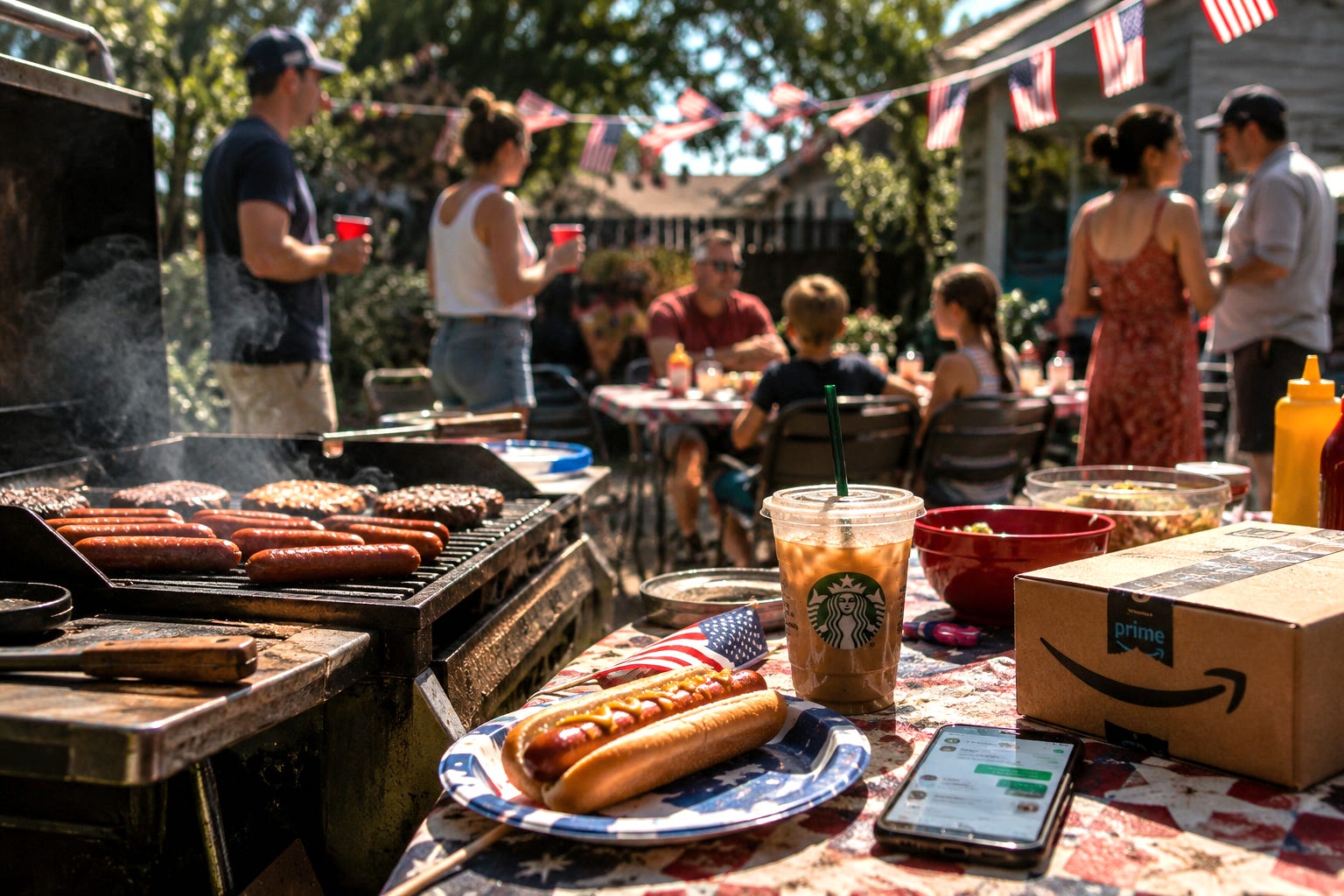
Mine looks like this: a backyard in Brooklyn, a grill going, kids of every possible origin waving flags already bent in half, a 1974 hot dog in one hand and a 2026 iced Starbucks sweating in the other while the group chat lights up with everyone else’s cookouts.
Yours looks different, and that’s the whole idea. What Americans keep choosing, every single time we’re handed an excuse, is each other. The Pilgrims had it right the whole time. The church is whoever shows up. So is the country.
Church is at noon. Bring something for the grill.