


Three days before Maggie Haberman sat down in the Oval Office to interview him for a book, Donald Trump went on Truth Social and called her a sleazebag writer. He floated adding her associates and Swan, whom he's taken to calling "maggot," to his Florida lawsuit. Then she arrived, and he greeted her like a favorite client he was thrilled to see. Warm, salesman mode. Nice to see you.
Haberman knew the post for what it was. She called it a hip check. A shot thrown in front of the crowd to keep a feud warm, with no expectation that anyone backstage takes it to heart. The attack was real in the sense that he posted it. It was not real in the sense that he meant it. By the time the cameras were on, the feud was off.
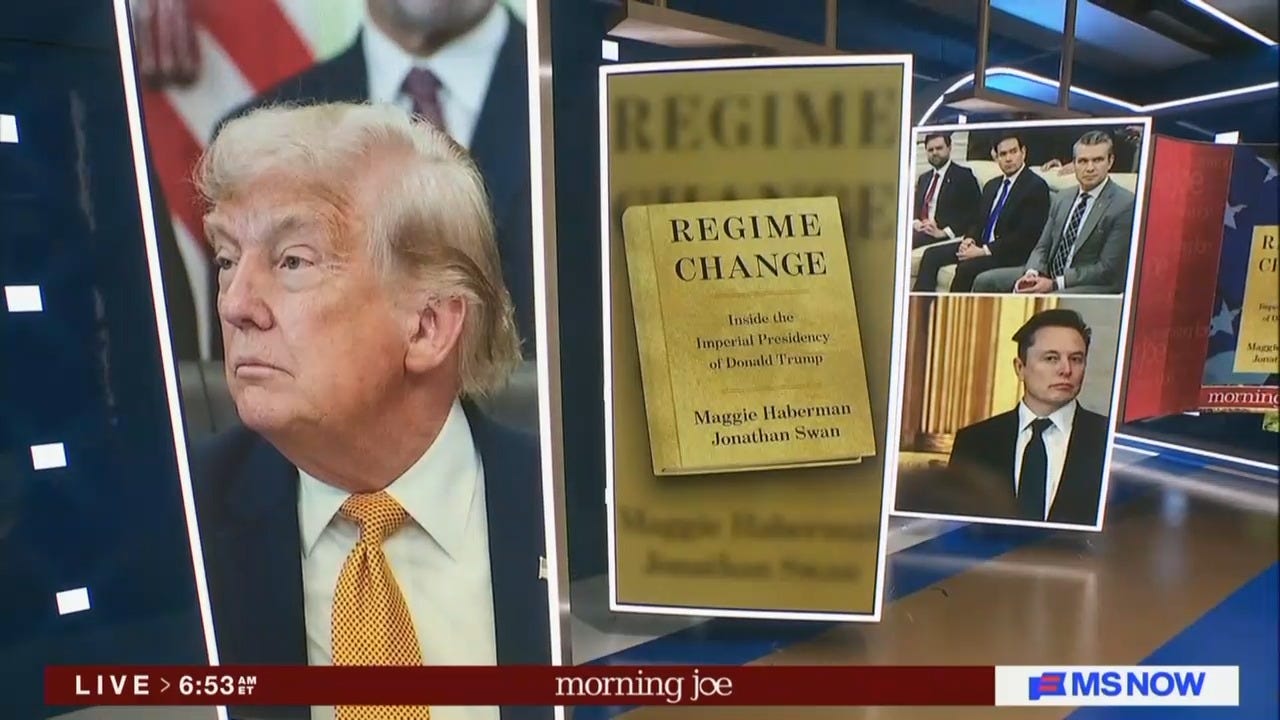
That gap, between the thing performed for the feed and the thing actually going on, is the most important fact about the second Trump term, and most of the coverage walks right past it. Haberman and Swan’s highly anticipated new book, Regime Change, is out today. It is a serious piece of work that reaches for the word the rest of us reach for too: shameless.
While the book is, among many things, a collection of insider scoops, each of which could be called a bombshell, the larger theme that emerges is that Trump survives exposure because he has absolutely zero capacity for embarrassment. But while the word shameless describes his character, it explains nothing about why some scandals detonate, and others land like a wet match. For that, you need Haberman and Swan’s own instincts, taken all the way. You need the word from wrestling she was already reaching for: Kayfabe.
Kayfabe is the pro wrestling industry’s term for the unspoken agreement that the staged thing is real. Everyone in the arena knows the match is booked, and the feud is written. The performance only works if nobody breaks the seal and says so. Kayfabe isn’t a lie the audience falls for. It’s the thing people tune into. Or more to the point, the contract the audience signs.
If you read Trump’s second term solely as a kayfabe operation, a lot of what looks like chaos starts to look like intention, or even a system operation.
Start with the casting, because Trump runs his administration like a writers’ room that’s behind on scripts. “We need plot twists,” he tells a startled ally, mulling whether to make Ron DeSantis his defense secretary, the way you’d pitch bringing back a character the audience thought was gone. He picks John Ratcliffe to run the CIA on the logic that if you were casting someone to play the CIA director, Ratcliffe is who you’d cast. He grades his own Oval Office ambush of Volodymyr Zelensky afterward as great television, better than The Apprentice. None of these are decisions about who should hold power. They’re decisions about what the next episode should do. The storyline is the job requirement.
Then there’s the production, which is sealed. Natalie Harp, the aide staff call “the human printer,” keeps Trump bathed in a constant stream of flattering coverage and adoring posts, reading them aloud, leaving him notes that say things like “You are all that matters to me.” That stream feeds the president, the president feeds Truth Social, and the feed becomes the wire. When reporters asked the White House whether the country was joining the war on Iran, they were sent to Trump’s Truth Social account. The official position of the United States government lived at the same address as his thoughts on a cable host who’d wronged him.
Follow the loop and notice what’s missing. There’s no outside air. A wrestling show survives only as long as nobody steps out of character backstage, and Trump has solved that permanently. The White House all but confirmed the book by refusing to deny its Situation Room scenes, and JD Vance went on Megyn Kelly’s show to call the reporting accurate. A promotion will let a damaging story run rather than admit there’s a backstage at all. There’s nowhere left to leak from, because the dressing room is the broadcast.
Fintan O’Toole, reviewing the book for the Times, sees the show-business fusion clearly, as most sharp readers of Trump now do. But watch where his last paragraph goes. He reaches for the nemesis that must follow, the reversal the classical arc promises, Trump gradually losing it as the war and the inflation and the polls close in. That instinct, that revelation, has to be followed by a fall, is the thing the kayfabe read overturns. The standard assumption is that exposure produces consequence. It doesn’t, because the crowd already knows. The marks at a wrestling show are not fooled. They stay because the one move that ends the night is standing up and announcing it’s fake.
Some of them see the work clearly and stay anyway. Others earnestly believe every angle is real. That's the part people miss about kayfabe: it never required the whole crowd to be in on it. It only requires that nobody breaks the seal. The knowing and the true believers hold up the same contract for opposite reasons, and the show doesn't care which one you are. The base isn't blind to the self-dealing or the bluster, or it doesn't matter that some of it is. Either way, breaking kayfabe costs them the only show in town.
It's all narrative-driven, which is something I've become obsessed with. I recently launched a newsletter called Morning Frame, which tracks Trump stories that cross the partisan wall and which die in their home ecosystem, and the pattern is stubborn. The billion-plus dollars the family has added to its fortune, the self-dealing that should by every old rule be a five-alarm story, barely travels. It runs in the outlets predisposed to run it and stops at the border. A heel doing heel things is not news. It’s the gimmick. It carries no new information, so it has nowhere to go.
What travels is the break. The single most propulsive thing that’s crossed the wall in months wasn’t a revelation about Trump at all. It was Tucker Carlson and Mark Levin going at each other, and at him, over Iran. That MAGA civil war conflict moved through Fox News and MS NOW and the legacy outlets at a velocity the self-dealing never approached, and it moved for one reason. It was a guy who was supposed to be in the show, stepping out of it on live television. A worker breaking character mid-match is the rarest and most electric thing the form produces.
I don’t think the wrestling is a costume Trump put on for politics. He came up in that world. He shaved Vince McMahon’s head at ringside at WrestleMania, he’s in the Hall of Fame, and he carried the whole McMahon orbit into his cabinet like luggage, Linda McMahon and all. This is his native grammar. What’s new is the scale of the venue. We spent twenty years watching the news business trade Cronkite’s authority, the kind that came from process, for the logic of the feed. The same logic jumped the fence. It didn’t just eat the coverage. It ate the thing the coverage exists to cover.
Here’s where the metaphor has to earn itself, because it can also lie to you. When the match ends, the loser gets up and walks to the locker room. The Iran strike does not reverse when the segment is over. The man ICE took does not walk back out through the curtain. The arch and the tariffs and the judges are not angles, they are the wreckage the angles leave behind. If the kayfabe read ever starts to feel comforting, you’ve misread it. The frame explains why the damage travels or doesn’t. It does nothing to undo the damage.
So here’s where it leaves the people whose job is to expose him. A scandal no longer spreads because it’s damning. It spreads because somebody breaks kayfabe. Until then, every revelation is just another episode, and the crowd, night after night, stays in character.
And so, every night, do we.
None of the staginess is new. We’ve known it was a show for years. Jonathan Karl sat in the front row and wrote a bestseller called Front Row at the Trump Show during the first term, and the title was the whole argument. The performance was never the secret. The secret is that we cover it anyway, knowing exactly what it is. The political press can see behind the curtain as well as anyone. We can tell you which feuds are worked and which posts were written to be quoted, and we quote them anyway. We file on the contrived conflict knowing it’s contrived. When the coverage is ironic, when it’s meta, when it arrives pre-armored in detachment, it is still coverage, and the detachment is just a nicer way of staying in our seats. All in doesn’t mean fooled. It means complicit.
That is the quiet genius of a book like this one. It tells you exactly how the show is built, and we read it the way you watch a magician who has already shown you how the trick is done. You know how it works. You can’t look away.
This column is the same move, and I know it. A media writer covering the press covering the show is still covering the show. There is no clean place to stand. The one thing nobody in this business ever actually does is say that part out loud. So consider this me, trying to break character.
💯