


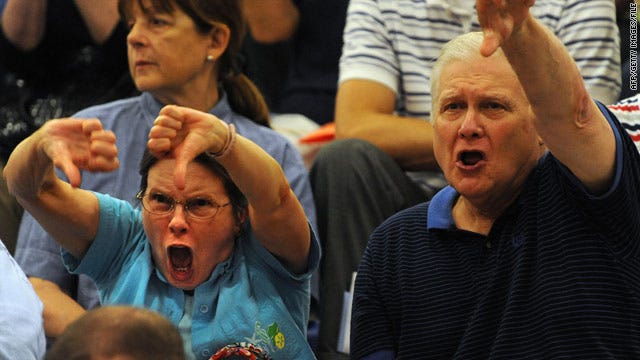
Working-class voters have spent the past three decades being sold a bill of goods by both Democrats and Republicans. Neither has delivered on campaign promises to look after the little guy. As the midterms are a week away, the same wage-earning voters are now in full and angry realization that both parties are full of shit, which has created a bizarre phenomenon of spawning similar identity crises across the partisan spectrum.
Candidates from both parties promised to look out for them and earned their votes on that promise, then instead bought tax breaks for the people who write the checks and own the stock.
Federal Reserve data for the first quarter of this year put about 87 percent of corporate equities and mutual fund shares with the wealthiest 10 percent of households. Every record market cheered in Washington is a cheer for the rich kids, not the underdogs. The parties differed in approach. Republican candidates told voters to blame Democrats, the government and immigrants. Democrats blamed donor class fat cats, corporations and Republicans. Either way, the rich folks that wrote the checks got the vast majority of the benefits.
The University of Michigan’s consumer sentiment index came in at 48 last week and Steve Rattner compared that figure against every midterm October since 1978. He found it’s the lowest on record, below the 60 percent it hit before the 22 midterms, and 15 percent below where it sat before the Iran war. People aren’t just shitty with Trump’s policies. They’re shitty because they’ve given up expecting either party to help them.
It’s easy to spot the panic in the campaigns. Reuters counted Republicans in 41 of 62 competitive races backing away from a president with the lowest approval of either of his two terms. But none of them are offering a reason to vote for them instead.
Democrats are running against a man who’ll never be on a ballot again, split between a socialist wing and a corporate one, and nobody can clearly say what they’d do with a congressional majority apart from checking a currently unchecked Executive Branch. Each party knows what it isn’t. Saying what it’s for could cost donors.
There are candidates who are deviating from the pro-donor norm this year and they are all doing remarkably well. James Talarico is tied with Ken Paxton in Texas, where no Democrat has won statewide since the first Bush administration. He’s done so by talking about wages, public schools, and corporations gouging people. In Michigan, Abdul El-Sayed beat his own party’s machine on Medicare for All, and Marist has him up two on Mike Rogers, who went on Meet the Press Sunday, got asked three times if he’s a MAGA Republican, and obfuscated before curiously calling the question disgusting. MAGA Republican used to be code for populism designed to help the neglected rural set, but has instead become something very different, which is a column for another day.
Then there’s Nebraska Senate candidate Dan Osborn, a steamfitter and former union local president, who is up against heir to the TD Ameritrade fortune, Pete Ricketts. They are in a dogfight of a real race in a state Trump carried by 20. Republicans call Osborn a Democrat in disguise, though he refused the Democrats’ endorsement in 2024, and this year the Nebraska party is backing him anyway because it’s got nothing better. He’s pro-union and pro-choice, pro-gun and hard on the border, and in Washington that combination is treated as an outlier or contradiction. In Nebraska, that’s a guy at a bar eager to talk about his beloved ‘Skers.
A Texas pastor, a Nebraskan steamfitter, and a Muslim public health doctor in Michigan, running in three states that agree on little but are drawing crowds angry with the status quo. They don’t each have the same exact complaints, but they also share a sudden awareness that the whole left-right fight is about keeping voters arguing about culture, distracting them from both sides agreeing about who gets the money.
The blame doesn’t belong to just one party, and it is no, it didn’t just start with Donald Trump. If anything, it started with Bill Clinton, who I’ve long called the most successful Republican president of my lifetime. Democrat on the ballot, sure. But he triangulated his way through the nineties, looking and governing a lot more like a Rockefeller Republican than like Jimmy Carter, which is probably why he won twice when Carter couldn’t win once.
NAFTA passed with bipartisan support and Clinton’s signature. He also killed welfare as we knew it and balanced the federal budget, but also tore down regulations dividing commercial and investment banking. George W. Bush and Barack Obama bailed out banks nine years later. “Too big to fail” meant leaving the little guy to their own devices.
Carried interest is a better example of bipartisan grift designed to only help the donor class. It’s the loophole that lets hedge fund and private equity managers pay a lower tax rate than a nurse or a teacher pays on a paycheck. But Obama and Trump ran on getting rid of it, and each had the votes to do it. But somehow, shockingly, it survived both of them, and the people it protects are still writing enormous checks to both parties. Go figure.
Trump came to political prominence with a promise to represent the mostly white forgotten men and women, the ones who live in rural C and D counties that nobody visits since the plant closed. By the time of the 2024 Republican National Convention in Milwaukee, Hulk Hogan was ripping his shirt off in support of Trump. It also featured Kid Rock and Dana White as part of a lineup that looked like a shameless effort to reclaim the phrase “White Trash” as a term of identity pride. The GOP was no longer the “country club” party, at least in branding.
He governed in a manner that decidedly helped the country club party. He passed a tax cut that mostly helped rich people and started a war that made gas more expensive. So much “freaking” money has flowed to the same donors his voters thought he was fighting, that Trump openly bragged about it during a rally this week. Voters now say corruption bothers them more than the price of groceries or gas, and 41 Republicans are trying to get away from Trump without losing his voters.
For thirty years, both parties have made working people angry. Trump was the one guy smart enough to run on that anger, which is now turning on him and the Republican Party.
Both Democrats and Republicans have campaigned and then behaved in a manner that has not only pisssed off a lot of voters, but has effectively gutted the middle class and overseen a redistribution of wealth to the 1% away from the vast majority of the voting public. The anger towards each party is so palpable that party lines are increasingly irrelevant. The real issue is the haves and the have-nots, and corporate politicians have largely revealed who they are fighting for.
So Tuesday the votes get counted, Democrats take the House and probably the Senate, Trump will cry fraud, and everyone moves on. The bigger story starts Wednesday.
Both parties made this mess themselves, and they’ve got two years to figure out who they are before 2028. Trump won’t be on the ballot to help them, or to blame. He was never what voters were mad about anyway. He just had the good sense to notice they were mad.
Both Republicans and Democrats are in identity crises of their own making, and each has to find a message in a post-Trump world. Because as of this time next week, he will never be on the ballot again, and both parties look remarkably flat-footed in how to address an increasingly pissed-off electorate.