


I wasn’t expecting the World Cup to become the happiest corner of the internet.
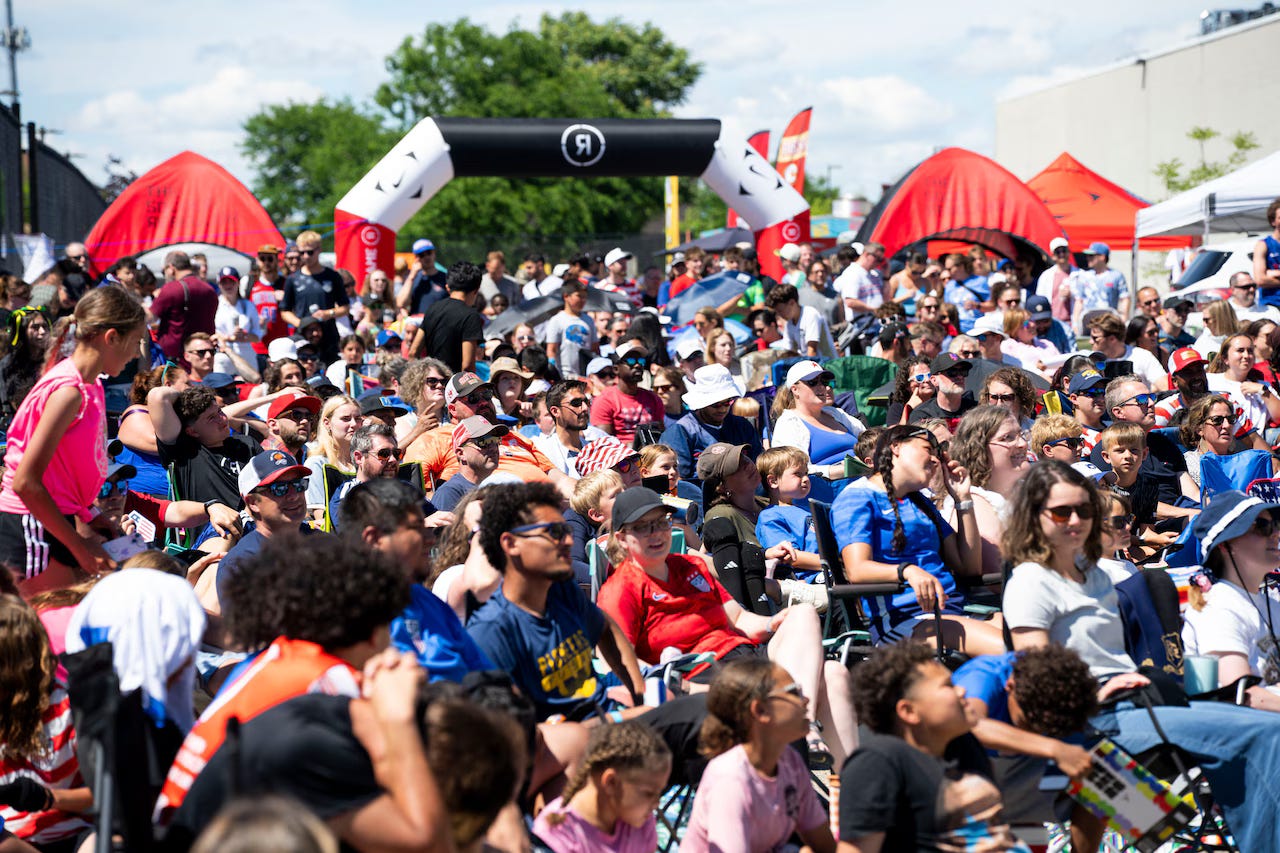
For about two weeks now, my feed has been filling with videos that feel almost out of time. Japanese supporters staying behind to clean their section after the match. Colombian fans falling silent so a lone DR Congo supporter could sing his national anthem, then engulfing him in hugs. Dutch fans turning downtown Kansas City into a bouncing sea of orange. Whatever the opposite of doomscrolling is, the World Cup seems to have invented it by accident. Call it JoyCore™.
I figured it would wear off. Lawrence, Kansas, had already hit me pretty hard. I assumed the internet would do what it always does and move on. Instead, every morning there was another clip. Another city. Another tiny act of generosity. Another reminder that people, when you get them close enough to one another, have a remarkable habit of disappointing the people who make money predicting they’ll disappoint each other. It’s been a genuine phenomenon of viral goodwill in a sea of doom.
Underneath all of it, the thing I kept feeling was relief. Fucking relief.
I hadn’t realized how much I missed seeing America this way, generous and unguarded and faintly ridiculous, until it was suddenly everywhere I looked. It felt like a homecoming. The America I grew up believing still existed somewhere beneath the noise kept surfacing on my screen, and I realized I’d been homesick for it without quite knowing.
It is a strange thing to be feeling the same week the country turns 250. On Friday, America heads into the anniversary unsure of itself, about to spend another Independence Day arguing over what it even is, who gets to claim it, and whether patriotism itself has become another partisan accessory. And the clearest reminder of what still makes this place worth loving has arrived from the least likely source imaginable: a World Cup that almost everyone expected to put America’s worst instincts on display for the entire planet.
This weekend, I wrote about hanging an American flag in my Brooklyn apartment and how much more I turned that over than a person should have to, now that the simple act of loving the place seems to come with a loyalty card you are nervous about being caught holding. What I landed on was that loving the country was never the hard part. Saying so out loud, without it sounding like an allegiance you never chose, was the challenge. And then, almost on cue, a few million strangers flew in and made the argument better than I had, without appearing to know they were making it. The story everyone is telling about this World Cup is that foreign fans came around to appreciating America, not because of what they’d read or had seen on the news, but because of what they saw and felt upon meeting us. The truer story, the version I cannot stop turning over, is that the rest of us Americans watched them do it and got reminded of what we like about the place ourselves.
The one that took me apart wasn’t a video at all. A former Peace Corps teacher found a Cape Verde watch party online and went to a bar in Oakland to cheer for a country where she had spent two years coaxing English out of teenagers three decades ago. She asked the organizer if he was from Cape Verde. He was, from Praia. She said she had taught there once. He asked her name. Then he told her she had been his teacher. Across thirty years and six thousand miles, because a nation of half a million people qualified for its first World Cup, a woman and the boy she once taught found each other again. It wasn’t the only story like that. Not by a long way.
All of which is wild because of how cocksure we all were that this global event was supposed to go the other way and look more like an international incident. For two years, the tournament was covered less like a footy event and more like a slow-motion diplomatic train wreck, and the pieces wrote themselves before anyone kicked a ball. Trump. Travel bans. ICE. Hostile borders. FIFA’s bottomless greed. The ugly American was finally cornered on his own turf and made to host the planet. The fear underneath all of it was never really about ticket prices. People were braced for America itself to get exposed, in front of everybody, on its own ground.
What happened instead has been something of a miracle. A few million visitors arrived expecting that country and ran into a friendlier one. You have already heard about Boston adopting Scotland and Lawrence, Kansas, adopting Algeria (which I wrote about so I will skip the recap.) The thing worth saying now is that those were not flukes. They were previews. Almost every host city has produced its own version.
For years, the only way most of the world could experience this country was at a distance, on a screen. The rallies, the executive orders, the border fights, the cable panels, the endless algorithmic outrage. America had stopped being a place you visited. It had become a thing you watched. People arrived expecting the version on the screen.
This is the blind spot of political media, and really of the outrage economy itself. It knows how to cover institutions because institutions generate conflict. Presidents. Agencies. Corporations. Parties. They produce statements, fights, scandals, and incentives. Ordinary hospitality is much harder to cover, because it isn’t strategic. It doesn’t come with a spokesperson. It doesn’t have an agenda. It just happens. The bartender in Lawrence is not the State Department, and the family in Kansas City waving a Dutch flag is not ICE. Nobody assigns a reporter to either of them.
The World Cup accidentally broke that model, and for two weeks people stopped meeting America through its institutions and started meeting it through Americans. Maybe that is all JoyCore ever was: so much ordinary decency that an algorithm built to reward outrage simply got overwhelmed by the evidence.
You could see the same short-circuit on television, in the one corner of American life built to keep people disagreeing. On Friday, Bill Maher handed a Real Time segment to the visitors, telling his audience they were reminding the country, right on cue for its 250th, that the place is kind of awesome. He even landed on the idea I had spent the same week chasing, that America was never meant to be perfect, only more perfect than it was. By Monday, Fox & Friends was making the identical case and crediting him for it. Maher and Fox & Friends agree on almost nothing, starting with what America even is. For one weekend the thing was too obvious for them to spin in opposite directions.
The funniest evidence has nothing to do with politics and everything to do with how strange the country is up close. Visitors keep wandering into a Buc-ee’s, the Texas-based mega-station with the cult beaver mascot and a snack literally called beaver nuggets, and reacting like they have found a lost civilization. They have developed an unhinged appreciation for ranch dressing, which is fair, because ranch stopped being a salad dressing a while ago and has become more of a bizarre national personality trait. None of this is normal, and America has never been normal, but there is a wide gap between weird and hostile, and most of the world spent two years braced for hostile and got handed weird, which turns out to be the kind of weird that buys you breakfast and asks where you’re from.
I am not trying to turn this into a tourism ad, so a couple of honest caveats. Not every grim prediction missed. The FIFA complaints have been loud and earned; the hydration breaks have turned ninety minutes of football into an ad-revenue-optimized television product sliced into commercial-friendly quarters; and the booing is deserved. And if the world really did come hunting for one loud American to confirm the stereotype, Fox Sports parked Alexi Lalas behind a desk every night and let him play the “Ugly American” everyone came looking for. The world united accordingly. But notice where all that anger actually went. At FIFA. At the broadcasters. At the executives. The institutions took every boo. The people took every selfie.
So the real upset was never going to be on the pitch. It came down to people, on the ground, finding out they liked one another a great deal more than they had been promised they would.
This Friday, we will start to celebrate another Fourth of July, arguing about what America is, which is fine. Arguing about the country might be the most American thing we still do. But at the exact moment we had grown least sure of ourselves, a few million visitors arrived expecting the country we have been fighting about and met the one we had almost forgotten to notice. For two weeks, America became a place again instead of a symbol.
The most convincing case for America all year was not made by a president, a politician, or a speechwriter. It was made by a bartender in Lawrence, a Peace Corps teacher in Oakland, and a few million strangers who came expecting something else.