


As I walked my dog, Frank, this afternoon, I found myself thinking about how sour the nation's mood is right now, then trying to think of another time in my lifetime when shit was as bad as it is now. And I landed on 1980.
I was a thirteen-year-old eighth grader in Overland Park, Kansas, just one year after moving from the small city of Hutchinson to the Kansas City suburbs. It may not surprise you that I was raised in a home obsessed with the news. 1980 was tough for a bunch of reasons, many of which are similar to today.
The nation was mired in a foreign relations debacle, though not one directly of the government's choosing, in terms of the Iran hostage crisis. The economy was in bad shape, though in a different way than it is today. And the president, Jimmy Carter, was largely considered a failure. The peanut farmer came across to many as not ready for prime time.
Today, gas prices are nearing record levels, largely due to a foreign policy morass also in Iran, but this time of the government's own choosing. The economy is not in great shape for the vast majority of Americans suffering through a significant affordability crisis, though, to be fair, the asset-owning class is doing wonderfully under Donald Trump.
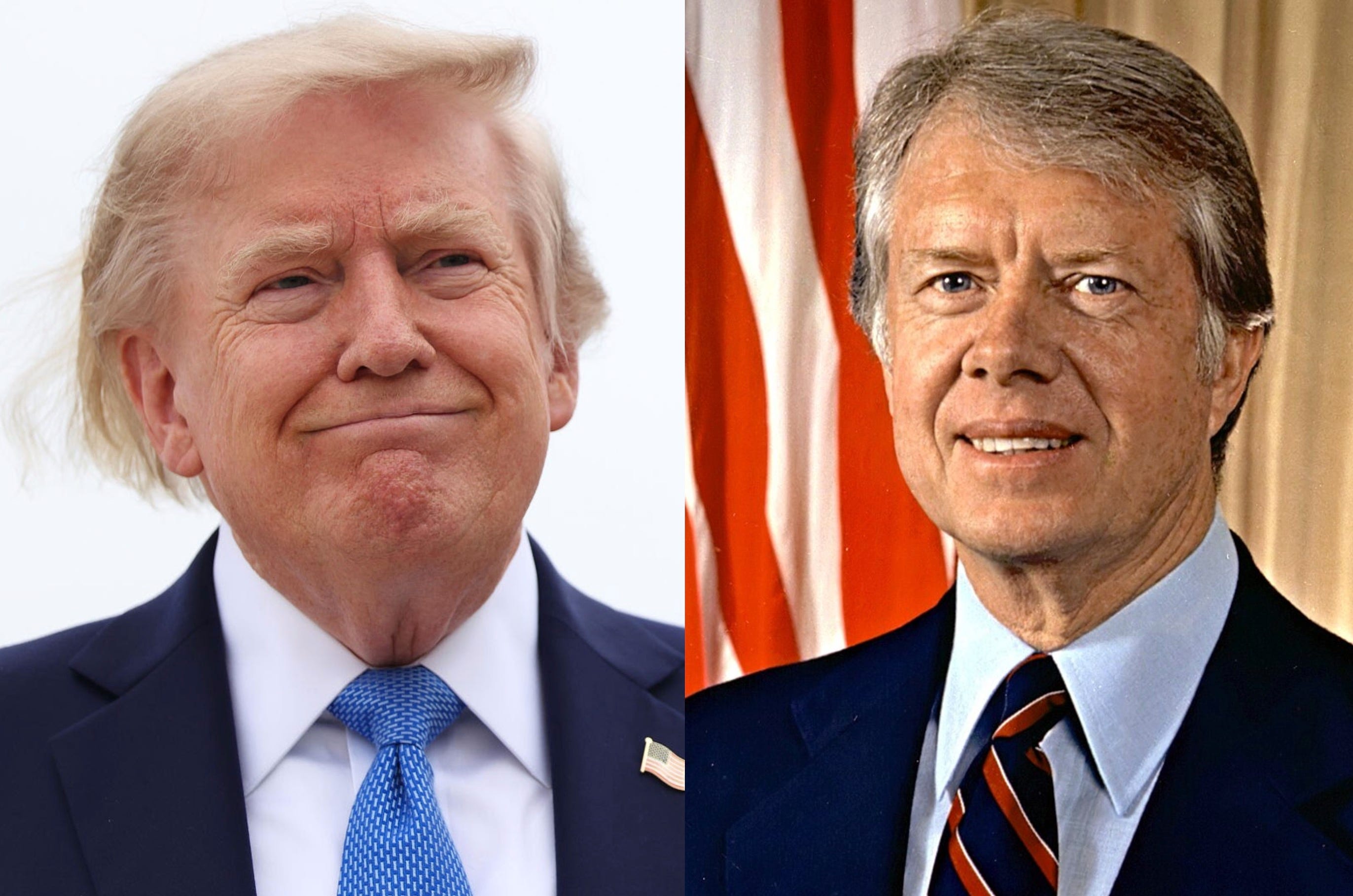
This is a prelude to the epiphany I had with my dog on a beautiful Autumnal day in Brooklyn: Donald Trump is the new Jimmy Carter. I said what I said.
Returning briefly to Overland Park in 1980, the sentence I heard most at home was “We can’t afford it.” My mother said it about whatever I’d come home wanting to buy something that week from Spencer’s Gifts at Oak Park Mall. My father had bet on himself with a food ingredient business that wasn’t paying off yet, and the financial stress was palpable even for an eighth grader. My mother had been a Carter delegate, and she stayed loyal to him while she stretched the grocery budget he was being blamed for. My dad was a Rockefeller Republican who was less than impressed with the Carter administration’s weird focus on noise pollution, the metric system, and what kind of candy bars were in the White House vending machine.
Cut to today, and consumer sentiment is remarkably similar to then, and don’t just take my word for it. The University of Michigan has tracked it since the early 1950s, and in 1980, with inflation near 14 percent and the prime rate around 20, the index bottomed out at 51.7. It actually fell to its lowest reading in its history just five months ago, coming in at 44.8, and it now sits at 48. The one metric designed to capture how Americans feel about their money reveals quite plainly that the mood is darker today under Trump than it was the year Carter lost 44 states.
But the hard numbers can’t explain the dark mood entirely on their own. Inflation is 3.7 percent today, and unemployment is 4.2 percent; had Carter had that data, he’d have run for reelection and expected to win. But people judge the economy by what eggs, rent, and car insurance cost compared with six years ago, and almost none of that has come back down. Then Trump struck Iran in February, and the price of gas went up along with nearly everything else. The most recent Reuters/Ipsos poll has Trump’s approval at 31 percent. Carter’s Gallup low was 28.
There are key differences between then and now, namely how the two presidents addressed what was self-evident. In July 1979, Carter addressed the nation in a televised prime-time speech and told Americans the country was suffering a crisis of confidence. His approval rating rose briefly after his speech, but he then pushed out five cabinet secretaries, and the address sort of hardened into a narrative about a president who’d lost control. Whatever the speech became later, Carter looked at the national mood and said what he saw. It ultimately didn’t raise anyone’s spirits.
Trump would never admit that things aren’t anything less than a “Golden Age,” which he may very well believe because he sees gold-leaf reliefs on White House plaster every day. He plays the part of Ronald Reagan while presiding over Carter’s national mood.
“Worse than Carter” has been the Republican insult of choice for 45 years, and Trump used it on Joe Biden constantly. Carter’s reputation has improved with the remarkable example he set in his post-presidency. And he doesn’t get nearly enough credit for appointing Paul Volcker in 1979, whose brutal rate hikes eventually broke the stagflation. Carter had returned to his peanut farm in Plains, Georgia by the time they worked.
Reagan collected the credit after his own “morning in America” slogan that accurately read the room and saw the need for a mood-lifting national pride so sorely missing after a decade of Watergate, Vietnam, gas rationing, and Iran hostages. Carter took the political pain for a cure that worked. Trump has spent his second term pressuring the Fed to cut rates.
The complaint against Carter focused on the malaise the country felt under a president who couldn’t fix it. People felt stuck and poorer than they should, and Americans feel that way again. Trump’s approach is to simply insist that they are wrong, over and over again.
Reagan won the White House in 1980 with a campaign that simply asked voters whether they were better off than they’d been four years earlier. Voters will answer a similar question next Tuesday while Trump insists they’ve never had it better.
They feel differently.