


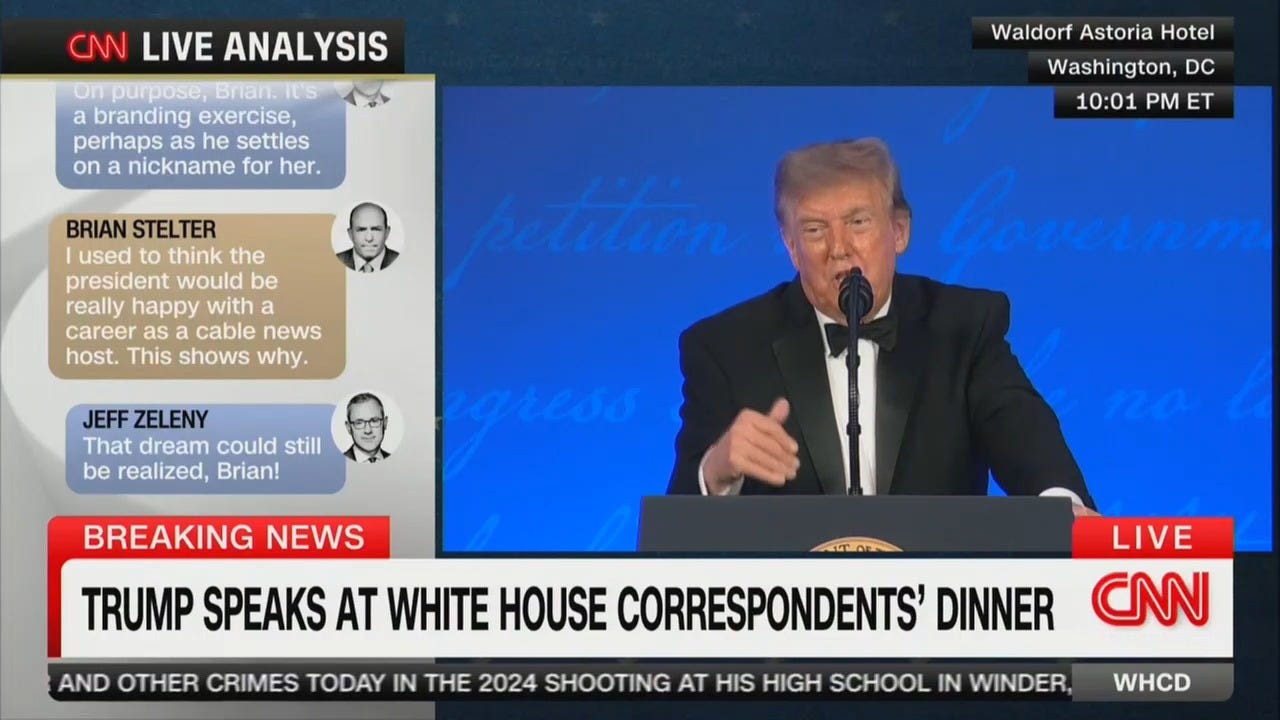
CNN aired President Donald Trump‘s speech at the rescheduled White House Correspondents’ Dinner in full Friday night, and tried something genuinely new alongside it. While viewers watched the president speak, the left half of the screen ran “Live Analysis,” a produced scroll of text messages from CNN’s own journalists, Brian Stelter, Daniel Dale, Jeff Zeleny, Betsy Klein, Kristen Holmes, all styled as a group chat. Fact-checks, reporting, color and banter floating by in little bubbles while the president worked through an hour at the podium.
It doesn’t take a massive cynic to see the calculation here. There has long been a debate over whether cable news networks are acting responsibly by giving Trump airtime for his Borscht Belt insult-comic stylings, which rely on hyperbole and often include baseless conspiracies. I happen to believe airing Trump’s speech live, particularly at this event and during a clear First Amendment crisis under his DOJ, is newsworthy, and any outlet should trust its viewers to be smart enough to understand what’s unfolding before them.
But the group chat experiment did not work the way it seemed intended to. One moment from that feed neatly expresses the problem.
At 9:40, two bubbles sat stacked beside the president. The top one recalled April’s shooting at the original dinner: “like an active shooter drill. It could have been so much worse. I appreciate how the president acknowledged as much.” The bubble directly beneath it relayed Trump at the podium: “Am I supposed to be serious? Am I supposed to be a comedian?”
Each had the same typeface, same rounded corners, and same visual weight. A memory of gunfire and a comedy bit, rendered identically.
The group chat shtick comes from Kasie Hunt‘s 4 PM show The Arena, where it sort of works alongside a rather pedestrian cable news panel show. And the decision to try it out for a Trump speech may have been well intentioned, but it failed in a few notable ways.
First, it was distracting. Viewers are already distracted by second screens, many holding phones tracking social media, or in my case, playing the three-minute speed chess I am hopelessly addicted to. And because a live feed has to keep moving, it filled the hour with material that rarely justified the competition for the viewer’s eye. Much of what appeared was banal and simply got in the way.
At 9:53, Klein reported: “The beef tenderloin was actually quite tender tbh.” Dale, the most rigorous fact-checker on American television, spent part of the hour on a spelling joke about his Canadian “neighbo(u)r.” Zeleny, at one point: Nicki Minaj “was set to be sitting right by our table!” The format pulls everyone toward it. Put journalists in a group chat interface for an hour, and they will start performing group chat like the annoying friend who is never as funny as they think they are.
Second, the chat gimmick flattened different kinds of information into identical units. At 9:48, Klein reported that the producers at her table had a timer running on the speech, thirteen minutes so far. The bubble directly beneath it carried Stelter noting that Trump had just referred to the end of his second term, notable given his jokes about an unconstitutional third one. A stopwatch bit and a question about whether the president intends to leave office, same rounded corners, same weight. Minutes later, Klein’s “Seems like a normal amount of weave to me” sat above Zeleny explaining that Trump holds almost no rallies in his second term, so viewers rarely see these weaving speeches anymore. This was snark and actual reporting sitting next to each other, interchangeable at a glance. The interface offered no way to differentiate the gravity of the message. Nothing on the feed carried any deeper meaning. The bubbles seemed intended as accountability, but in practice, they made an hour of the pernicious “bad man” easier to consume without making it easier to understand.
Trump blustered through his material that, over the course of an hour, was clearly not landing. The group chat’s polite objections and performative jokes largely missed what was unfolding before them: the president was bombing. Which was the biggest miss, but the reporters should be forgiven because THEY WERE DISTRACTED BY THEIR PHONES. We’ve all been there, amirite?
And that’s the issue. The harder the feed worked, the smaller CNN looked. So an attempt to sanitize and contain the president made him look bigger. Anyone trying to follow both halves at once came away knowing less than someone who just watched the man talk. The network took the bait, then narrated itself taking the bait. Weird.
Trump spent much of his speech insulting the institution and journalists seated before him. This came just days after his Justice Department tried to seize the phone records of reporters’ relatives. The group chat bubbles did not diminish any of it. Yet the format did serve one institutional purpose. It let the network carry the speech and challenge it at the same time, with nobody required to say anything to anyone’s face. It was an attempted excuse or alibi that no one bought.
I know this format well because twenty-five or so years ago I produced VH1’s Pop Up Video, the show that put snark in bubbles over music videos and made annotation a television genre. The bubbles worked because the footage was inherently silly and disposable, designed to mock an overly serious Show Biz racket. Music videos were bloated and self-serious and deserved puncturing. The bubble commentary carried an instruction to the viewer: relax, none of this matters, we are all in on the joke. That instruction is baked into the form. You cannot type your way out of it with serious words.
Pop Up Video put the jokes in the margins because the main event was disposable. CNN put them there because the main event was not. We annotated hair-metal videos with gags about the hair and video shoot riders. CNN annotated a president attacking the press with a review of the beef.
Ten years after the escalator, CNN still does not know what to do with Trump. Friday night, it admitted it in bubbles.
The chyrons need this disclosure in small-print… “relax, none of this matters, we are all in on the joke”
That's funny. I remember popup video on VH1 - when it was still watchable.