


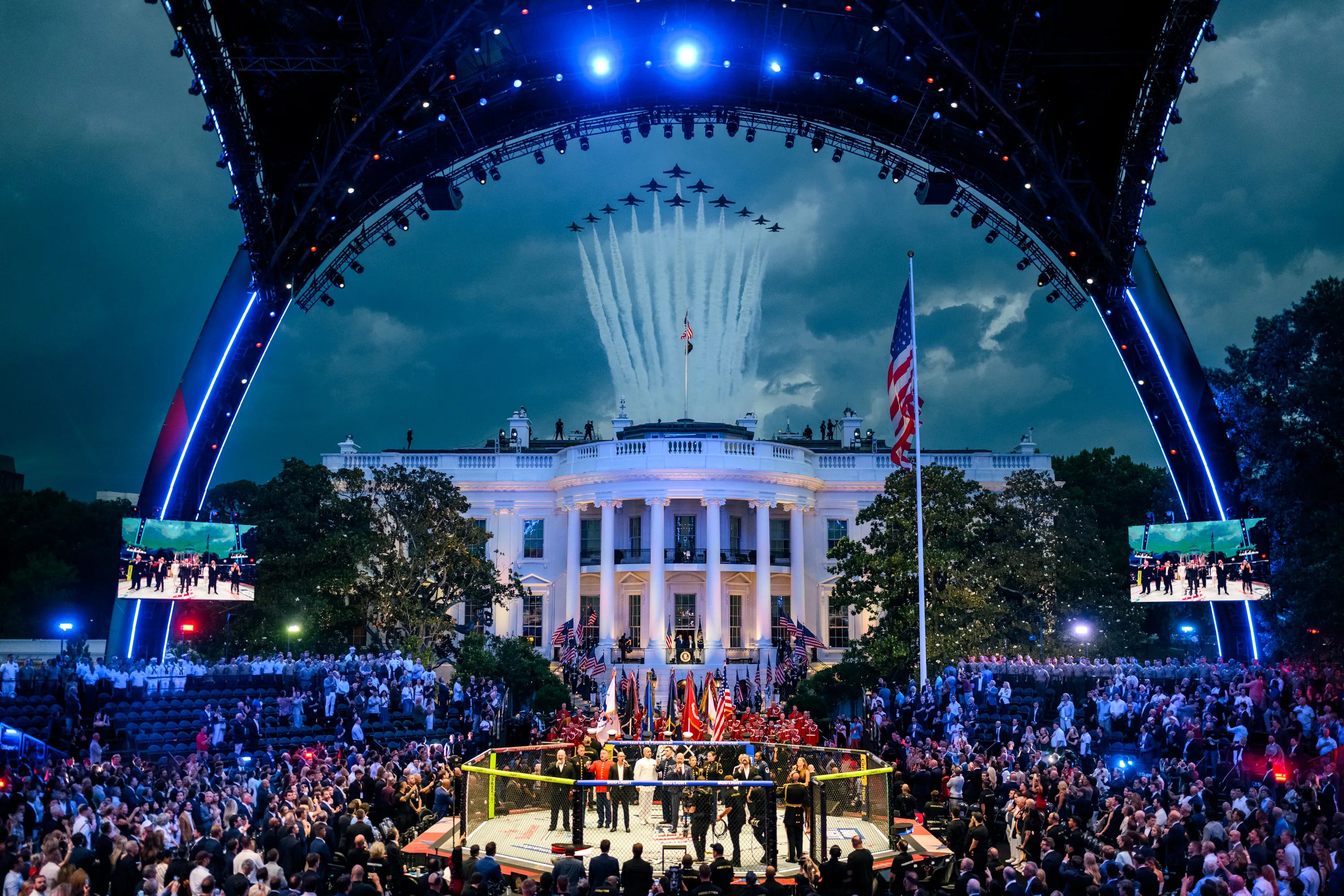
Hours after the Iran deal landed and the yelling started on both sides, a bigger story broke. The FBI announced it had foiled a plot to attack a UFC event on White House grounds. Drones. Explosives. A plan to shoot people as they ran. By any normal measure, that’s the story of the week.
It never really made it beyond Fox News.
And within days, it had already been put to work. The Justice Department cited the foiled plot in a federal court filing, not to prosecute anyone, but to build a ballroom.
DOJ told a federal appeals court the foiled attack showed a “compelling need” for the new $600 million ballroom going up on the site of the old East Wing, because its mass would shield the grounds and give the Secret Service better sightlines. A plot against a cage-fighting show became an argument for construction inside of a few days. The story got a job before it got a verdict.
That’s most of what you need to know, and it has nothing to do with whether the plot was serious. The question worth asking is what a story is for, and this one went to work fast.
The filing called it an “assassination plot” demanding a fortified ballroom, even though the charging documents in the case alleged conspiracy, attempted murder, and firearms offenses. And on the same Tuesday DOJ was talking the threat up in court, JD Vance went on Fox and talked it down. The plot was “not that advanced.” The suspects “weren’t in town.” It “didn’t even get close to the point of execution.” Same day, same network running the story into the ground. The government got specific where specificity sold the ballroom and got loud where volume helped.
Most writers go somewhere predictable from here. They reach for “buried.” They say Fox flooded the zone to drown out a humiliation, and the counts are right there to back it up. Fox ran the plot 70 times. MS NOW eight. CNN three. But those numbers mostly tell you Fox covers terror more than the other guys, which is a little like discovering ESPN covers football. What they really measure is appetite. One audience was hungry for this story and the other two weren’t. Nobody had to bury anything. The plot just got offered to the people who wanted it.
What those people wanted was a different feeling. Think about the week Trump’s base had just lived through. The Iran deal landed as a humiliation. Retreat. Backing down. Three hundred billion dollars headed to Tehran. That’s a miserable thing to carry around if you watch Fox to feel good about the man you voted for. The foiled plot gave them something else to hold. Vigilance. Strength. Enemies stopped at the gate. Same hour of airtime, opposite payload. That’s the trade, and it’s the whole column. Call it a mood swap.
The Iran story was already dying on its own by the time the plot showed up. Once the right and the left agreed the deal was bad, the fight went out of it, and a fight is the only thing that keeps a story breathing. The fire was already going cold. All the plot did was decide which feeling the base walked away with. Not the loss. The win.
You don’t need a room full of operatives with a plan to make this happen. You just need an incentive. Fox keeps its audience by keeping that audience from feeling beaten. A demoralizing story shows up, and the apparatus reaches for a mobilizing one the way water finds the drain. Nobody drafts a memo. The gradient does the work. Fox got a more favorable story. The DOJ got a more convenient argument. Everybody got what they needed.
It kept tripping over its own people everywhere else, which is part of why it didn’t travel. A former Homeland Security official pointed out that the president and vice president weren’t even briefed on the plot beforehand, the kind of briefing you’d expect for a real imminent threat against the very event they were attending. The men now holding the plot up as a reason to fortify the building weren’t told about it while it was supposedly live. A story that argues with itself in public has a hard time getting past the audience that already wanted to believe it.
We’ve watched this one run before, and the people who ran it admitted it. Tom Ridge, the first man to lead Homeland Security, wrote that on the eve of the 2004 election his colleagues pushed to raise the terror threat level over his objections. He softened how he put it later, and he’s owed that. But the man in charge of the warnings said out loud that the warnings were a target for political timing. Cornell’s Robb Willer went and measured the thing. He tracked every federal terror warning from 2001 to 2004 against the polls and found each one lifted Bush’s approval by an average of nearly three points the following week. It even moved his numbers on the economy.
So this is a known mechanism, not a hunch. And here’s the part the cynical version always misses. Nobody had to fake anything. The plot was real. The arrests were real. The charges are real. Nobody invented an event. They just handed a real one the job the week called for. Inflate it in the filing, wave it off on cable, run it 70 times on one channel and three on another, and let it do its work.
The plot’s job was never to bury the Iran deal.
It was to hand the base a better feeling to carry out of the week.