


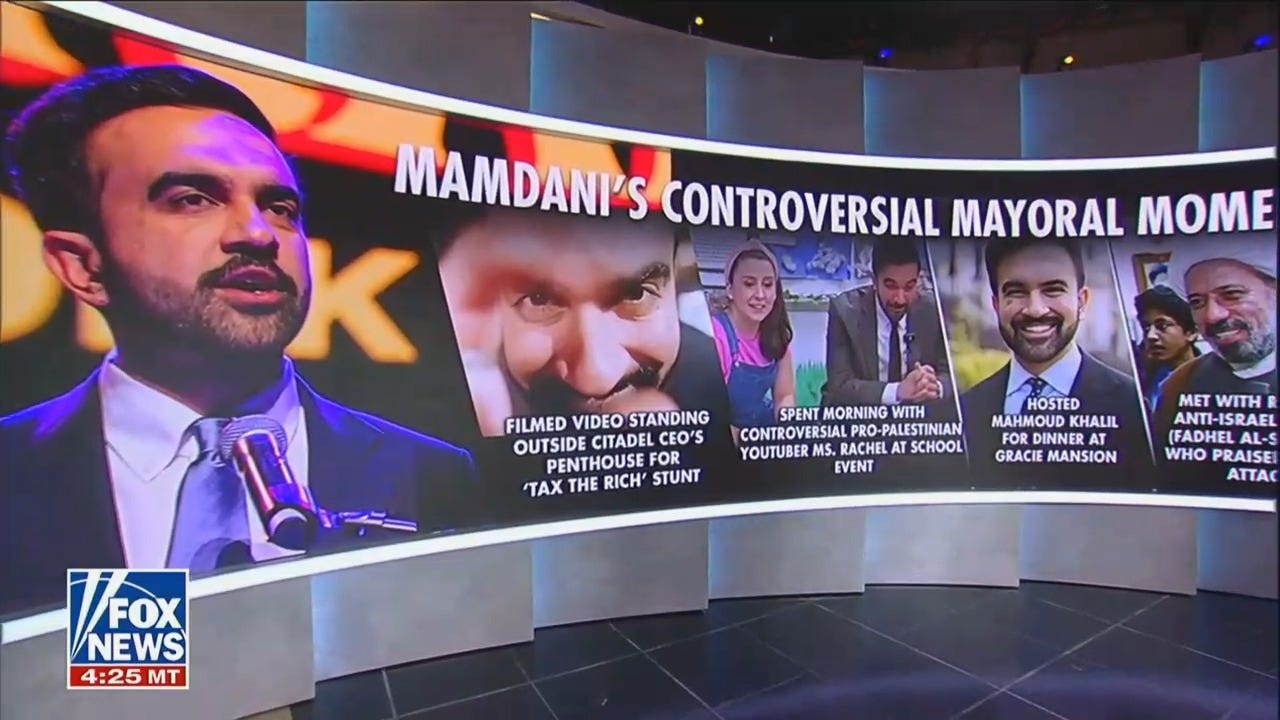
Ainsley Earhardt asked her Fox & Friends guest Friday morning whether the mayor of New York City was an anti-Semite. The guest didn’t hesitate. “Absolutely. There’s no question about it.”
That is not a small thing to say on national television about a sitting mayor. It used to be the kind of accusation that ended Democratic careers. And it’s not difficult to imagine Zohran Mamdani, watching it land or hearing about it later, becoming quietly delighted, or at least validated.
Because the segment proved a point he has been making for some time. Mamdani has argued, repeatedly, that disagreement with the Israeli government gets reflexively converted into accusations of anti-Semitism by people who can no longer tell the two apart, or who have a political reason to pretend they can’t. His critics have called this a dodge. Then they got on Fox & Friends and acted out the precise dynamic he has been describing.
The case for the prosecution, laid out over the next several minutes, was this. Mamdani had decided to skip Sunday’s Israel Day parade, becoming the first New York City mayor in more than sixty years to do so. He criticizes the Israeli government. He won’t endorse Israel specifically as a Jewish state. He has met with pro-Palestinian activists. The indictment then expanded to include his father, a professor at Columbia, and his wife, whose Spotify playlists were entered into evidence. By the end of the segment, the guest had concluded that Mamdani and his family don’t just dislike Israel. They hate America.
When a political argument reaches the point where a politician’s wife is being judged by her Spotify activity, it usually means the argument has exhausted its stronger evidence.
I want to be clear up front that I think skipping the parade was a mistake. The mayor of New York has symbolic obligations that don’t always line up with his personal politics, and the mayor of a city with more than a million Jewish residents should have shown up. This isn’t complicated. Mayors march in parades whose underlying politics they don’t share all the time. It’s part of the job.
So this isn’t a defense of the decision. It’s an interrogation of the reaction, because the reaction is where the more interesting story is.
Mamdani has a specific political instinct that has nothing to do with socialism, communications, or coalition building. His instinct is to notice which political prohibitions have stopped working as prohibitions, and which positions still trigger the old establishment reflexes but no longer carry the political costs they used to.
If you were designing a political act specifically to test whether the old rules still apply, you could hardly do better than skipping the Israel Day parade. It isn’t some donor event or private gathering. The parade sits at the center of New York’s Jewish civic life and at the intersection of Israel, Democratic coalition politics, and the kind of symbolic mayoral duty that goes back generations. For decades, skipping it would have been politically unthinkable for a Democrat with statewide or national ambitions. Mamdani skipped it anyway, knowing exactly what would follow.
The Fox & Friends segment isn’t a threat to Mamdani’s political future. It’s the proof of concept.
I want to be careful about how strongly to state what’s happening here. The damage from a segment like this can take months to show up. Approval ratings move slowly, donors and primary challengers move more slowly, and there is a version of this story in which the consequences simply lag behind the cause. The mistake would be to assume that the absence of immediate consequences means the old rules no longer apply. That’s a bigger claim than the evidence supports. What can be said is that the rapid, automatic political damage these segments used to produce isn’t showing up as quickly as it once did.
We’ve seen this pattern once before with socialism. Mamdani embraced the label during his campaign and refused to soften it after he took office. Twenty years ago, that would have been disqualifying. The conservative media response came right on schedule. He was a communist. The breadlines were coming. None of it landed the way it would have a generation ago because the audience the rhetoric needed to reach had moved.
The parade is the second test of the same instinct, on a different rail.
The institutional Democratic Party in this city has spent decades treating pro-Israel positioning as a baseline requirement for any candidate trying to win citywide. Mamdani has built his entire political career on the belief that the assumption is outdated.
The data supports him, at least on the trend lines. Pew has tracked Democratic sympathy toward Israelis versus Palestinians for years, and the drop has accelerated since October 7. Among Democrats under 30, sympathy for Palestinians now exceeds sympathy for Israelis by a wide margin. Among younger American Jews, the connection between Jewish identity and unconditional support for the Israeli government is weaker than it was a generation ago, and weakening further. Polling on capitalism versus socialism among Democrats under 35 has been moving toward socialism for 15 years. The voters who delivered Mamdani City Hall are the same voters among whom these shifts are most pronounced.
The taboos didn’t emerge from nowhere. Older Jewish voters who lived through 1948 and 1967 and 1973 are not wrong to feel that support for Israel is woven into their understanding of Jewish safety, and I say that as someone who grew up at the tail end of the Cold War, when socialism still meant Soviet bread lines and Chernobyl. The coalitions that enforced the old rules had real reasons for enforcing them. The question isn’t whether those reasons were legitimate. The question is whether the coalition that holds them still dominates the politics of the places Mamdani is running in.
The closest analogue in recent American politics is Donald Trump, which is a comparison about political instinct rather than about anything else. Trump’s real talent, before he was anything else, was noticing which supposedly disqualifying positions no longer disqualified anyone. Immigration enforcement. Trade skepticism. Contempt for the Iraq War consensus. The Republican professional class was reading from a map of the electorate that had stopped being accurate, and Trump was reading from the map that actually existed. Mamdani appears to possess a version of the same skill on a different set of issues, which is why the comparison is worth making even though the politics are opposite.
Now, I have to be honest about my own argument here. The strongest case against what I’m describing isn’t that Mamdani is wrong in some general sense. It’s that the taboo has decayed in a geographically and demographically concentrated way that’s adequate for winning a Democratic primary in New York City and inadequate for everything else. The voters who elected him in the primary are not the same voters who decide a general election, and they’re not the donors and institutional players he’ll need to govern alongside for four years.
It’s possible Mamdani is right about the room he’s in and wrong about which room he’s actually going to have to govern from. The parade decision doesn’t resolve that. Every political entrepreneur is making a wager about where the electorate actually is, and not all wagers pay off. Trump was right about the 2015 Republican primary and wrong about plenty of other things since. The bet is legible. It can also lose.
What’s not in doubt is that something has changed about how this is supposed to go. A New York mayor was called an anti-Semite on national television and the political infrastructure that used to convert charges like that into immediate consequences didn’t activate the way it once did.
Maybe the rules no longer apply. Maybe we’re discovering they still do, just more slowly than they once did.
So sick of that anti semite shit. Boo hoo. Zionists are anti human.