


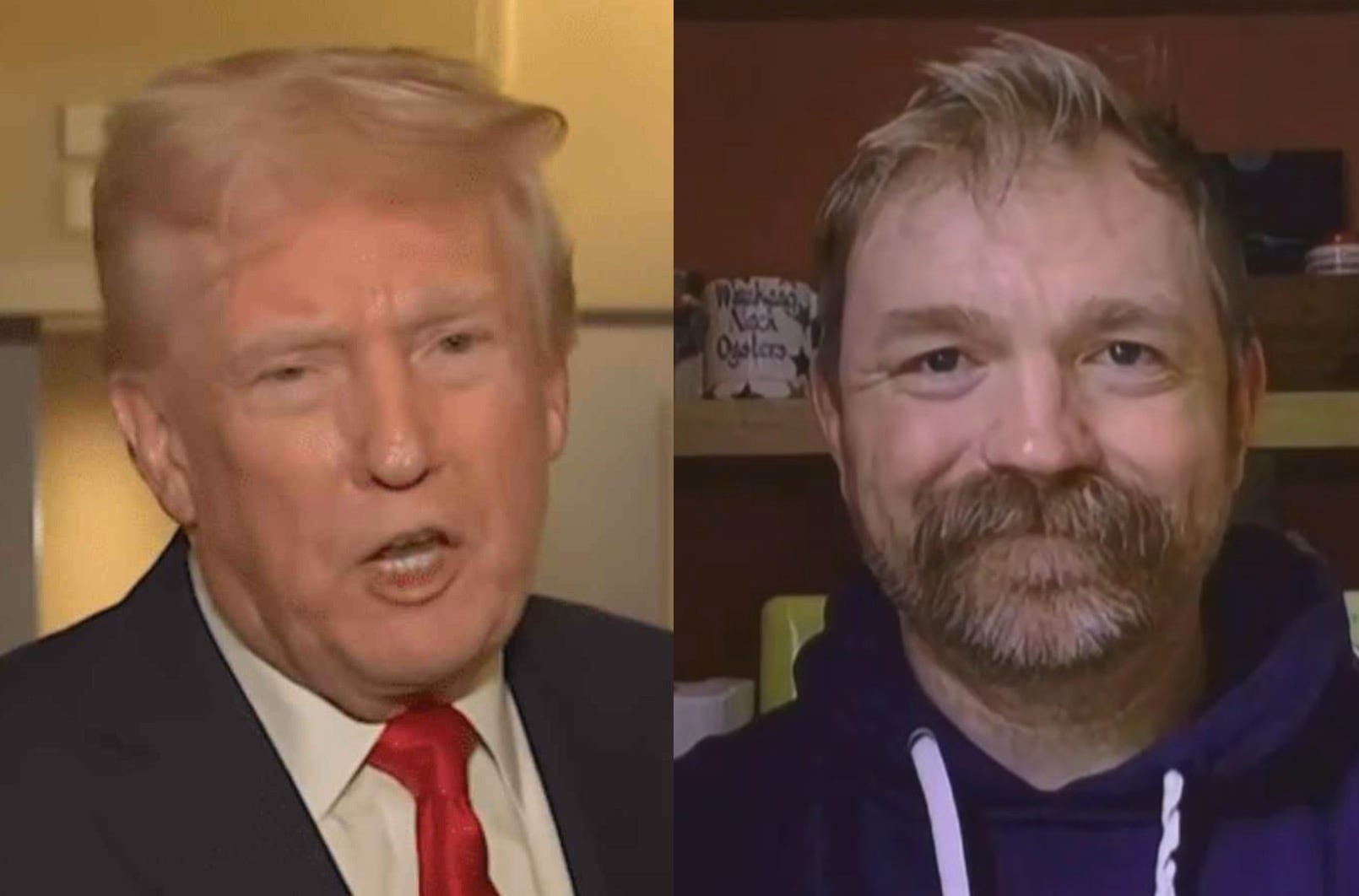
Graham Platner winning the Maine primary despite a week of negative coverage is not the story.
The real story, which only occurred to me after I spent a column writing about the first one, is that Graham Platner’s political success, despite some deeply concerning behavior, should no longer be surprising.
And almost nobody was surprised.
A candidate with a Nazi-adjacent tattoo, sexting allegations, a trail of embarrassing posts, and a public revolt from his own former campaign manager won a Democratic Senate primary by 77 points. The coverage was relentless, unsparingly tough, but mostly accurate. The result barely moved.
I wrote this morning about why the coverage didn’t land, that the attacks were built for a national audience rather than the voters who actually decide. That was the supply side. But this column focuses on the demand side, which paints a more uncomfortable self-portrait of the body politic.
Why are we, as voters, in both parties, increasingly willing to buy the flawed candidate anyway? The voters are not ignoring the behavior. We see it. We weigh it. And sadly, we decide that winning the seat matters far more than any sin.
To understand why, you have to be honest about what happened to the referees, and that story goes back much further than Platner and even earlier than Donald Trump.
For most of the modern era, there was a rough consensus about who got to call a candidate disqualified. The major papers. The networks. The parties. The churches. The universities. The courts. These institutions were never clean, but they had legitimacy, and when they collectively decided a candidate was finished, the verdict held.
Yes, there was Vietnam, Watergate, and various political scandals that seem tiny in scale in hindsight, like Iran-Contra, but in almost all instances the institutions held (Howard Baker anyone?)
Then 2008 happened. The soberest institutions in the country, the banks and the regulators and the ratings agencies, walked the economy off a cliff, and almost none of them paid for it. The people who lost their houses watched the people who caused it keep their bonuses, and then watched the same establishment ask to be trusted again as if nothing had happened. The crash radicalized the left and the right at the same moment, which is the tell that something structural was breaking and not just one party’s nerve. Occupy Wall Street and the Tea Party were effectively the same outraged scream, only in different dialects.
That is the fulcrum. Not the first institutional failure and not the last, but the one that seems the clearest distillation of radicalization from both directions at once that made all the others impossible to wave away. Because here is the part my own profession would rather not say out loud. The referees did not lose the country’s trust to a wave of irrational suspicion. They spent it.
And once you see the pattern, it is everywhere. The establishment press sold the Iraq war on bad evidence and never fully reckoned with it, then spent two decades performing a certainty its record did not support. Religious institutions that built their whole claim on moral seriousness spent years concealing abuse. Universities priced themselves out of reach and then asked to be trusted as neutral arbiters. The parties kept handing voters a list of acceptable candidates and kept losing to the ones they had ruled out.
None of these are secrets, and that is the point. The institutions failed at the exact thing that justified their authority, and then declined to apply to themselves the judgment they kept reserving the right to apply to everyone else. The press demanded accountability, which it would not accept. The parties enforced standards that their own leaders could not meet. The voters watched the referees call fouls on the field and never once called one in the booth. After enough of that, a character verdict from those quarters stops reading as information. It starts reading as one more institution protecting itself.
This is what Trump’s political rise actually proved, and it was never that the behavior was fine. He proved, again and again, that a candidate could absorb supposedly fatal information and survive, and that the people calling it fatal had no power left to make the ruling stick. Once voters stop trusting the referee, they stop accepting the call. Trump did not create that condition. He was the first to fully exploit it.
For many in legacy media, this was largely portrayed as a Republican phenomenon. It wasn’t. It was just further along on the right. Democratic institutions kept exercising the authority to remove their own problem figures long after Republican institutions had mostly surrendered it. Al Franken resigned. Andrew Cuomo resigned. Bob Menendez was convicted and dismissed from the national stage. Whether those calls were right is beside the point. Democratic voters still accepted that the institutions making them had the standing to make them.
For years, that was an apparent asymmetric narrative between the parties that Democrats not only amplified but took comfort in. The story the left told itself was that the right had abandoned character while the left still enforced it.
The comfort was already false. The party and its friendly press spent a year insisting Joe Biden was sharp while the country watched otherwise, then turned on him in a single weekend once the evidence could no longer be managed. The questions about John Fetterman’s health were brushed aside as bad faith until they weren’t. Each time, the institutions chose to protect their man over leveling with their voters, and each time a little more of their standing drained away. A side that spends its credibility shielding its incumbents cannot keep it to discipline its insurgents. Platner is the sign that the distinction is collapsing, and the two sides did not reach the same place at the same time or by the same road. They are reaching it now.
This is why Platner’s defenders reach for Trump. Not because the cases match. Because the logic does. Once one side proves the price no longer has to be paid, the other stops paying it. Unilateral disarmament is not a virtue in a knife fight.
Which brings us to the part that should worry you more than any single candidate.
When character stops being decisive, the system does not simply tolerate flawed people. It begins selecting for them.
Think about what it now takes to win. Not goodness. Not restraint. The ability to stand inside a week of saturation coverage about your worst moments and not flinch. The capacity to treat public humiliation as weather. The talent for reading your former campaign manager call you unfit in the Washington Post in the morning and walking onstage that night to a crowd that loves you for it.
Those are not neutral traits. They are a specific personality. Shamelessness used to be a liability that capped a career. It is now closer to a qualification. The candidate who can be embarrassed is at a structural disadvantage against the candidate who cannot, because embarrassment is the last lever anyone has left, and on certain people it no longer pulls at all.
This is the real cost of the broken trust, and it is bigger than Platner and bigger than Trump. The referees spent their authority, and they are not getting it back by asking. The country still cares about character. It just no longer trusts anyone to make the call.
So the field tilts. Slowly, election by election, toward the people hardest to shame. And the people hardest to shame are rarely the ones with the strongest conscience. More often they are the ones who never carried much of one to begin with.
It rewards candidates willing to maintain the Kayfabe illusion, Platner gives Republicans ammo to fundraise on and Fox to sell ads on.
Platner also fuels the Political-economy. He won’t pass progressive laws (see Bernie and AOCs record) he would just tip lobbying funds away from republicans if Susan Collins is out all while subsidizing the news-tainment industry.
MTG, Fetterman, Platner are all promoted to stimulate donors, lobbyists and advertisers for the opposite party. Jeff Zucker had a cash cow with Trump and is probably eyeing his next ex-WWE prize…