

The Iran deal may be a disaster. JD Vance may be its only winner.
Yes, this is the counterintuitive political story of the week that nobody is quite saying out loud — yet. You heard it here first.
Trump’s Iran deal is a disaster. Not a complicated, both-sides, reasonable-people-disagree disaster. A disaster. Republican Senator Bill Cassidy called it the worst foreign-policy blunder in decades. His GOP colleague Ted Cruz said giving billions to theocratic lunatics who want to murder us is an exceptionally bad idea. Sen. Roger Wicker put it in writing that the deal makes Obama’s 2015 agreement look like a pittance — and if you know one thing about Republican politics, you know “worse than Obama” is the costliest thing a senator can say. Lindsey Graham did something he almost never does: he walked away from a camera rather than defend it.
Nobody in Washington wanted to own this thing. So Trump handed it to his vice president and even joked on camera that he’d blame Vance if it fell apart and went back to executive time at the White House.
JD Vance took it. And somehow came out ahead.
That’s the shit sandwich thesis: Trump handed Vance a grenade, and Vance turned it into the best political week of his career. But there’s a bigger story underneath it, one that matters well beyond this week and this deal. To see it, you have to look at the other guy.
I’ll be honest — I’ve never been a Vance true believer. I’ve long thought the idea of him as the natural MAGA heir was overstated, that he was picked for loyalty and utility and the movement would eventually want someone who felt less like a conversion and more like the real thing. This week complicated that read. Because what looks like a story about an Iran deal is actually a story about two men who read the same moment and made opposite bets on their futures.
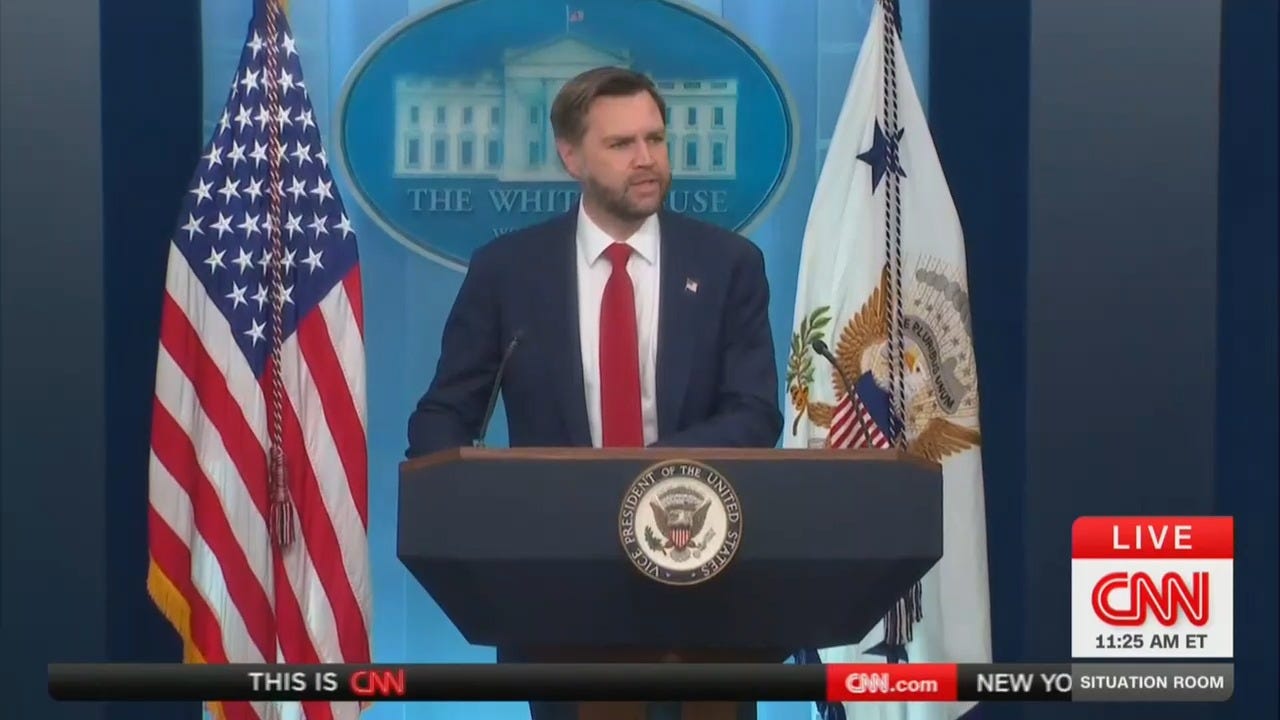
Vance was all over the media this week doing a press tour for his new book. He went on The Five on June 16th, before the deal was even signed. Then The View, where he took the heat but honestly held his own and showed up notably graceful and game. Then on Thursday, he held a hastily assembled press briefing at the White House for a full hour, alone, taking everything reporters had. By the end of the week, Jonathan Lemire on Morning Joe correctly described Vance as someone who “has become sort of the face of these negotiations.” The morning shows were treating the vice president as if he were running American foreign policy. Because for about five days, he kind of was.
He was supposed to be promoting a book. The book is called Communion, about restoring faith in God. In interview after interview, when he wasn’t talking about faith, Vance was telling Americans to “have a little bit of faith” in Trump’s Iran deal — a memorandum of understanding that Marc Thiessen dubbed the “Vance peace deal,” that Lindsey Graham called Vance “the architect” of, and that Trump joked he’d pin on Vance if it collapsed. Paul Begala on CNN called it what it was: Trump “kicking poor JD Vance under the bus.”
Vance laughed it off. Then he went back to the briefing room and spent another hour explaining the deal in terms that sounded less like a Trump accomplishment and more like something he’d already believed for years.
The moment that made the week was Thursday morning at the podium. Israeli cabinet members had been attacking the deal. Vance didn’t deflect. He went straight at them.
“Donald J. Trump is the only head of state in the entire world who is sympathetic to the nation of Israel at this moment in time,” he said. “And he happens to be the head of state of the world’s superpower. If I was in the cabinet of the Israeli government, I might not be attacking the only powerful ally that I have anywhere left in the entire world.” And then: “You can’t just kill your way out of solving every single national security problem that you have.”
Brian Kilmeade, Fox’s most reliably friendly host, said on Fox & Friends the next morning that he was “kind of shocked to see JD Vance go after Israel.” Richard Haass, a card-carrying foreign policy establishmentarian, called it “a frightening statement, tinged with threat.” When you’ve startled both the Fox couch and the Council on Foreign Relations in the same news cycle, you’ve really done something notable.
That’s not standard Republican boilerplate. It’s not the language of AIPAC donor events or Mark Levin monologues. A Republican vice president told Israel its credit was running out, on camera, without flinching. Tucker Carlson must have been thrilled! The neocon interventionist wing that has dominated GOP foreign policy for two decades just watched one of its own say things they’d have called disqualifying coming from a Democrat.
What made it land is that Vance wasn’t performing. He was defending an “America First” conclusion he’d already arrived at years ago. When he said at the podium that if Iran doesn’t follow through “there’s no skin off our back, nothing changes from where we are right now” — that isn’t spin. That’s what he thinks. The guy delivering the restraint doctrine happened to actually believe it.
Now look at the other guy.
Marco Rubio is, on paper, the senior foreign-policy voice of the administration. As Secretary of State, he had every institutional reason to be the face of this moment. Instead, he went quiet — so quiet that his two-day media silence became its own news story. When Trump signed the MOU, Rubio was there to receive the document. That was his role. Begala put it plainly on CNN: Rubio, “smarter than the average bear, is hiding in the tall grass.”
Which brings us to the real political stakes. For all the talk about the Iran deal, Washington spent the week watching something else: the two Republicans most likely to inherit Trump’s coalition in 2028 make opposite choices.
Last October, according to Maggie Haberman and Jonathan Swan ‘s new book Regime Change, at a private dinner, Trump asked Rupert Murdoch to compare the two men. Murdoch had privately tried to talk Trump out of picking Vance as his running mate in 2024. When Trump asked what he thought of JD, Murdoch paused: “Well... I think JD has the potential to be great.” Trump asked about Marco. Murdoch answered immediately: “Marco is brilliant.” The other guests talked privately about that moment for weeks. This week, “the potential” showed up. “Brilliant” received the document.
It’s the oldest tension in politics: “discretion as the better part of valor” versus “fortune favoring the bold.” Rubio read the deal and read the polls and decided this was not his hill to die on politically. Maybe that will prove to be the right call. Maybe the deal craters in 60 days, and Rubio is the guy who kept his powder dry while Vance owns the wreckage.
But here’s what that calculation misses. Vance doesn’t just own the deal. He can credibly argue that he ended a deeply unpopular war (started by Trump and Israel), pushed back on an ally that overplayed its hand, and did it in language that maps perfectly onto the isolationist America First coalition that actually runs the Republican Party right now. The neocon interventionist wing that Rubio represents didn’t just lose the argument this week. They lost the airtime.
Trump picked Vance in 2024 because he was loyal and useful. That’s very different from being the guy everyone looks to when Trump isn’t in the room. This week, through the worst possible circumstance, Vance became that guy.
Trump created the war. Trump signed the deal. When it came time to explain what any of it meant, JD Vance was the one standing at the podium.
For a vice president, that’s usually a supporting role. This week it looked like an audition.
Choo choo haha, yup it’s the natural “Smark” role: enjoy the Kayfabe, pump the story, clickbait the populace.
This article is brought to you courtesy of Peter Thiel.