


If there is one massive takeaway from this 2026 World Cup, it is that Lionel Messi has secured his place as the greatest footballer of all time. Another, less discussed takeaway is that Argentina is the least popular national side in the world, and upon close and ugly inspection, there are a ton of good reasons why.
The fact is, Argentina sucks, and it is only marginally to do with how they play. Watch the non-Messi portions of this team for a half, and you arrive at the seminal SNL sketch “¿Quién Es Más Macho?”, and not in a charitable way.
Give Messi everything. He is 21 World Cup goals into a career that ran out of superlatives a decade ago, more than any human being who has ever played the tournament. The booth has spent this month in open worship, and every word of it is earned, and this is almost certainly the last time the world gets to watch him do it.
Give them the football, too. They are a serious team, they have survived three knockout rounds that would have buried most sides, Cape Verde in extra time, Egypt from two goals down, Switzerland on a Julián Álvarez thunderbolt in the 112th minute, and they are into the semifinal on merit. All of that is true and none of it is the point.
They are the bandwagon team of this World Cup and you could see it in the Arrowhead lot on Saturday, a sea of the same sky blue ten worn by people from Overland Park and the Upper East Side who have never been to Buenos Aires and picked this team the way you pick a favorite song after it’s been played on Z100 a thousand times. But the pregame tailgate was conspicuously, almost entirely white. So was the team that fans came to support.
The neighbors are not on the wagon. The Los Angeles Times published a dispatch from Mexico City Wednesday morning reporting that fans across Latin America are rooting against the last Latin American team in the tournament, and quoting a Mexico City shop owner who asked how anyone could sympathize with a squad whose discourse he called supremacist and racist.
That resentment got fresh fuel this month when Argentine broadcaster Eduardo Feinmann went on air after Mexico’s elimination and announced that he detests Mexicans, detests them with his soul, and that what they feel for Argentina is envy. It was ugly enough that the president of Mexico called the remarks appalling. Feinmann then explained that he had not meant the Mexican people, and suggested President Sheinbaum had bigger problems, like her cartels. The same dispatch quotes ordinary Argentines who say they are appalled too, and reject all of it, and I believe them. This column is not about them.
Plenty of people have been trying to tell you about Argentina. French national defender Wesley Fofana tried two summers ago, after he watched a video of the world champions singing about French players like him and called it uninhibited racism. Hugo Lloris tried. The French federation tried, in a legal complaint. Egyptian national team coach Hossam Hassan tried, or seemed to try, last Tuesday night in Atlanta, and I will come back to him.
The celebratory song sung by Argentina is a perfect place to start.
After winning the 2024 Copa América, the reigning world champions got on the team bus and sang about the French national team. Not about Colombia, who they had just beaten in the final, but about France, and specifically about France's Black players, who the song says are not really French at all. Their parents are from Angola. Their mother is from Cameroon. Their father is from Nigeria. But the passport says French. Woven through the same verses are slurs calling those players gay and calling them trans, because the song is settling two questions at once, who is a man and who gets a country. Enzo Fernández, Fofana's teammate at Chelsea, found it funny enough to livestream from the bus.
Most nations would spend ten years living that down. Argentina spent a week. FIFA said the incident was being looked into, and the investigation evaporated so completely that Kick It Out, English football’s anti-discrimination watchdog, was still writing letters six months later asking anyone at all what had become of it, and no sanction has ever surfaced. Argentina’s undersecretary of sport said on the radio that Messi, as captain, should apologize, and the president of Argentina fired him inside of a day. The vice president of Argentina went online to say that no colonialist country would intimidate them over a song, that the hypocrites could stop feigning their indignation, and that she stood with Enzo, by name.
The chant was ratified at the top of the Argentine state, by name. For real.
And it is sitting on top of a hundred and fifty years of work. Argentina built itself into the European country that wandered into South America by mistake, and it did that on purpose. Black Argentines were roughly a third of Buenos Aires around independence, and then the state stopped counting them. The category came off the census and the people were reclassified as trigueño, wheat-colored, until the population vanished into a footnote. Nobody counted Afro-descendants again until 2010, when under one percent of the country raised a hand.
The country’s own president was still reciting the result in 2021, explaining that the Mexicans came from the Indians and the Brazilians came from the jungle, but the Argentines came from the ships, from Europe. Alberto Fernández apologized for saying it. Nobody has ever apologized for building it.
In 1938 the Argentine foreign ministry sent a secret circular to its consulates in Europe ordering them to deny visas to Jews. Eight years later Juan Perón opened the ratlines, and by most estimates something like five thousand Nazis and collaborators came down them, Mengele and Priebke among them, and Adolf Eichmann, who lived in a Buenos Aires suburb under a false name until the Israelis pulled him off the street. Perón said on tape before he died that he had saved as many of them as he could, because Nuremberg was a disgrace. Argentina shut the door on the people running from the camps and held it open for the men who ran them.
That is the machinery that produces a squad that looks like this one, a traveling support that looks like this one, and a bus full of world champions singing about who is allowed to be French. It is not a coincidence and it is not a smear to say so. It is policy, and the policy worked.
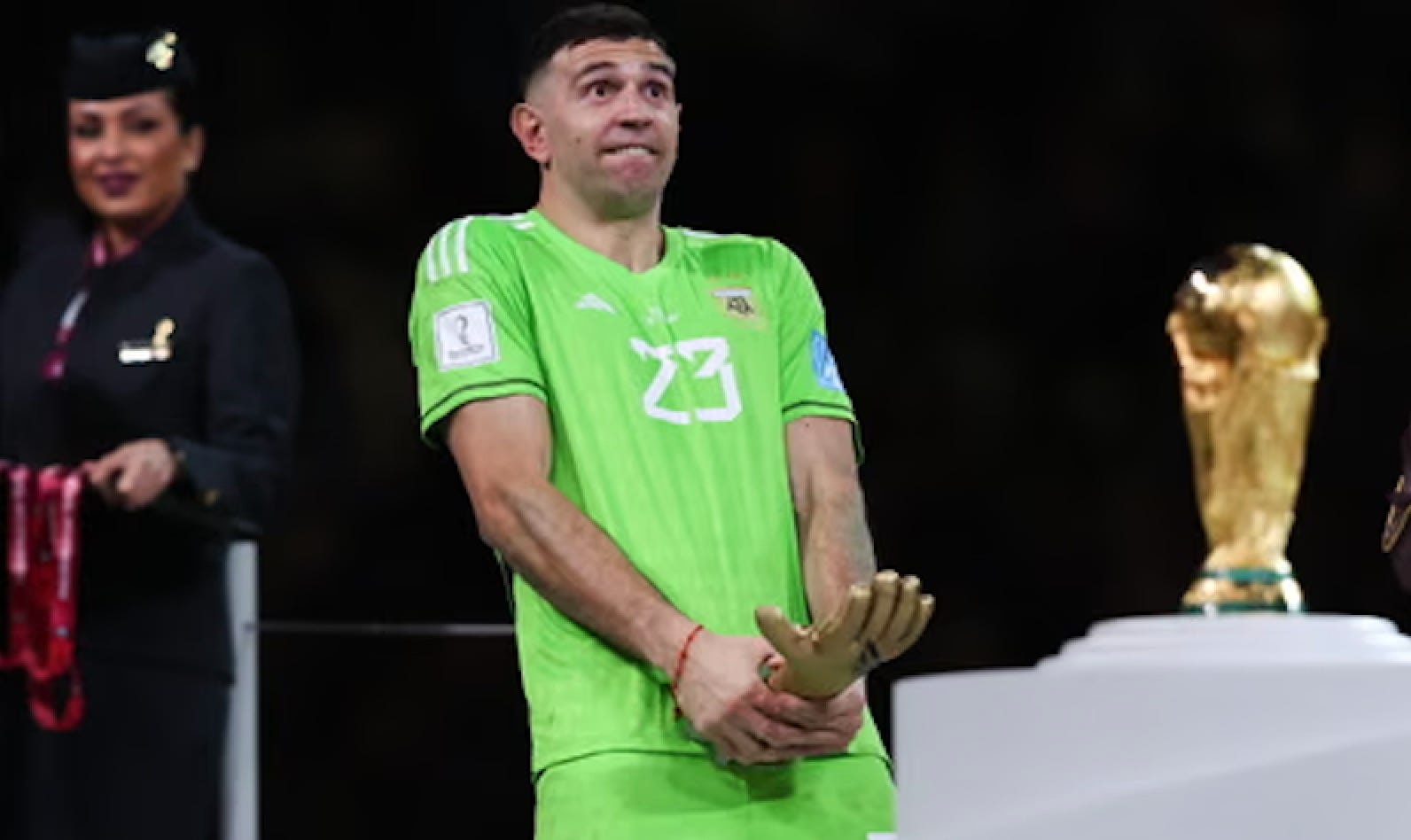
The rest is embarrassingly immature swagger. Emiliano Martínez accepted the Golden Glove in Qatar and made an obscene gesture with it on the podium in front of the planet, then did it again in Miami. The squad flew home from Doha with a baby doll wearing Kylian Mbappé’s face and Martínez led his teammates in a minute of silence for him. FIFA has fined Argentina for homophobic chanting so many times it is effectively a line item in the federation budget. And at this World Cup, per the Times, Argentine fans have been recorded at two separate matches hurling racist slurs at an African American streamer. Same voice, same posture, no consequences, ever.
Which brings us back to Atlanta. Egypt was leading the champions by two goals with eleven minutes left, and they had been made to score the second one twice. The first version was erased by a video review that went digging back through the buildup until it turned up a foul on Lisandro Martínez, and Mostafa Zico had to beat the defense all over again ten minutes later to make it count. Then Mohamed Salah went down in the box moments before the winner and got nothing, not even a review. Then Enzo Fernández headed in the winner in stoppage time. Egypt’s goalkeeping coach was shown a red card in the chaos that followed. And Hossam Hassan raised his arms and crossed them into an X, the gesture FIFA introduced two years ago as the official signal that racial abuse has occurred on the field.
Nobody knows exactly what Hassan meant by it, and the not knowing is the part worth sitting with. He flashed the signal more than once while his own staff tried to pull his arms down. The referee answered it with a yellow card. The protocol the gesture exists to trigger, stop the match, suspend it, abandon it, was never activated, and afterward Hassan talked only about the officiating, at one point claiming the Argentines had pressured the referee before the match by bringing up France, of all countries, and the France national team. No one in authority has asked him what he meant, then or since.
Here is what FIFA did instead. Within the week its disciplinary committee opened a case against Hassan, for insulting the officials, for failing to control his staff, and for the gesture itself, with a touchline ban and a heavy fine on the table. Its refereeing chief announced that unfounded allegations have no place in the sport. The organization that let an investigation into the world champions singing about who counts as French dissolve without a trace needed seven days to open a file on the man who made the anti-racism sign.
The week since has produced an enormous quantity of American television about video review protocols and the correct application of the laws of the game, and not one minute asking why a World Cup manager threw the sign for racial abuse at the officials in a match decided by the guy who filmed the bus. Nobody had to organize that silence. Criticizing Argentina has felt for twenty years like criticizing Messi, and nobody wants to be the man kicking a beloved genius on his way out the door.
A disclosure, this late, because this is where it belongs. The opponent on Wednesday afternoon is England, and my ancestry is English, all the way back to the earliest colonial days (and no, that’s not pride; it's context). So, some measurable percentage of the bile above is the oldest fuel in sports: wanting the other team to lose. The rest of it is the public record, names and dates and census tables and FIFA case files, and the record does not care who I am rooting for at three o’clock. Check my work. That is the whole point.
Messi either leaves the stage on Wednesday against England, or on Sunday in the final in New Jersey, but he will go. Then the apparatus of affection that has been wrapped around this team since 2006 leaves with him, and what is standing there is a squad that has never once been made to answer for itself, in front of a crowd that will have to work out what it was cheering for.