




Friday, June 26, 2026
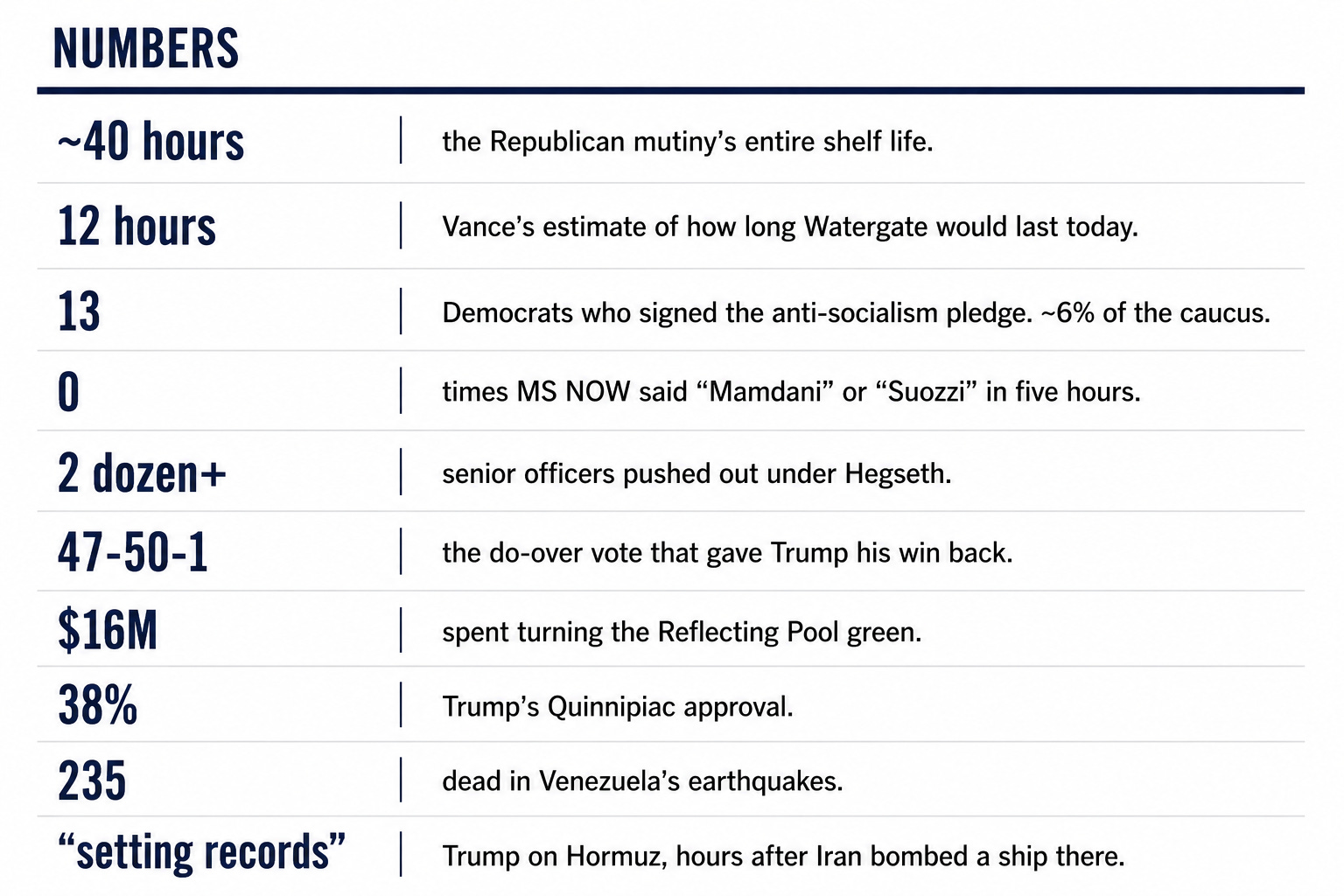
Two versions of one story ran all morning. CNN and MS NOW couldn’t stop talking about Regime Change, the sold-out new tell-all on Trump’s “imperial presidency”; Fox News all but ignored it, while the vice president turned up at the Nixon Library to insist Watergate would be a 12-hour story today.
Both sides are now turning the fight over who controls the government into merchandise, a bestseller on one side and a Nixon-rehab tour on the other. The one story all week with real stakes, Wednesday’s Republican revolt, was gone from every show by breakfast.


01 — Regime Change Sold Out in a Day, and Its Bombshells Are Everywhere … but Fox News
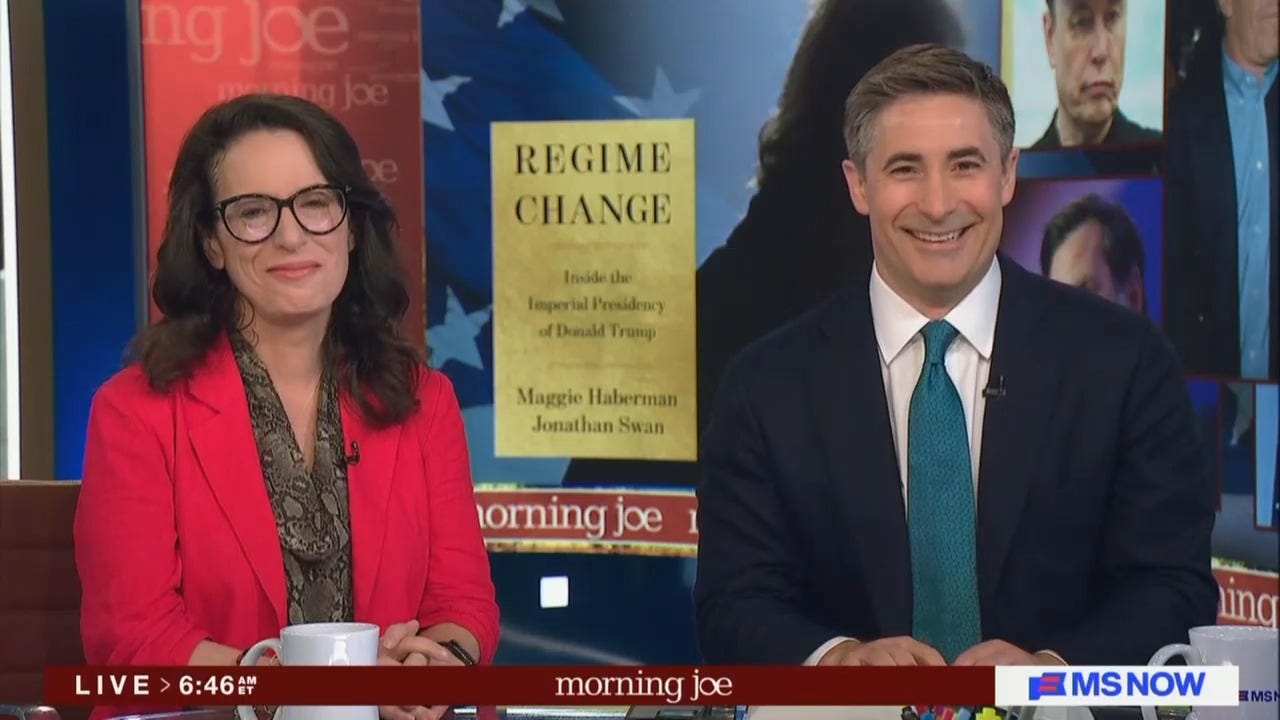
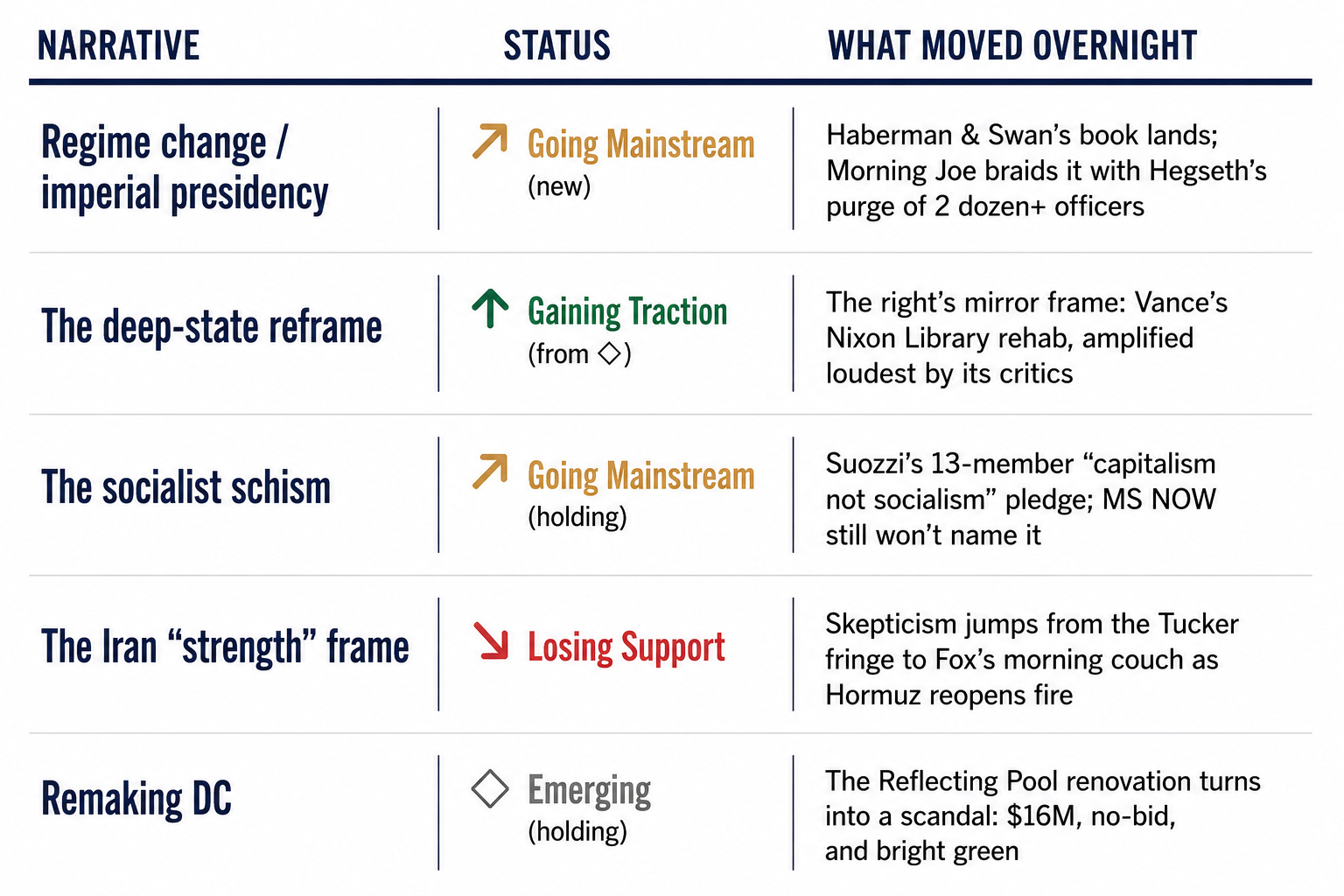
↗ Going Mainstream (new validator). Delta: Haberman and Swan’s book sold 150,000 copies on day one, the publisher ordered 150,000 more to keep up, and it is tracking as the year’s biggest nonfiction launch. The right reframed the institutions fight as deep-state persecution; the left’s version just became the fastest-selling nonfiction book of the year. Regime Change: Inside the Imperial Presidency of Donald Trump is already back at the printers, and Maggie Haberman and Jonathan Swan have carried it across CNN and MS NOW, from Kaitlan Collins’s table to two full Morning Joe segments braided with Hegseth’s purge of the senior command. On Fox News the book surfaced exactly once, when Jessica Tarlov, the lone liberal on The Five, said she had “just finished reading Regime Change” and called it “really good,” at which point her co-hosts talked over her, joked it was fifty pages (it runs 450), and waved her to wrap.
The Read: A book that moves 150,000 copies in a day is real demand. Fox’s one brush with it ran about fifteen seconds, from the house liberal, before the hosts changed the subject, which is how a network handles a story it would rather its audience not finish hearing.
02 — JD Vance Is Rehabilitating Nixon, and His Critics Are Distributing It
◈ → ⬆ Gaining Traction. Delta: zero new facts; the frame’s loudest amplifier was the network that hates him most. VP JD Vance rolled the frame out on stage at the Richard Nixon Presidential Library, the monument built to its subject, telling a book-promotion audience that Watergate “would be like a 12-hour news story” today and that the deep state took down Nixon the same way it later came for Donald Trump. There is no news in the claim. It traveled anyway, and not on his own network. Morning Joe gave it a full segment of fury and CNN teased it twice, while Fox & Friends skipped the Nixon argument entirely for a softer Vance item about his wife’s $8.75 maternity dress. The frame spread fastest through the people working hardest to discredit it. MS NOW spent ten minutes relitigating Yale and Watergate in the belief it was rebutting Vance, and the effect was to broadcast him.
The Why: You rehabilitate the most disgraced president in living memory when you expect to need the comparison. The next intelligence purge is already in galleys.
03 — Moderate Democrats Draw an Anti-Socialist Line. All 13 of Them.
↗ Going Mainstream (holding). Delta: the sweep narrative grew a faction overnight — 13 House Democrats, a slogan, and a letterhead. Tuesday, democratic socialists led by Zohran Mamdani swept the New York primaries, and within hours, the win was a fight over what it meant for the party. By Friday, it had produced a counter-insurgency: Tom Suozzi on Fox & Friends, unveiling the “Promise to America,” thirteen House Democrats branding themselves capitalist, patriotic, and pro-cop in direct response to the Mamdani wing. Audit the uprising, and it comes to thirteen members, roughly 6% of the House Democratic caucus, which is closer to a support group with a press release. On the right, it gets played as proof of an existential Democratic civil war, while across four primetime hours and a morning, MS NOW has not said Suozzi’s name, or Mamdani’s, even once.
The Tell: A Democrat launched the rescue of the Democratic brand on the single friendliest Republican couch in television, because that is where the demand for the product lives.

The Mutiny — Trump berated Senate Republicans over Iran, called Cassidy a “lunatic,” and held a bipartisan housing bill hostage to his SAVE Act before the revolt collapsed by midnight; the Atlantic‘s “Meltdown” has the week. Read it →
The Socialist Schism — After the NYC primary sweep, moderate Democrats are scrambling to define themselves against the socialist wing. Background →
The Hormuz Strike — Iran hit a Singapore-flagged ship in the strait days into the deal Trump calls “pure strength.” Read it →



The YOLO Caucus. Trump has primaried them out or pushed them into retirement, so they owe the base nothing and, with nothing left to lose, they are getting louder. The individual defections are old news: Thom Tillis, Bill Cassidy, and John Cornyn have needled the president for months. The story is that they now amount to a class, and the class is growing. The tell this week is escalation. Tillis didn’t just grumble about Iran; he called the president’s hand-picked intelligence chief “an incompetent sycophant,” aiming straight at the loyalist hire. As the 2026 map keeps converting Trump-skeptical incumbents into lame ducks, the caucus expands, and so does the only on-the-record Republican criticism the White House has no leverage left to stop.
The Read: The GOP’s honest opposition now consists entirely of people with nothing left to lose. It is getting louder and larger, and for the moment it changes nothing.


Fox & Friends cold-opened on the World Cup, then gave the morning to the Democrats’ civil war: “is this the beginning of a democratic civil war?” and a warm sit-down with Suozzi about his anti-socialist pledge. The sharpest moment was unscripted. On Iran, the hosts doubted their own president, with Brian Kilmeade asking whether the White House is even leveling and Lawrence Jones giving the deal sixty days. What never came up was the housing hostage, the Cassidy mutiny, or the week the Atlantic just christened “The Meltdown.” The morning after the worst Hill stretch of the term, the friendliest couch led with soccer.
CNN This Morning led with the Venezuela earthquake, then the immigration rulings as “Trump’s mass deportation machine wins big,” refereed in a both-sides group chat that sat a Trump defender next to a Haitian woman facing deportation. Audie Cornish kept it at arm’s length, the disaster and the law, light on the brawl. It was the arbiter’s posture, on a day that offered two civil wars to choose from.
Morning Joe cold-opened on Vance’s Nixon riff and could not put it down, the panel relitigating Watergate, Yale, and state schools for a full segment. The villain was Vance, recast as a deep-state apologist. For the entire hour it never mentioned the civil war Fox was leading with, not the sweep, not Suozzi, not the schism its own audience is living through.
QUICK TAKE: Each network’s open is a confession of what it wants its audience thinking about, and Friday’s were unusually plain. Fox opened on the Democrats’ fracture, MS NOW on Vance with no mention of that fracture, CNN on a literal earthquake. Both partisan networks spent 6 a.m. on the other team’s civil war, and MS NOW spent its hour distributing the exact frame Vance built for it. The only segment that costs a network anything is the one about its own side’s fight, which is why nobody booked it.

The Supreme Court handed Bayer immunity from thousands of Roundup cancer suits, a ruling that spiked search traffic and topped Prism’s source count (13 outlets) and otherwise evaporated. Across fifteen cable hours, primetime and morning, it earned three passing mentions and not one segment. The problem is structural: a corporate-liability story has no villain a partisan audience is pre-trained to boo, so it dies on contact with television. What breaks it open is a single plaintiff with a face, and every plaintiff’s lawyer in America knows it.

The accidental thesis of the week belongs to the vice president. JD Vance said Watergate would be a 12-hour story today, and in doing so he described his own method. When every frame decays at the same rate, the winner is whichever one is cheapest to keep alive.
A real revolt is expensive to sustain. It needs senators willing to stay angry, facts that survive a second day, and reporters willing to file the follow-up. A manufactured Nixon riff costs almost nothing, because it spreads on its own and travels furthest through the people trying to discredit it. That asymmetry decided the week. The mutiny, for all its documentation, was gone in two days, while the Nixon line, with nothing behind it, reached two networks by breakfast on the strength of its critics’ outrage.
That tempo is the thing to watch into the fall, more than the generic ballot or the approval number, though both are quietly miserable for the president. An operation that can produce a fresh frame every forty hours does not need any single one to hold up. It needs the last one forgotten by the time the next one lands, and on Friday’s evidence, the morning shows are keeping the schedule for him.
Methodology: Narrative status is determined by source velocity, validator movement, and cross-ecosystem pickup across Narrative Prism’s 151-source universe. Prism’s four ecosystems are left, right, legacy, and mainstream. Sources: June 26 morning-show transcripts (Fox & Friends, CNN This Morning, Morning Joe), with June 25 primetime as context; political media sites and newsletters across left, right, and independent ecosystems; Narrative Prism intelligence briefs.
About Morning Frame / Narrative Prism — Morning Frame is powered by Narrative Prism, a media intelligence platform that tracks how major stories are framed across political, media, and social ecosystems. By analyzing thousands of sources in real time, it identifies which narratives are gaining traction, which are fading, and how the same events are framed for different audiences. The goal isn’t to tell you what to think. It’s to make visible the machinery that shapes public understanding of the news.
❤️“Morning Joe’s outage does Vance’s marketing“ 💯
I almost forgot we had a thiel-fellow cosplaying as a VP…