





Monday, June 29, 2026
The weekend froze, but it sits in front of a loaded week. The Supreme Court starts handing down opinions Monday morning, the housing bill Donald Trump torched lands back on his desk today, Colorado’s insurgents get their first test outside a coastal city tomorrow, and Iran talks resume Tuesday.
By Monday morning, the divide was a split screen: Fox threw a birthday party live from the National Mall while CNN and MS NOW ran the autopsy of the host. Every camp picked the story that flatters it, away from the one with a price tag, and the week that decides things waited offstage.
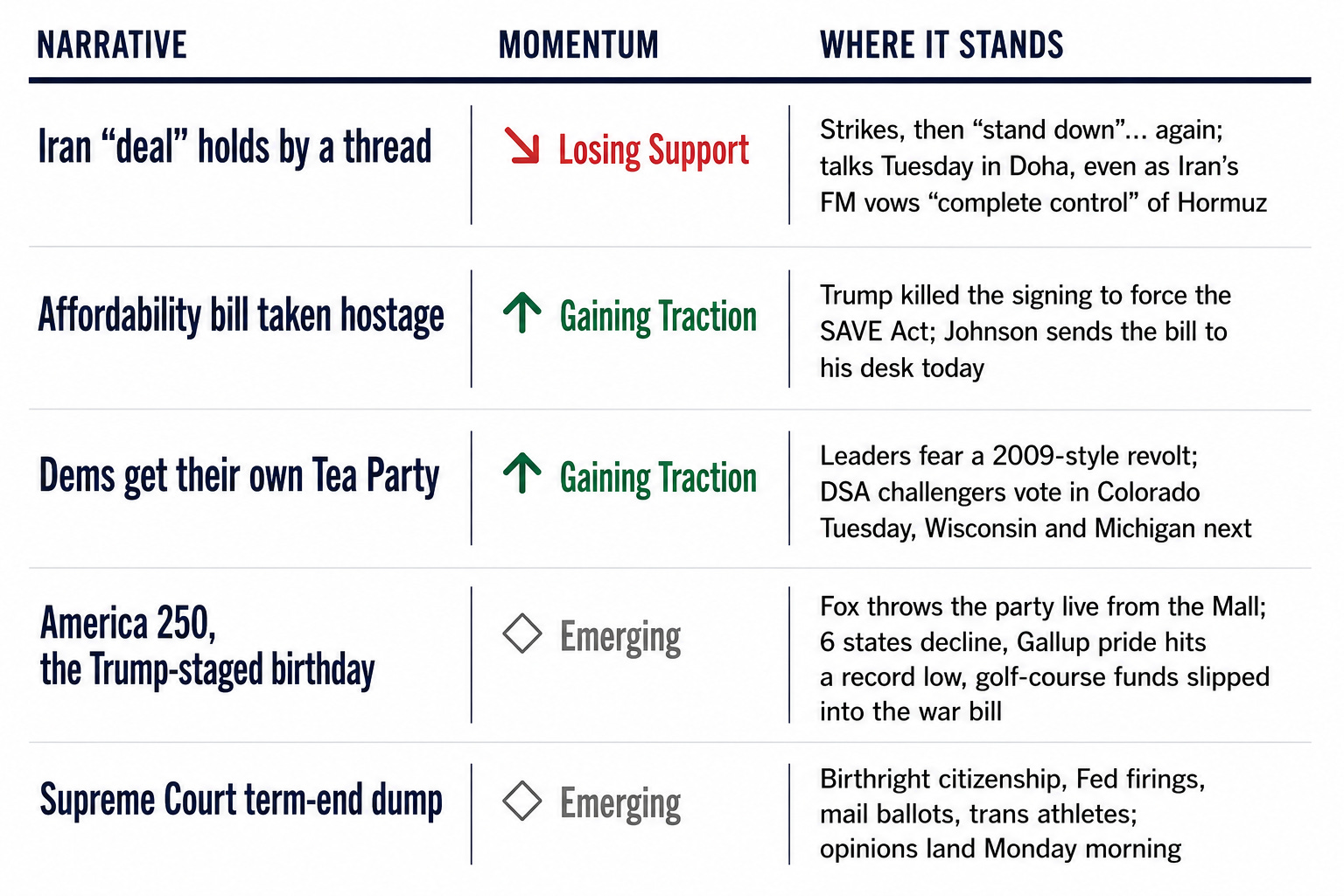

01 — The GOP’s Affordability Own-Goal: Trump Is Holding His Own Party’s Housing Win Hostage
⬆ Gaining Traction (new). Delta: Speaker Mike Johnson sends the veto-proof housing bill to Trump’s desk today, forcing the choice the president dodged when he killed last week’s signing. Washington spent the weekend staring at a rare thing, a bill both parties wanted: the 21st Century Road to Housing Act, passed with veto-proof majorities. Minutes before the ceremony, Trump pulled it, demanding the Senate first pass the SAVE Act, a voter-documentation measure that has failed five times. On Fox’s Sunday Night in America, the standoff became a story about election integrity and the filibuster, and the housing bill went unnamed. On the left, Pod Save America aired his own audio, “I made billions of dollars with housing,” and called him a slumlord. Now Mike Johnson sends it back: sign the thing he tried to kill, veto a bill with the votes to override him, or let it pass untouched. Whichever he picks, the bill becomes law, and all the cancellation changed was the messaging around it.
The Why: The SAVE Act suppresses the GOP’s own low-turnout voters, so the party that needs an affordability win most is the one keeping it off the air.
02 — America’s Iran War Is Over So Often It Needs a New Ceasefire Every Weekend
↘ Losing Support. Delta: fresh U.S. strikes after a tanker hit, then yet another “stand down” that Iran’s own foreign minister immediately undercut. The official story is peace through strength: the strikes worked, Iran folded, the deal is holding. The weekend complicated it. After Iran hit a tanker in the Strait of Hormuz, U.S. Central Command struck back, Iran fired on Gulf targets in Kuwait and Bahrain, and by Sunday both sides agreed to “stand down,” again, with talks set for Tuesday in Doha. Then Iran’s foreign minister, Abbas Araghchi, said Tehran would take “complete control” of the strait, which is not what a stand-down sounds like. It was the one story every side covered, with coverage nearly tripling overnight, and the gas-price worry has migrated rightward to RedState, Breitbart, and Townhall while the left leaves it alone.
The Tell: A victory frame indexed to gas prices and a calendar is a frame on a clock. When you’re winning, you don’t keep announcing you’ve stopped fighting.
03 — The Democrats Are Getting Their Own Tea Party. Their Leaders Just Noticed.
⬆ Gaining Traction. Delta: the establishment names the threat out loud as the insurgency’s map jumps from New York to Colorado, Wisconsin, and Michigan. For a week the story was a New York oddity around Zohran Mamdani. Over the weekend it became a pattern the party named itself, with Democratic leaders telling Axios they fear their own version of the GOP’s 2009 Tea Party revolt. The tell is the language from inside the house: Senator Chris Murphy, no socialist, now says “capitalism isn’t working,” and Trump, who was supposed to make Mamdani his boogeyman, admitted he likes the guy and went hunting for a new one, branding D.C.’s mayor-in-waiting Janeese Lewis George a “Communist.” A democratic-socialist barista is poised to topple a 15-term congresswoman in Colorado tomorrow, with Hasan Piker flying in to phone-bank and Wisconsin and Michigan primaries close behind.
The Read: A Tea Party works by making the establishment fear its own voters, and this one already has the party admitting out loud it is being out-organized from the outside. Colorado tells us how fast that fear spreads.

Iran: The U.S. and Iran agreed to stand down again after a weekend of strikes on Gulf targets and to meet Tuesday in Doha, though Iran’s foreign minister insisted Tehran will take “complete control” of the Strait of Hormuz. (Axios)
Housing: Speaker Mike Johnson sends the bipartisan housing bill to Trump today, forcing the choice he dodged when he torpedoed last week’s signing to demand the SAVE Act. (Politico)
Colorado: The Democratic insurgency faces its first inland test Tuesday, with a DSA challenger poised to topple 15-term Rep. Diana DeGette and Sen. John Hickenlooper‘s seat suddenly competitive. (Politico)

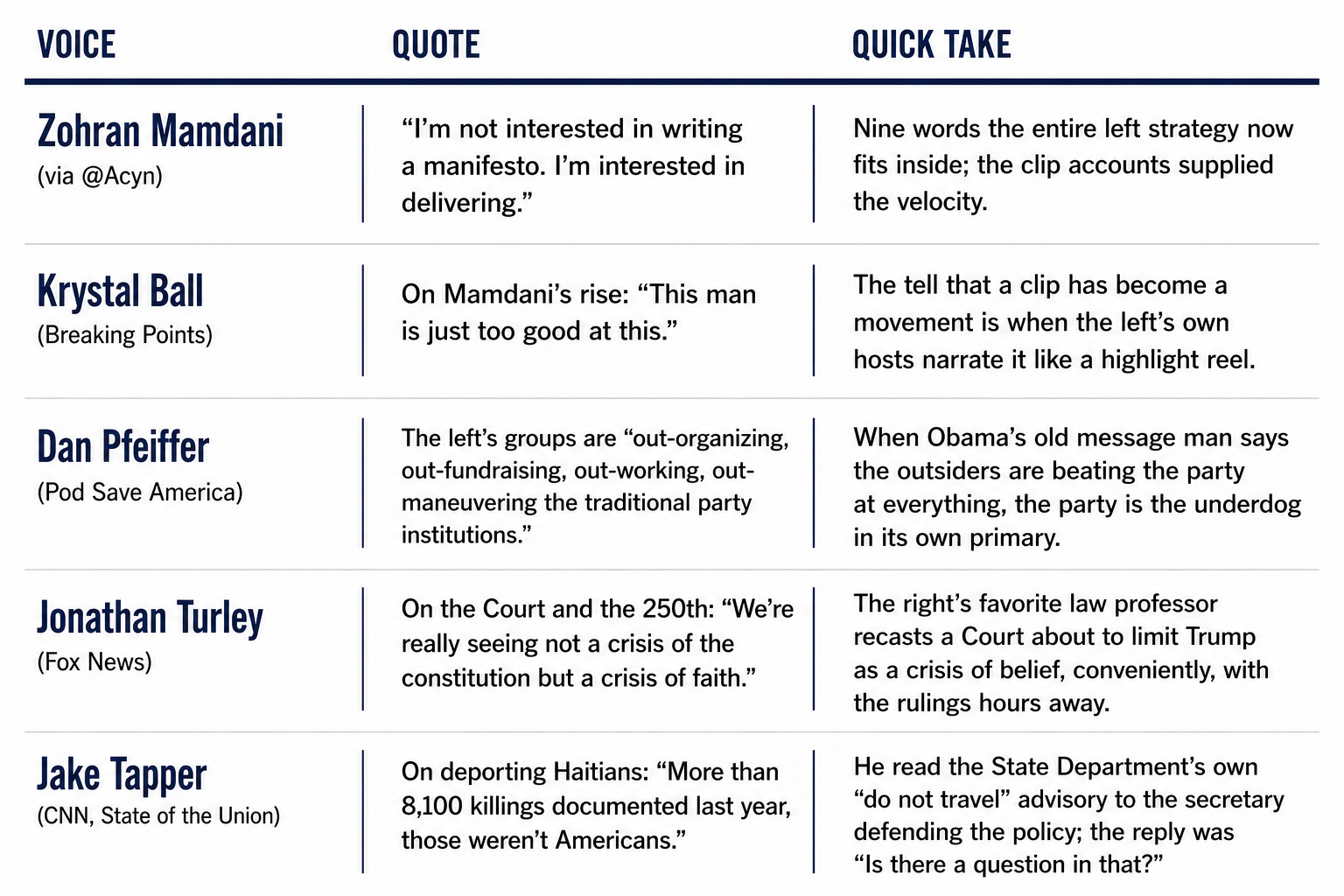

The right cracks on its best issue. Immigration was the one subject Trump still owned, and over the weekend his own side started inching away from it. MAGA host Tomi Lahren tore into the DHS secretary over the Haitian deportations and warned Republican voters would “stay home” in November. Ohio Governor Mike DeWine called the same deportations “not in the United States’ interest.” On Morning Joe, Jonathan Martin marked the shift, saying Trump “gave it away in Minneapolis” by “raiding grandmothers and housekeepers.” These are not the usual Senate skeptics. When a red-state governor and a base-famous influencer break in the same week, the crack has reached the floor of the coalition.
The Read: A coalition can absorb its moderates complaining. When the loyalists go quiet on the issue that wins for them, it usually means the issue has stopped winning.

A quiet weekend giving way to a loud week, counted up
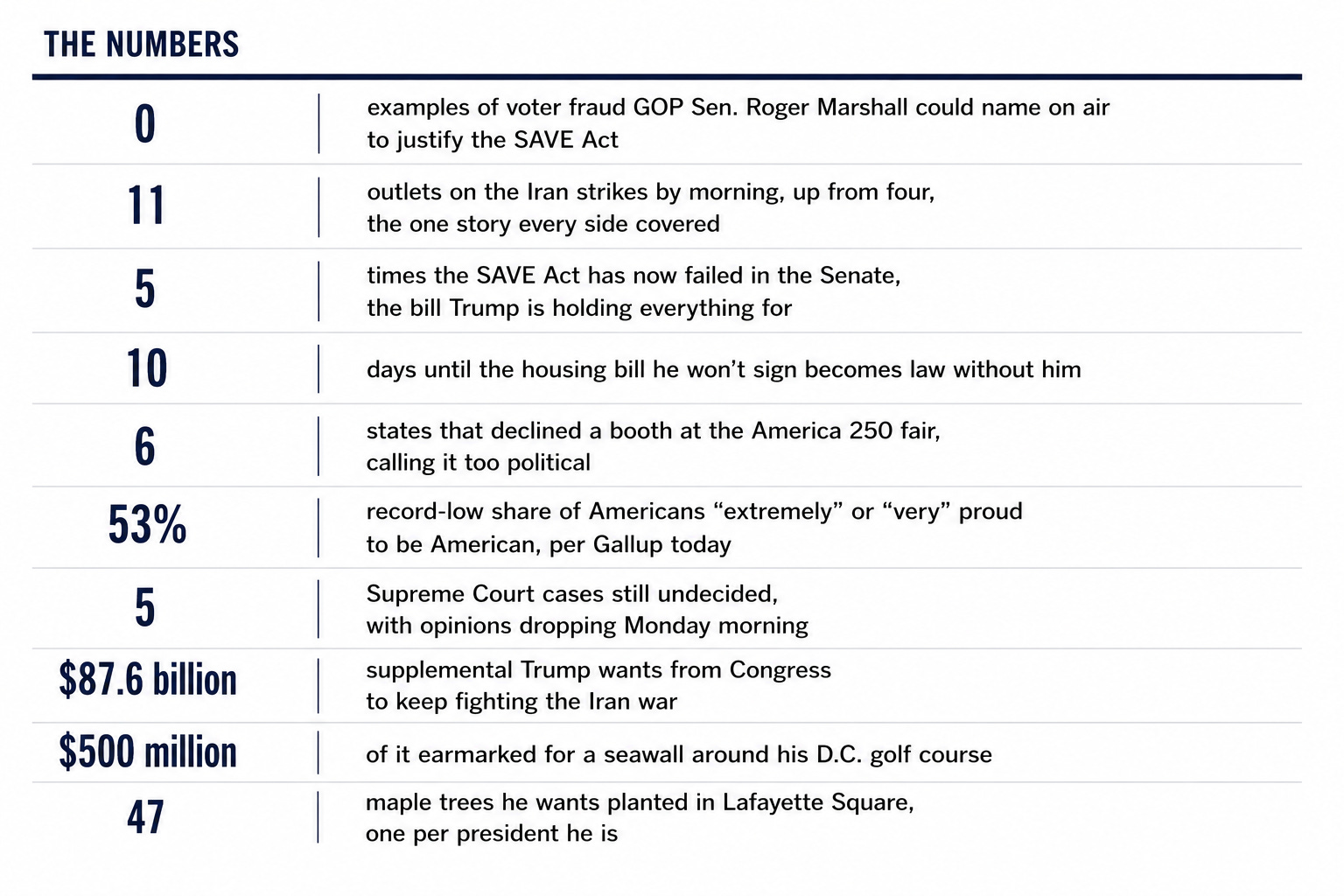

Monday’s morning shows split the screen so cleanly you could teach from it, three networks working the same news from what felt like three different countries.
Fox & Friends broadcast the entire show live from the Great American State Fair on the National Mall, cold open to close, between the president’s Marine band and a Chinese immigrant’s viral pancake stand. The villains were the democratic socialists and the six states that declined a booth, framed as too small to celebrate the country. What never aired was the revolt inside Fox’s own party. Cassidy and Massie had just lost primaries and were warning of a “shellacking,” and the friendliest couch ran a party instead, reading the housing bill as a coming Trump win rather than the hostage situation its own senators were describing.
Morning Joe ran the inverse: an hour on the SAVE Act’s missing evidence, JD Vance‘s “cynicism,” and the Democrats’ “Tea Party moment,” with the GOP cast as lemmings marching into the sea. Axios’s Jim VandeHei laid out the socialist wave coast to coast. What it skipped was the birthday entirely. While Fox waved flags from the Mall, Joe never went there.
CNN This Morning did the sharpest reporting and the most flinching. Audie Cornish’s group chat walked the renovator-in-chief story, the $500 million golf-course seawall tucked into the Iran war bill, the no-bid contracts, the park fees drained from Yellowstone for D.C. Then, after someone called it “depressing” and someone else “grim,” the chat pivoted to the World Cup.
QUICK TAKE: Each network edged away from the one story that implicates its own audience. Fox cut to a birthday party rather than let its own senators warn the base about who is blowing the midterms. The left couldn’t film the country’s 250th without it reading as a vote for the man hosting it, so MS NOW stayed on the SAVE Act and the Tea Party. CNN had the best material of the three and kept reaching for the World Cup anyway, because a grim reflecting pool in July 4 week flatters no one. The omission was different each time, and the instinct behind it was not.

The Justice Department had a pile of evidence to bring criminal charges against Abbott Laboratories over a baby-formula contamination crisis, then quietly dropped the case and settled for clawing back money, per the Wall Street Journal. A child-safety story with no partisan villain to boo dies on contact with television; what breaks it open is a single sick infant with a name, and the clock on that is already running.

The weekend froze and the morning confirmed why. Every camp retreated to the story that flatters it and away from the one that indicts whoever holds power. By Monday the pattern was hard to miss: a birthday party on one channel, an autopsy on the next, and the best reporting of the morning interrupted to talk about soccer. The thing all three edged away from is the same. Affordability is the only movement most people can feel, gas and rent and groceries, and it is the one nobody on television wants to own, because owning it means naming who is making it worse.
That is the deeper logic of the 250th itself. A confident country does not need a two-week fair and a senator walking 250 miles to feel patriotic, and the morning Gallup put national pride at a record low is the morning the celebration got loudest. Over-explanation is the first sign of a frame under strain, and right now the loudest frame on television is the one insisting everything is great.
The week will test it faster than the weekend hid it. The Supreme Court starts deciding birthright citizenship and firing power Monday morning, the housing bill the president killed is back on his desk, Colorado votes tomorrow, and the fireworks are Saturday. Watch whether the party gets louder as the receipts come in. That is what a frame does right before it breaks.
Narrative status is determined by source velocity, validator movement, and cross-ecosystem pickup across Narrative Prism’s 151-source universe. Prism’s four ecosystems are left, right, legacy, and mainstream.
About Morning Frame / Narrative Prism — Morning Frame is powered by Narrative Prism, a media intelligence platform that tracks how major stories are framed across political, media, and social ecosystems. By analyzing thousands of sources in real time, it identifies which narratives are gaining traction, which are fading, and how the same events are framed for different audiences. The goal isn’t to tell you what to think. It’s to make visible the machinery that shapes public understanding of the news.