

SPOILER: This is for people who have already seen You Can See Everything. If you haven’t, stop reading unless you’re okay with spoilers.
Nathan Fielder has made a three-hour movie that promises to settle whether Elizabeth Holmes is a fraud. The only fraud I could find in the movie was its true subject, Nathan Fielder. You Can See Everything barely qualifies as a documentary, and for long stretches, Holmes is merely a supporting character in a film that ends up being about the man asking her the questions. A few million people have paid to watch it, and the vast majority have emerged from the theaters praising him.
I went in with reasonable expectations and some goodwill. I have enjoyed his television shows, and it's a rare event when a documentary breaks through and becomes a major cultural event. You Can See Everything opened to a whopping $15 million in limited theatrical release, the biggest documentary box office weekend since Fahrenheit 9/11. Its opening was helped by enormous hype after a secret Telluride premiere and a near-perfect Rotten Tomatoes score. Like many movie goers, I was told be reliable friends to go into the film knowing as little as possible, so I did. I’ve long believed that managed expectations are the key to enjoying any movie, and life in general, but this felt like homework from the first reel.
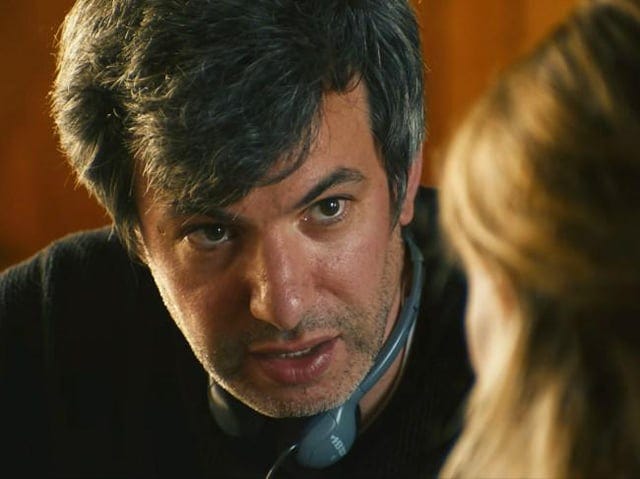
The theater crowd’s immediate reaction caught me off guard. Fielder shoots himself in close-ups so tight you can count his pores, and almost every time his face filled the screen, half the theater laughed. He hadn’t done anything funny, and most of the time he hadn’t done anything at all. These people came into the theater having decided they loved the movie before it started. Given the massive amount of screen time he got, Fielder seemed well aware that he could exploit that goodwill for cheap laughs.
The film’s initial conceit is straightforward. Holmes and her partner, Billy Evans, invite Fielder and co-director Lance Oppenheim to film them for the 34 days before she reports to a federal prison. Fielder presses her on everything and, at one point, gets her to say, with a straight face, that she’s never told a lie. Then Holmes goes to prison, and the movie turns into something else entirely. Moviegoers talk about that turn like it’s some wild trapdoor, but it plays more like a hallway into a different film.
Yes, the documentary about Elizabeth Holmes suddenly becomes a documentary about making a documentary about Elizabeth Holmes. It’s a reasonably clever execution that focuses on Fielder’s doubts, his crew’s arguments, his phone calls and his conscience, with a detour through Amanda Seyfried. By the end, Holmes is mostly a voice on a prison phone. I walked out of the theater knowing less about Holmes than I knew walking in. It took three hours for me to come out more confused than before.
For the first half of the movie, Fielder comes across as a documentary purist. He fights Evans over which questions he’s allowed to ask, and he gets visibly indignant when Evans shuts down an interview with a former Theranos engineer who suggests Holmes lied about the technology. But about two-thirds of the way in, Fielder tells us that before a single frame was shot, Evans asked for a cut of the film’s profits, and the filmmakers negotiated one with him. By the film’s own account, they had conflict-of-interest concerns at the time but signed anyway. Holmes was in another room, and neither the filmmakers nor the audience ever understood whether she was part of the profit-sharing deal.
The man Fielder spends the movie fighting with for editorial control, and is a crucial subject of the film, had a piece of the box office the whole time he was on camera. Every question Evans cut off, and every conversation he steered, came from someone who stood to make more money if the movie was a hit, and both Evans and Fielder knew that while he was filming him. That’s not a documentary. It’s a reality show.
Documentary filmmakers have long argued about the negative effects of paying subjects for decades. That taboo has loosened over the years, but every serious defense of the practice assumes the money is out in the open and not the price of access.
Hoop Dreams filmmakers gave Arthur Agee and William Gates royalty shares equal to their own, but worked out that arrangement after the film existed. Errol Morris was open about paying Abu Ghraib soldiers featured in Standard Operating Procedure a fee. Jon Else, who ran the documentary program at Berkeley’s journalism school, explained the traditional view on the matter: “Paying people to talk to you poisons what they tell you.” A share of profits gave Evans (and maybe Holmes?) reason to perform on camera. Viewers don’t know this, however, in the first half of the film.
But as the film pivots, Fielder makes the profit share deal a plot point. The last stretch has him trying to talk Evans out of the money, and Evans, who is loathsome enough on his own, gets cast as the heavy. When he finally gives up his cut, the film plays it as the moment the film’s integrity has been rescued from his naked greed. It’s a shameless framing because Evans isn’t the bad guy here; it’s Fielder, Oppenheim, and A24 executives who agreed to the contract! As filmmakers, they’re responsible for maintaining documentary standards, not Evans. Everything had been shot by the time he walked away from the money. Handing it back afterward doesn't change a frame of what we saw.
The critics are treating the deal as evidence of Evans's villainy, just one more thing on the list of awful things he does. Reviews that mention it at all treat it as a twist, but I've seen nobody ask why a filmmaker who spent half his movie lecturing his subject about documentary rules signed that contract in the first place.
Elizabeth Holmes made smart people feel they were witnessing something important, and got them to write massive checks without seeing her device work. Fielder has done the same thing to moviegoers, and in my theater they were laughing before he’d shown them anything at all.
Fielder and Holmes have clear chemistry when they are on screen together, but in a sort of unsettling way. Maybe they both know they sold lucrative machines that didn’t work as advertised.
Thanks for a clear-eyed reaction to this film.