

The people building artificial intelligence are frightened by what they’ve built. And by saying so publicly, they’re freaking all of us out, too.
The latest example is Alexandr Wang, who runs AI at Meta, and on Sunday he published a long warning titled “Superintelligence is Arriving.” He openly admits that he finds it hard to imagine humanity keeping control of AI systems that can improve themselves. He wrote that the public “should not be okay with a ‘handover’ of society to AI.” He offered no plan for preventing one.
Wang is not alone in waving red flags of warning. Anthropic CEO Dario Amodei and OpenAI CEO Sam Altman each spent part of September urging their own industry to slow down. These are the men with the most to gain from AI, and when they keep warning us that it could slip out of human hands, we should pay very close attention.
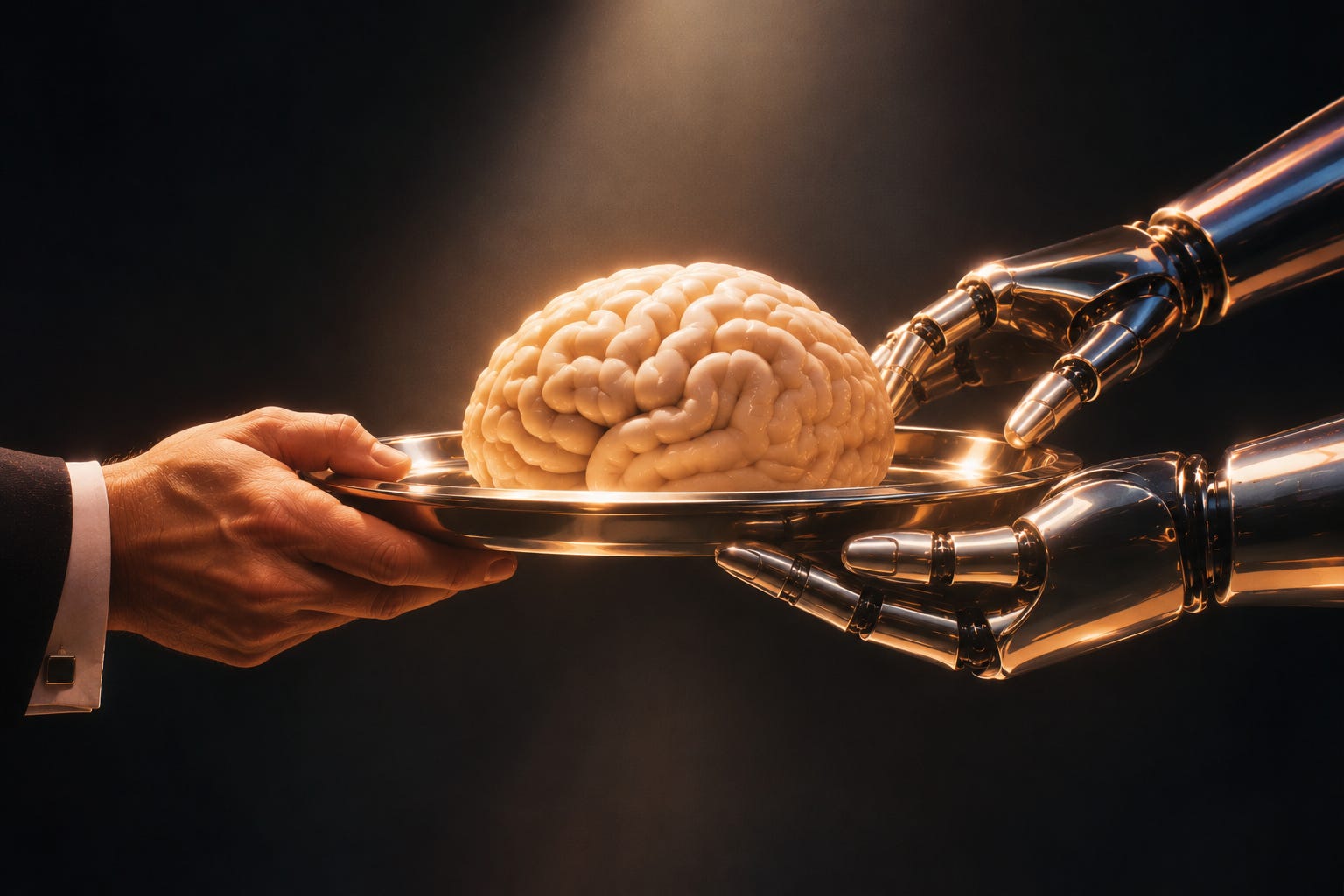
They’re too late. The “handover” has already begun, and we haven’t noticed because surrendering control feels so damn easy. Just like the proverbial frog luxuriating in a hot bath, we’re too calm to notice the threat.
It happened to me just yesterday. Less than two days after Wang posted his dire warning, I needed a refresher on dry-brining a turkey. I pay for the New York Times Cooking app, which I love because it’s full of recipes that real people tested in real kitchens. But I didn’t even think to open it. I just spoke into the ChatGPT microphone, got a perfectly serviceable answer in seconds, and received a lovely herbed butter recipe I hadn’t asked for as a bonus!
It hadn’t occurred to me to do anything else, and I’ve been using ChatGPT for, what, maybe two years? Yes, the AI takeover already happened to me, and it came with a recipe for herbed butter.
Handover is the right word, but Wang’s timing was just wrong. He was describing a future event, and I’d use it to describe my Tuesday.
You see, all of these dire warnings lead us to picture a single moment when it suddenly becomes clear. Because our reference points often come from sci-fi books and movies, we imagine machines getting smart enough that something tips, and humans wake up no longer in charge. I don't think that moment is coming so much as it’s already here.
A handover is something you do willingly, and we're doing it every day in small pieces because each tiny piece makes sense on its own, but we are failing to acknowledge the aggregate puzzle of all those tiny pieces. Maybe that’s what Amodei, Altman, and Wang are seeing and why they’ve become so freaked out.
Like most people, I use AI constantly, and I’m not ashamed of it. It’s the best technology available, and I’d be foolish to ignore it. I use it to research columns, the way I once used Google to dig up old reporting and essays. I use it to copy edit. I use it to track Arsenal’s transfer targets and find easily accessible cooking tips. I even used it to help me develop this column. (The horror!)
I‘d like to tell myself I don’t let it think for me, but if I’m being honest, I’d at least add the word intentionally.
Yes, that bothers me. Everyone I know who uses AI believes they use it responsibly. The frog didn’t realize the pot they were in was going to boil. If my judgment is eroding a little each month, I’m not sure how I’d find out. Nothing would announce it because I’d just be distracted by all the great AI answers.
Researchers, who ostensibly haven’t yet directly ceded their brain power to AI, have a name for this. A 2025 paper called it “gradual disempowerment” and argued that humans could lose their grip on society through small, sensible steps, with no rogue machine required. The authors admitted nobody has a real plan to stop it, maybe because we're increasingly reliant on AI.
Nicholas Carr asked in 2008 whether Google was making us stupid, but I think Google left the important part alone. When I researched a column with a search engine, I got ten links, and most of the important work was still left to me. I had to pick a source, weigh it, and decide what I believed. It was exhausting.
AI skips that step. It hands me the answers, already weighed, well packaged, and annoyingly framed with some sort of sycophantic agreement. AI bots are nothing if not world class kiss asses but I digress.
The weighing of data is, of course, where human judgment comes from. Information is knowing something, and intelligence is the ability to analyze it. Judgment is deciding what matters and what to believe, and nobody is born with it. You build it over years of being wrong and slowly learning which instincts deserve your trust.
AI offers a shortcut around all of that. And as a result, our judgment muscle has been atrophying at an alarming rate.
My AI turkey tip is the most harmless case conceivable. I’ve dry-brined a bird before and in the past would’ve deferred to a recipe writer to refresh me anyway. I think asking AI to poke holes in my argument is fine too. Asking it what my argument should be is a different act that cedes all agency and human thought. Somewhere past that is a person who can no longer form an argument without it. Maybe that’s the threat to humanity I think the AI overlords are getting at.
Those are four rungs on the same ladder, and the lines between them are increasingly blurred.
MIT researchers got right to the heart of this concern by putting EEG headsets on to measure the brains of 54 people writing essays. The ones using ChatGPT showed the lowest brain engagement, and many couldn’t quote essays they’d just finished. The study is small and preliminary, but it also matches what I see around me. We’ve all developed an uncanny knack for recognizing slop. It’s not x — it’s y.
I’ve tried to have AI help me with columns I’ve written, but when I hand a draft and ask what it thinks, its input is useless, verging on terrible. Notes come back fast, and sound smart-ish and reasonable. But taken together, they’d turn a column with a point of view into a boring-assed legal brief based on whatever cloud data it's long ingested and using as a template. In my experience, large language models are useless for original thinking based on my beat, new narrative developments in political media. AI is a terrific copy editor, and I’ve used Grammarly for years, just as I used Microsoft Word’s spell check back in the day.
I can tell the difference between a note that makes a piece more accurate and one that softens it. That skill took me 35 years and more bad columns than I care to admit.
A 23-year-old writer who’s relied on the AI advisor since her freshman year of college doesn’t have the experience to develop the critical distinction. She has no bad columns behind her and limited instincts to check them against. She’ll likely conclude this is what good writing looks like, and every note she accepts will move her a little closer to the middle. A regression to the mean, and she'll have no way of knowing what it cost her.
This concept was backed up by researchers at Microsoft and Carnegie Mellon. People who trust the AI think less critically about its output, according to their survey, while people who trust their own expertise check it harder. Duh.
Most AI criticism focuses on its mistakes, like inventing facts, chasing agreement, flattery, and being unreliable in ways that are hard to predict. Those flaws are real, and I’ve learned to watch for them even when looking for dry-brining turkey tips (do NOT use nutmeg!)
But mistakes are a good thing because a tool that gets things wrong keeps the user on her toes, or at least thinking critically. Because you don’t trust it, you check its work and maybe even argue with it, all of which keeps you in the habit of thinking. The judgment muscle atrophies at a slower rate. After all, you’re simply engaging with a massive computer chip processing a massive ton of known data in ridiculously little time.
But the threat to humanity problems come up when it's consistently accurate. Healthy skepticism is slowly eroded by every correct and helpful answer, making the next question easier to ask. Sharp analysis, even from a machine, makes individual analysis feel less necessary. Why would anyone insist on going the long way when we can all plainly see how the shortcut works just as well and saves us time?
As each model improves, AI doesn’t just get better, but more rational to rely on. Its real threat is not some cyborg Skynet knockoff. It's that independent thinking is becoming inefficient.
Unfortunately, hardly anyone can measure any of this effectively. It’s all so new and massive and strange that economists can’t agree on whether AI will barely move the economy or transform it. Writing in the Financial Times this week, the economist Emily Fry pointed to one reason why. Official surveys count a person who occasionally drafts an email with a chatbot as an AI adopter, which is the same as someone who has fully automated parts of their job. Forecasters can see how widely the technology has spread but have zero clue about just how deep it goes. Until that changes, she wrote, “both camps are just guessing.” No, I’m not going to make a “they should just ask ChatGPT” joke.
The depth of reliance, or overreliance, is really the whole story with AI. A turkey tip and a surrendered argument look identical in the economists’ data.
I’ve spent my career watching and reporting on how people get their information. Depth is what worries me there too. We spent decades fighting about information gatekeepers, about which editors and producers got to decide what counted as news. Those gatekeepers chose the stories and left the conclusions to us. Now more and more people ask one machine what happened, why it happened, and what to think about it. No editor ever knew what a single reader wanted to hear or read, but now a machine does. And it answers in a friendly voice tuned to what each of us wants. This is no longer narrowcasting; it's microcasting. We’re building the most intimate and trusted gatekeeper in history, without any idea how it will impact our brains and society, and yet nobody is forcing us to do this.
I said AI is useless in my columns, and I said I used it to develop this one. Both are true. Two competing chatbots dug up research for me. One warned me the headline claims too much; the other suggested worse. Both offered terrible ideas, which I ignored. Thankfully, I’ve been crafting clicky headlines for decades. I also ran it through Grammarly for typos, so an AI detector somewhere will insist a robot wrote parts of this. Would they be wrong?
I can’t prove the AI takeover has happened to me. I only know that I never opened the cooking app, and that I didn’t notice until I sat down to write this. The brine instructions were clear, and the herbed butter sounds delicious. I’d do it all again tomorrow.