



The argument over what voters will care most about in the coming midterms is already being made every night on cable news. You can see it in the rundowns, lead stories, and panel discussion topics. The topics that anchors, hosts, and showrunners decide are worthy of inclusion, what deserves a basic 30-second read, and what they skip entirely reveal a much better explanation of their underlying perspective than a Media Matters or NewsBusters hit piece.
Over enough nights, these editorial decisions add up to a case for what each network’s viewers will have on their minds when they walk into the voting booth, which is why I spent the day counting the biggest topics across each network over the past three weeks.
Anyone who has read my byline knows that I am a sucker for transcript mention columns. I find them quite revealing in how different networks prioritize different stories and what they largely leave untouched. It’s better evidence of a point of view, and often bias, than the hyperbole of a cable news host looking to get a cheap Mediaite headline.
But it came to mind while I have been watching cable news this week (after taking a delightful vacation break to Cape Cod). The networks are covering much of the broader news stories, but the angles they take- and, more to the point, where they suggest blame- are different. Well, they are remarkably different from show to show and network to network. Duh, right?
Lindsay Clancy’s jury has been out since last Thursday. Fox News has covered this trial of a Massachusetts mother who does not dispute killing her three children was criminally responsible for it like a presidential campaign. Live updates, correspondents on the courthouse steps, medical analysts on the evidence, and prime time working the deliberations every night. It’s unquestionably a big story for the network’s viewers, but if I’m being honest? I could give a lick about it. True crime isn’t my jam. Sue me.
Over the same three weeks, MS NOW said the name Clancy 31 times. Now I’m not saying MS NOW is hiding a murder trial. That would be weird. Network execs presumably looked at it, and surely decided it was a local Massachusetts crime story with a true-crime audience, and moved on. Fox News looked at the same trial and saw a franchise many of their viewers are fascinated by. Both are entirely reasonable judgment calls editors make every day, and I have made plenty of them myself. Whether a story makes it on your television is a decision, and different people in different newsrooms approach it with different goals. This principle also applies to the reason restaurants have menus.
So I noticed the Clancy-palooza and wanted to see how the network’s coverage has developed over the past three weeks. I searched 21 different news subject terms in a cable news transcript database that indexes closed captions across Fox News, CNN, and MS NOW across he same three-week period. (I’ve explained my methodology and its limitations at the end of this column, sticklers.)
Like any reasonable navel gazer, I just assumed I’d find three separate realities, because that’s the conventional wisdom which has the advantage of being obvious. But that wasn’t always the case! Take, for example, the search for the term “jobs” came back with nearly identical mentions across all three networks: Fox News 4,245, CNN 4,051, MS NOW 4,207. Harmonic convergence! Three newsrooms that agree on very little, landing within five percent of each other on the labor market.
But wait, there’s more! A search for “immigration” delivered similar results (631, 696, 762, respectively) as did a search for “ICE” (1,605, 1,669, 1,293). A search for the commodity “Oil” ran similar numbers (1,043, 817, 911), and “Hormuz” produced similar total mentions as well (946, 841, 812). Five of my twenty-one terms came within a quarter of each other across all three networks, and on ten of them no network fell below a fifth of the combined total. We are the UNITED States of America, not the DIVIDED States, amirite?
If there really are three distinct cable news realities, then the mention of “jobs” should not be flat across all three. Neither would mentions of “immigration,” of all subjects, since that’s the topic everyone assumes divides us. Yet, the three networks said the word at nearly the same rate. Maybe we really aren’t so divided after all? Not so fast.
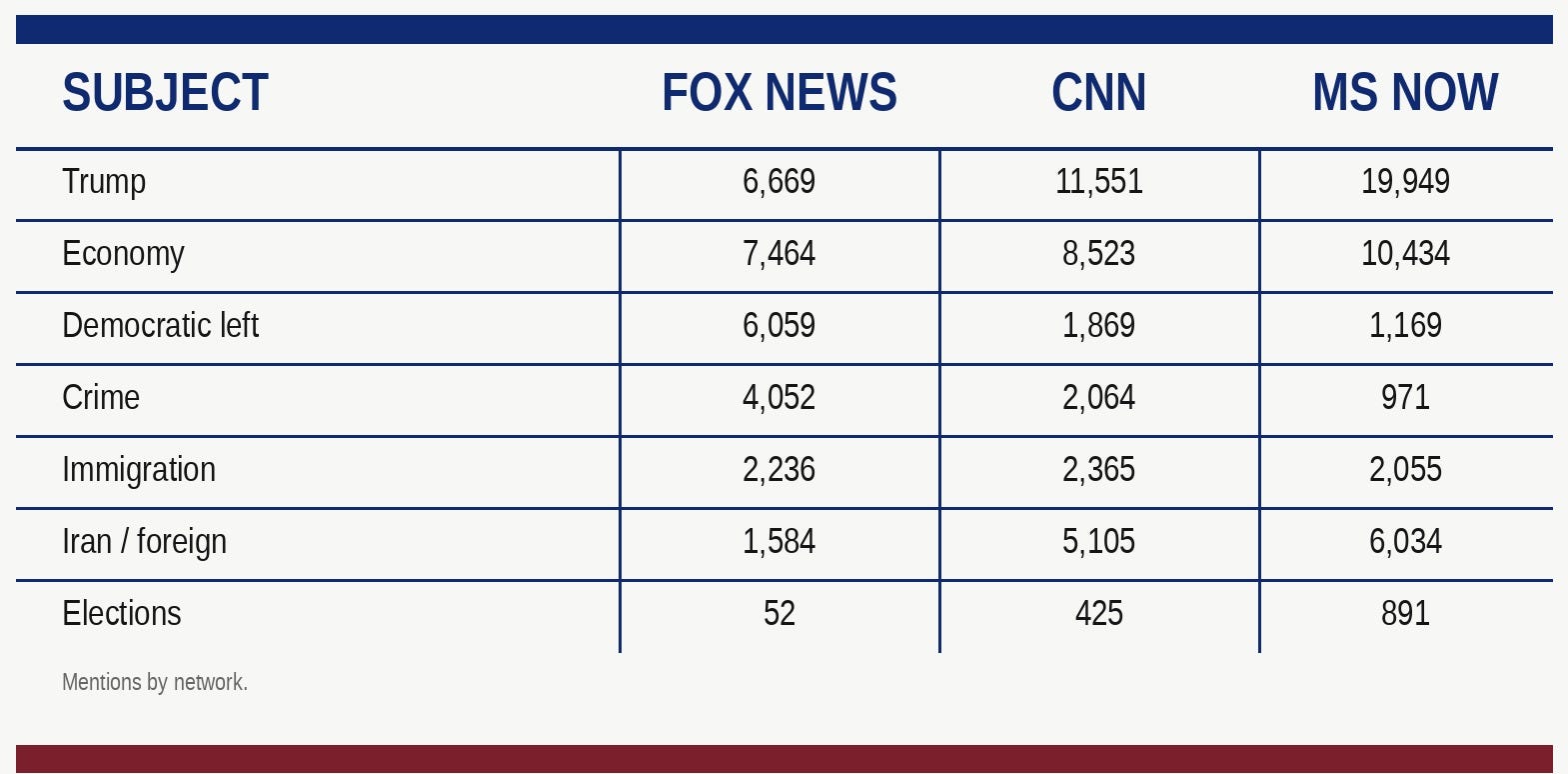
Then there’s the list of topic mentions that behave the way everyone expects. The search for “tariffs” showed a big disparity, with the following mentions by network: Fox News 350, CNN 1,180, MS NOW 1,526. Similar results with “gas price,” with Fox News at 390, CNN at 711, and MS NOW at 1,098. “Socialist” shows a predictably massive difference, with Fox News going ALL IN with 2,442 mentions, CNN at 786, and MS NOW at 523. Similarly, “DSA” had the same pattern, with 1,829, 409, and 344 mentions, respectively. Conversely, “Mail ballot” got only 52 mentions on Fox News, but 425 on CNN, while MS NOW doubled it with 891 mentions.
But the pair of related search terms that really stood out to me centered around the Iran war itself. Again, while “Hormuz” produced even coverage at 946 / 841 / 812, searching for mentions of “Iran” (389 / 4,032 / 5,076) revealed a bigger story. It’s the same war, the same three weeks, and the same tankers. But one word names the place where the story is happening, and the other names who is doing it, and three networks covering one conflict were notably on which of those two words to say.
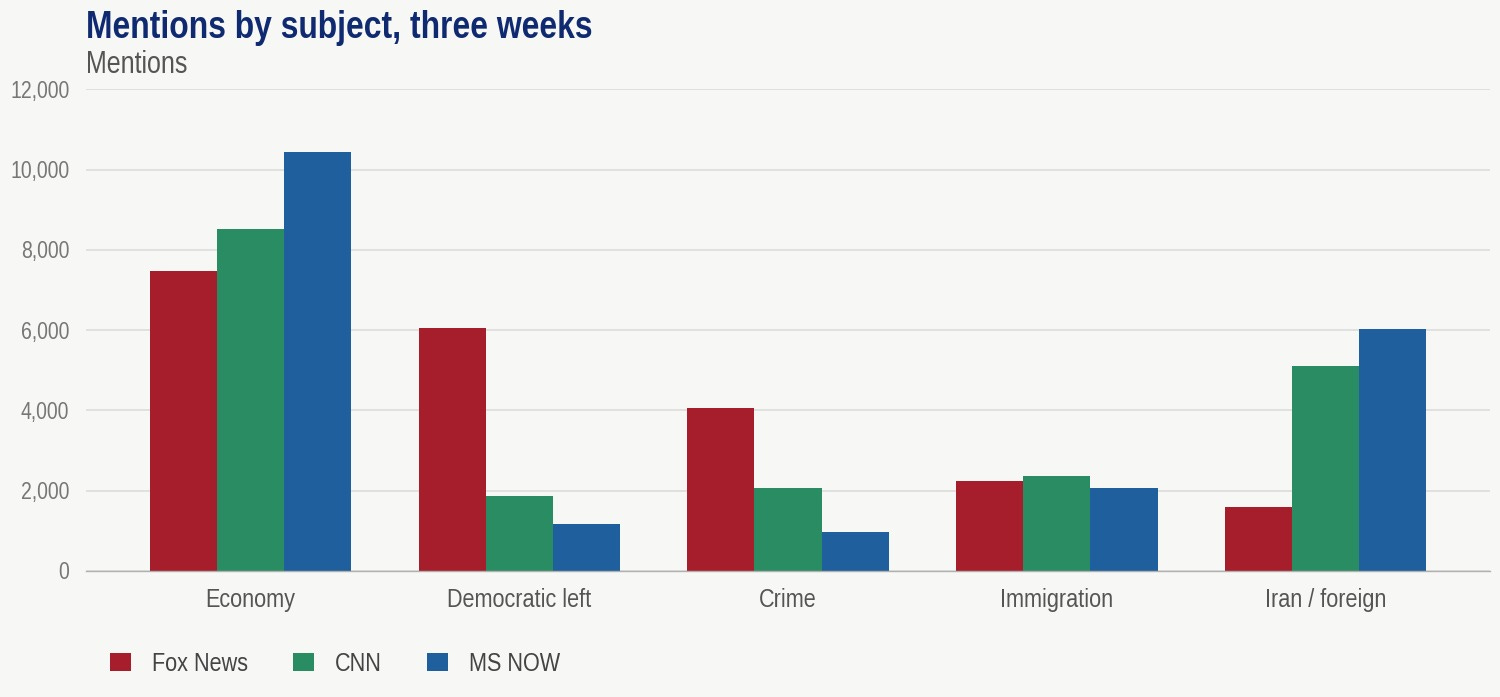
This same unevenness runs through the search results of economy-related terms. Fox News mentioned the word “oil” 1,043 times and “gas price” 390 times. CNN ran roughly even on these terms, with 817 and 711 mentions, as did MS NOW, with 911 and 1,098. Why the difference? Covering the price of a barrel of oil is more about a disrupted global supply chain, while reporting on the price of a gallon of gas invites questions about who’s in charge and responsible for inflation. It’s the same basic story reported in two distinct registers, and each network has picked one.
It’s probably best understood by these handy (and dandy!) charts. First mentions grouped by subject:
The same data expressed as a bar chart illustrates the differences more clearly:
When I began researching this, I expected to write a column about one network’s coverage, but the data told a different story. I applied one rule to all three networks, flagging a network as “quiet” on a term when it accounted for less than 20 percent of the three networks’ combined mentions, where an even split would be 33 percent, and Fox News was flagged five times, MS NOW four, and CNN twice.
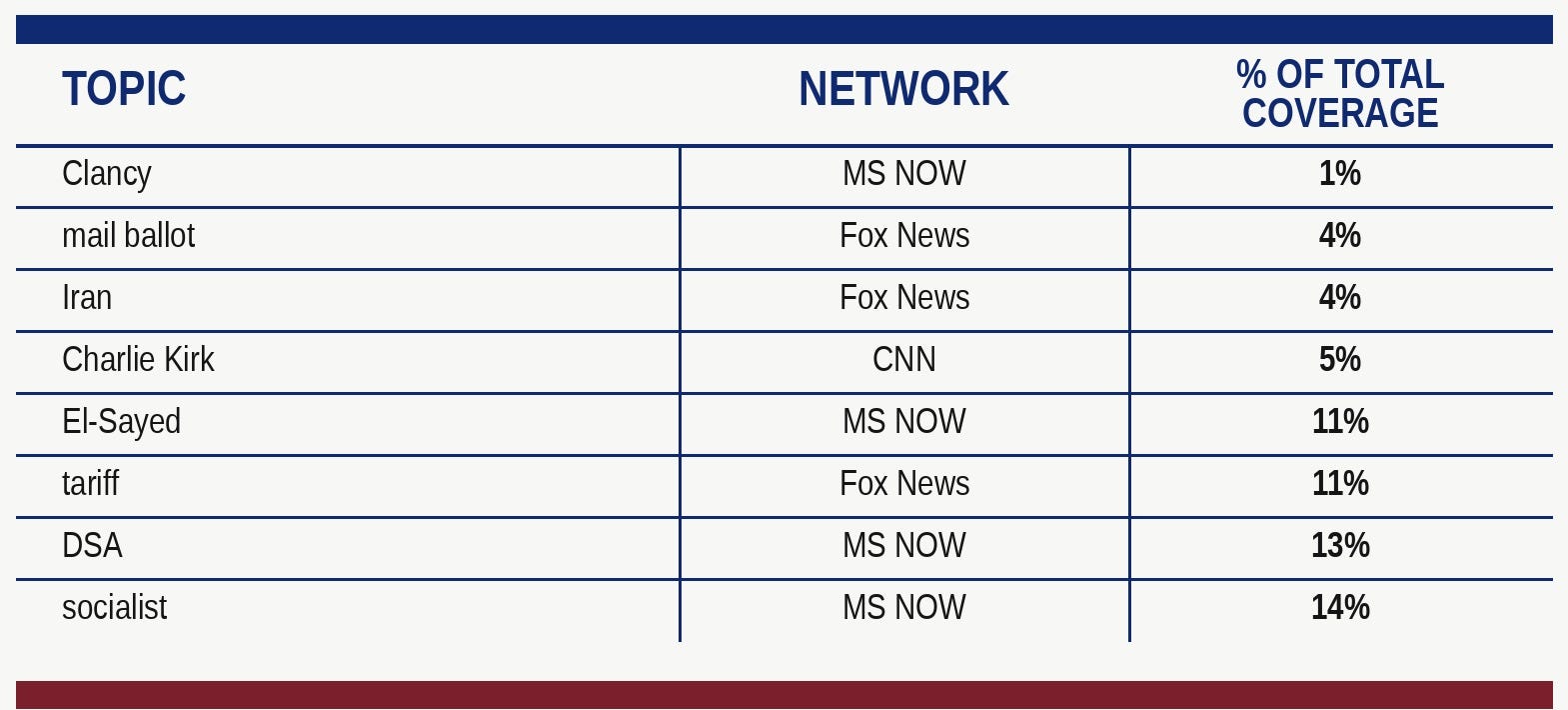
MS NOW’s 344 mentions of DSA and 302 on Abdul El-Sayed show the same instinct as Fox News’s 350 mentions of tariffs. It’s the same with CNN mentioning Charlie Kirk only 34 times in three weeks, while Fox News said it 401 times and MS NOW 187. Every newsroom has a topic it gives less airtime to than its competitors do. That’s just the business. (Please refer to the previously made restaurant-menu metaphor).
Yes, there are serious, lingering concerns about partisan media dividing the country and leaving us unable to agree on facts or even a shared reality. But these numbers point to something stranger. The three networks appear to have more in common in their news coverage than the three-realities cliché suggests. Jobs are jobs, the strait is disrupted, people are crossing the border, and all three channels say so at about the same rate. They diverge in which version of the story they tell, and who ends up getting the blame.
That makes the next nine weeks a useful experiment, because cable is already showing you the competing frames each side is likely to promote into the fall: the barrel and the gallon, the strait and the country. Whether the networks feed the campaigns or the campaigns feed the networks is beyond what this data can tell you, and the answer is probably both. Symbiosis! What October will tell you is which narratives grew out of the news coverage, became the campaign, and decided the results.
Methodology: I searched SnapStream transcripts, which indexes cable news closed captions, for the same search terms on Fox News, CNN, and MS NOW over the same three weeks.