


At some point, repeated, unfulfilled promises stop being predictions and start decaying into a not-so-appealing ritual.
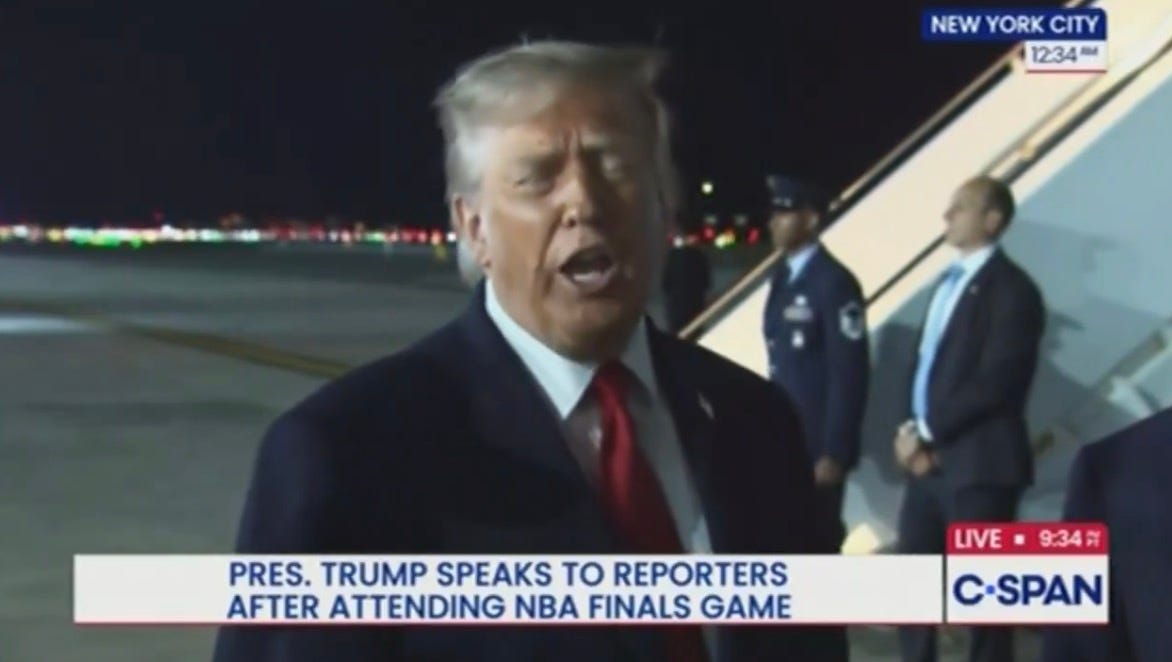
Donald Trump has promised an Iran deal is days away 37 times in 78 days. On Monday night, standing on the JFK tarmac after the Knicks game, he said it again — and then said there are no sticking points, and that the whole thing could be wrapped up in an hour.
By Tuesday morning, something had shifted. Not on CNN, where skepticism about Trump’s Iran timeline is a standing feature. On Fox.
Bloomberg’s Annmarie Hordern caught Trump on the tarmac and asked him to clarify his timeline
Trump: “Two or three days.”
Hordern: “You’ll be signing a peace agreement in two or three days?”
Trump: “No, no — we have a good chance of doing it. We should be able to do it in one hour, if you want to know the truth.”
Hordern: “What’s the biggest sticking point right now?”
Trump: “I don’t think there are any sticking points.”
A reporter asked the president about obstacles to a deal he has been promising for 78 days. He said there aren’t any. He said they could wrap it up in an hour. Then he got on a plane.
CNN put a number on screen Tuesday morning: 37. That’s how many times Trump has made some version of this promise over the past 78 days. The graphic isn’t a fact-check. It isn’t saying Trump is lying or adjudicating the state of the negotiations. It’s doing something more precise: documenting that the promise has been made so many times that evaluating any individual instance no longer tells you very much.
It is a neat encapsulation of where we’ve landed with this president. We stopped asking whether this particular promise is true. We started counting how many times the promise has been made.
That’s a different kind of information. And what happened on Fox & Friends Tuesday morning suggests it’s starting to reach audiences the counter wasn’t built for.
At 6:12am, Brian Kilmeade played a clip of an Iranian parliament member whose words went beyond a simple denial. “We do not see a serious will to reach a framework that could actually be implemented. As for uranium-enriched materials, enrichment itself and nuclear issues, we are not currently negotiating on those matters.” That’s not just Iran denying the negotiations. It’s Iran saying they don’t see serious intent on the American side either. Two parties each describing the other’s lack of seriousness as the obstacle is not usually how a deal in its final stages looks.
Kilmeade asked: “Are they not talking to the foreign minister? Or are they different? Are they playing a game here?”
Fox’s foreign correspondent Trey Yingst was on the same segment, reporting from Tel Aviv. His answer didn’t reassure. “That question is, who is in charge? Who can actually make the final decision to an agreement with the United States? Is this the foreign minister? Is it Iran’s president? Ultimately, we know that sign off will have to come from the new supreme leader of Iran. Things are still very unclear in the region. And it’s really not clear if the Iranians are willing to make a good faith deal at this point.”
It’s a smart question. It gets at the real challenge facing American diplomats: negotiating with a regime that has been ravaged by roughly three months of bombing, with much of its leadership killed and its chain of command fractured. But it also hung a lantern on the central problem with Trump’s deal promises. If nobody can identify who on the Iranian side has the authority to close, the promise of an imminent agreement starts to look less like a prediction and more like a wish.
Fox & Friends moved on to JD Vance finding God. The question didn’t come back.
An hour later, in the 7am hour, Kilmeade returned to the same territory with a retired admiral. The admiral confirmed the Iranian split was standard procedure: milk it, give nothing, survive the administration. Then he said Trump needs to set a hard deadline and be prepared to act when it expires. The war has now run 100 days. The implicit question hanging over the conversation was what happens if the deal is still days away on day 101.
Kilmeade put it plainly: “I don’t know what to make of this. Does this guy have a vote, too? Are they working together or apart?”
Two segments, same morning, same network, same unresolved question.
What makes those exchanges worth examining isn’t the answers. The admiral’s read on Iranian negotiating tactics is conventional wisdom. What makes them worth examining is who was asking and where. Brian Kilmeade is not a skeptic of this administration. Fox & Friends is not where you go to find friction with Trump’s foreign policy. When a contradiction becomes difficult to explain even on friendly terrain, that’s usually worth paying attention to.
Axios founder Jim VandeHei put the administration’s position as plainly as anyone has, on Morning Joe: “What the White House is looking for is what is the least messy, most publicly defensible explanation for getting out of this mess.” That one sentence recontextualizes what “days away” has been doing. Not a prediction. A posture. One that Kilmeade found himself unable to sustain across two segments, and that Yingst confirmed in the first.
Kilmeade wasn’t trying to undermine the administration. He was trying to explain a contradiction to his audience and couldn’t. That’s the tell. Not a skeptic pushing back but a validator running out of explanation. Narratives rarely weaken because opponents attack them. They weaken when supporters start asking questions.
Trump may still get a deal. He could announce one tomorrow, and the 37 would become a footnote about a president who kept his word even when nobody believed him. The number doesn’t foreclose that.
But it changes what the promise costs to make. The counter didn’t have to be in Fox’s broadcast to be in the room. Kilmeade put it there himself.
That’s what 37 looks like when it reaches a friendly audience: not rejection, not revolt, just a simple question that didn’t need asking six weeks ago.