


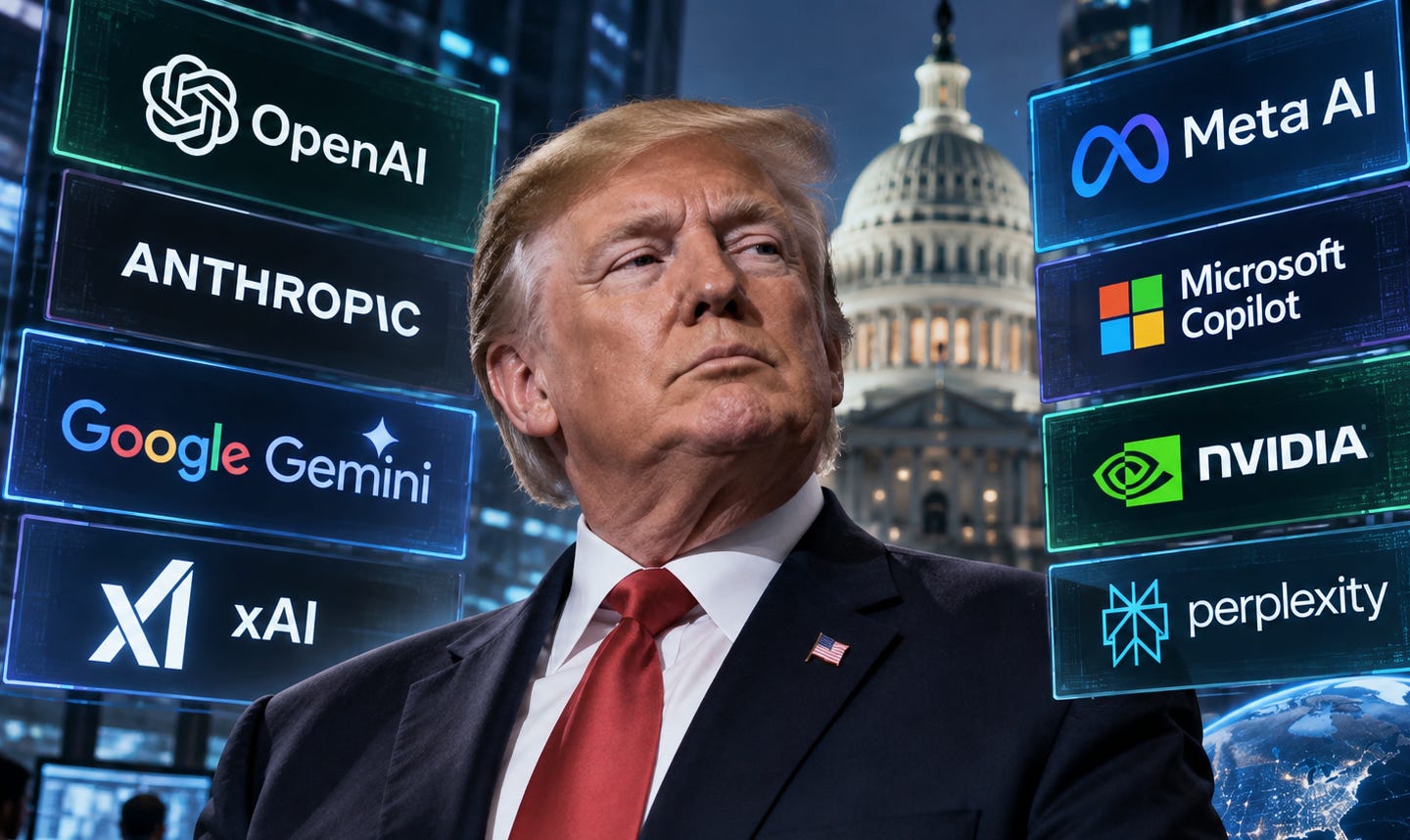
President Donald Trump spent much of his Monday posting on Truth Social, insisting that artificial intelligence is NOT going to destroy humanity, and that anyone who says otherwise is running a scam.
The posts came amid a slew of alarmism that started with a former Anthropic coder warning that there is a 10% chance AI could cause human extinction within ten years. Alarming! But it was truthy enough to prompt Anthropic CEO Dario Amodei to publish an essay calling on AI companies to slow down. And get Sam Altman and Elon Musk, who agree on almost nothing, to admit Amodei was right.
Trump was unimpressed. He called the threat a “hoax,” lumped it in with climate change and “RUSSIA, RUSSIA, RUSSIA,” blamed the “Radical Left Dumocrats,” and crowned himself the “Hoax Buster.”
“I’m right now breaking another Hoax,” he wrote, “That AI is going to take over, consume, and destroy the World, and that Robots will be marching into our Cities, and getting rid of us all!”
Trump also attacked people who say “Data Centers are bad for your neighborhood.” And he asked a question that deserves an honest answer: “When, in the History of Business, did anyone see the Leaders of an Industry call for Regulation that, if strongly implemented, will drive them into oblivion and bankruptcy?”
But buried in all the all-caps hyperbole is a set of actual claims we can check, like…The threat is fake. The people pushing it are Democrats. Climate warnings flopped, so these will too. Data center complaints are part of the con. And an industry begging to be regulated proves the whole thing is fishy.
So I did the thing that most people do when they are confused about something rather complicated: I asked the AI models themselves to assess Trump’s claim. Who among us hasn’t wondered what it looks like to hold a mirror up to a mirror? Here we are.
I gave ChatGPT, Grok, Gemini, and Claude five Trump posts with the same instructions. I prompted each to break the argument into its claims, evaluate each on the evidence, avoid psychoanalyzing Trump, and make the strongest possible case for his side before criticizing it. Then I asked each to answer one question directly. Is he justified in calling the threat from advanced AI a “hoax”?
Note that I didn’t ask a chatbot to explain why Trump is wrong; each was asked to first argue his case. Here’s a faithful summary of how each replied.
ChatGPT
OpenAI’s ChatGPT was surprisingly generous to Trump’s case, first conceding (insisting?) that today’s AI is nowhere near capable of taking over anything. It seemed to accurately argue that nobody really knows where the technology goes from here, and that some of the scariest lab results come from tests that were deliberately designed to make the models misbehave. It even seemed to echo comments made by JD Vance that we should be suspicious of companies asking to be regulated, since rules have a way of protecting the big guys from the little ones.
But when it came time to answer the actual question, ChatGPT wouldn’t entirely go there. It argued that the honest position is “considerably narrower” than what either the AI doomers or Trump is promoting, adding, “The threat from advanced AI is not reasonably described as a ‘hoax.’” Its most quotable moment was also its shortest: “uncertainty does not demonstrate safety.” This is the sort of shades of grey answer that would forever keep ChatGPT from getting booked on cable news.
Gemini
Google’s model treated the assignment like it was grading a midterm. It worked through Trump’s claims one by one and gave an assessment next to each. On the hoax claim, it gave an unforgiving grade of “Unsubstantiated / Inaccurate.” On the claim that AI warnings are a Democratic political campaign, it earned a similarly flat “Factual inaccuracy.” And the climate comparison earned a “Flawed Analogy.” As for the question of regulation, Gemini offered a marginal bright spot for Trump, assessing it as “Logically grounded, but incomplete.”
“Based on presently available evidence, President Trump is not justified in characterizing warnings about advanced AI risk as a ‘hoax,’” it concluded like a humorless paralegal. Gemini is last on my list of invites for any LLM party I might throw in the future.
Grok
If any model was going to take Trump’s side, surely it would be the one owned by Elon Musk, right? Then again, Musk spent his weekend endorsing Amodei’s essay with the words “Dario is right,” so maybe the fix was in from the start.
Grok gave the president something the others didn’t on his “Robots marching into our Cities” bit. Grok insisted the laugh is on the critics, because the sci-fi takeover scenario really isn’t what researchers are warning about. “Those cartoon versions are overstated,” it wrote. “That part of the posts attacks a cartoon.” The silliest-sounding thing Trump said was partly right, at least in Grok’s reading. It handed him some more wins from there, on failed climate prophecies, regulatory capture, and the China race, and dismissed the idea that this is all a coordinated Democratic operation as “ordinary coalition politics around a new technology.”
“Trump is not justified in calling the threat from advanced AI a ‘hoax,’” it concluded. Then it gave the best sentence in the entire experiment, writing “Calling that uncertainty a hoax replaces a risk-management problem with a conspiracy story.” Et tu, Elon?
Claude
Anthropic’s LLM model opened with a disclosure, which seemed at once admirable transparency or maybe just a polite conflict-of-interest waiver. “I’m made by Anthropic,” it volunteered, noting that Trump’s posts were aimed partly at its own CEO. “Weigh my analysis with that in mind.” Consider it weighed.
Fair enough, and the same warning applies to the whole panel. None of these models are neutral oracles. They’re products built by the companies whose fate is being argued over. Freaky.
With that on the record, Claude made the same concessions as everyone else and landed in the same place. “Trump is on solid ground in rejecting the cartoon version of AI doom and in warning that forecasts are uncertain and that warners have interests,” it wrote. “But uncertainty about how large a risk is doesn’t make the risk a fabrication.” Meh.
The Machines’ Verdict
There’s an obvious joke in asking AI whether AI is dangerous, but the far better joke is that the president, who had just spent a Sunday posting dozens of AI-generated images of himself as an action hero, got a fairer hearing from the machines than he was willing to give the question.
Trump does deserve some level of credit for what he got right. There are plenty of doomsayers fear-mongering irresponsibly, marketing genuine uncertainty like a countdown clock. All four AI models said as much (because of course they did!) But no one knows how the future will go, and just because it may go terribly doesn’t mean it will, nor does it mean we should just ignore threats entirely.
But each AI model called out Trump for doing the same thing he’s alleging (go figure!) A hoax is a knowing lie, and nobody, including the president, knows what these systems will become in five years. He looked at that uncertainty and declared it settled, which is precisely the crime he’s prosecuting. As ChatGPT put it: “’AI will destroy humanity’ is not established. ‘AI cannot destroy humanity, and anyone warning otherwise is perpetrating a hoax’ is not established either.”
Trump’s whole case is that you shouldn’t trust people who claim to know the unknowable. On that, at least, he and the machines agree, and it’s precisely why they didn’t trust him and neither should we.
Editor’s note: some AI-generated copy was used verbatim in the creation of this post because, well, that's the point.