


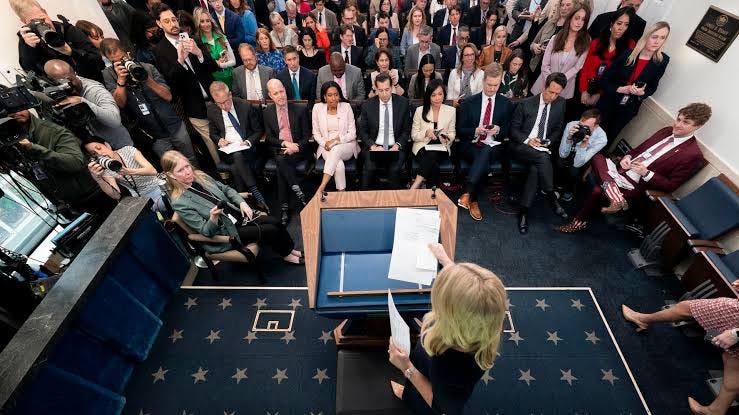
The Independent’s Andrew Feinberg received an email from the White House press office Wednesday informing him that he’d no longer be riding along on Air Force One to Iowa as the print member of the Press Pool. It had no signature and offered no reason, though the reason was obvious. A day earlier, he had asked President Donald Trump a question in the Oval Office, and the president had asked him back, “What’s wrong with you? Are you a sick person?”
That same week, the White House counsel gave Politico 48 hours to retract three stories about White House Chief of Staff Susie Wiles, apologize to the president, and delete the stories from its archives. The New York Times reported that Trump keeps asking aides to clear the reporters out of the Brady briefing room and put FDR’s swimming pool back where it used to be. And when a CNN reporter asked whether he’d traded sanctions relief to Russia for an American prisoner, the president of the United States told her, “You’re a dummy, and you work for CNN.”
Of course, the press corps responded the way the press corps always responds. Jacqui Heinrich, Fox News’s senior White House correspondent and the president of the White House Correspondents’ Association, called the Feinberg move retaliation. Politico didn’t just lawyer up; they also edited a headline and added an editorial note. Nabobs nattered about this being an “unprecedented” attack on the press, insisting this is a serious threat to the First Amendment, and they’re absolutely right.
Underlying this attack, however, is that only one-third of the country trusts the people making the complaint. And that’s precisely the issue that the Trump administration is trying to exploit.
That one-third number is from a Gallup poll just last month. Thirty-three percent of Americans have a great deal or a fair amount of confidence in newspapers, television and radio to report the news fully, accurately and fairly. When Gallup first asked the question, in the Watergate years, the answer was 72 percent. Last year it hit 28, the lowest ever recorded. This year’s figure is a rebound, and nearly all of it came from Republicans, who went from 8 percent to 22 percent. Democrats are the only group in which even half the people trust the press. Only 31 percent of independents think favorably of the press.
The Trump White House is attacking an institution whose constitutional protections are intact (for now) and whose public standing is…less so. The administration doesn’t need to convince anyone that reporters don’t deserve punishment. Or at least, that’s how they are acting. Trump sees punishing the press as coming with zero political cost.
The press hasn’t run the same numbers, and why should they? It's not a political polling issue; it's one of principle. It's about Constitutional rights, but not everyone sees it that way. And that’s the rub.
I say this as someone who has spent much of my career inside the thing I’m describing. I was the founding editor of a website whose business became cable news clips. I write a newsletter about news narratives in political media. When the press covers an attack on the press, I am both the audience and the product, and I know what the story feels like from the inside. It feels like the biggest story in the world.
This is a dispute between a president nobody much likes and a profession fewer people trust. A fight between the deeply unpopular (with roughly identical approval ratings) and one most people find hard to root for, alas. (Save, of course, the whole constitutional rights thing.)
The press has lost the national argument for over fifty years, and it didn’t start with Trump. Spiro Agnew didn’t just coin the alliterative “nattering nabobs of negativism”; he also called network anchors a “tiny, enclosed fraternity of privileged men” in 1969. Rush Limbaugh created a wildly lucrative and influential national radio show built on the premise that the mainstream media was lying to its audience. In 1996, Fox News launched with the “fair and balanced” slogan that worked for viewers convinced the rest of the media was neither fair nor balanced.
By the time Trump started calling reporters the enemy of the people, the ground had been prepared for well over three decades. He didn’t invent distrust of the press; he exploited it to the degree that he now believes it’s something he can control. For the record, this IS a dangerous precedent.
After the White House pulled Jim Acosta’s hard pass in 2018, a Trump-appointed judge restored it, and the whole thing ostensibly evaporated. The second-term administration is now going to court, and staying there. CNN, MS NOW, and Politico were barred from the grounds and had to get a judge to let them back in. The Pentagon cleared out its press corps earlier this year. Reporters are getting dropped from pools so frequently now that it's almost stopped being newsworthy. None of this is just bluster; it's draconian, and yes, authoritarian. But coverage of that story gets proverbial crickets from viewers outside the navel-gazing set.
The press corps correctly sees this retaliation as unprecedented. The people who create cable news rundowns see other stories as bigger priorities.
Feinberg’s name was mentioned only once on CNN, Fox News, and MS NOW over the past 24 hours, and it came during a Morning Joe segment focused on Trump’s attacking the press. Instead, the networks whose reporters are being thrown out of the Press Corps are leading with the Ohio governor’s race, implying that even they’re prioritizing what viewers want to see instead of the constitutional crisis they’re enduring.
The Gallup poll asked whether people believed the press, not if they should be punished. They should ask whether a president should be able to decide who gets to ask him questions.
I bet those results would be far more favorable to the media.
What's different and new this admin is the deflection of uncomfortable questions with ad hominum attacks. Troublesome women are stupid or ugly, and men are sick, non maga media is fake, and the question is never addressed. The attack becomes the story rather than the deflection.