


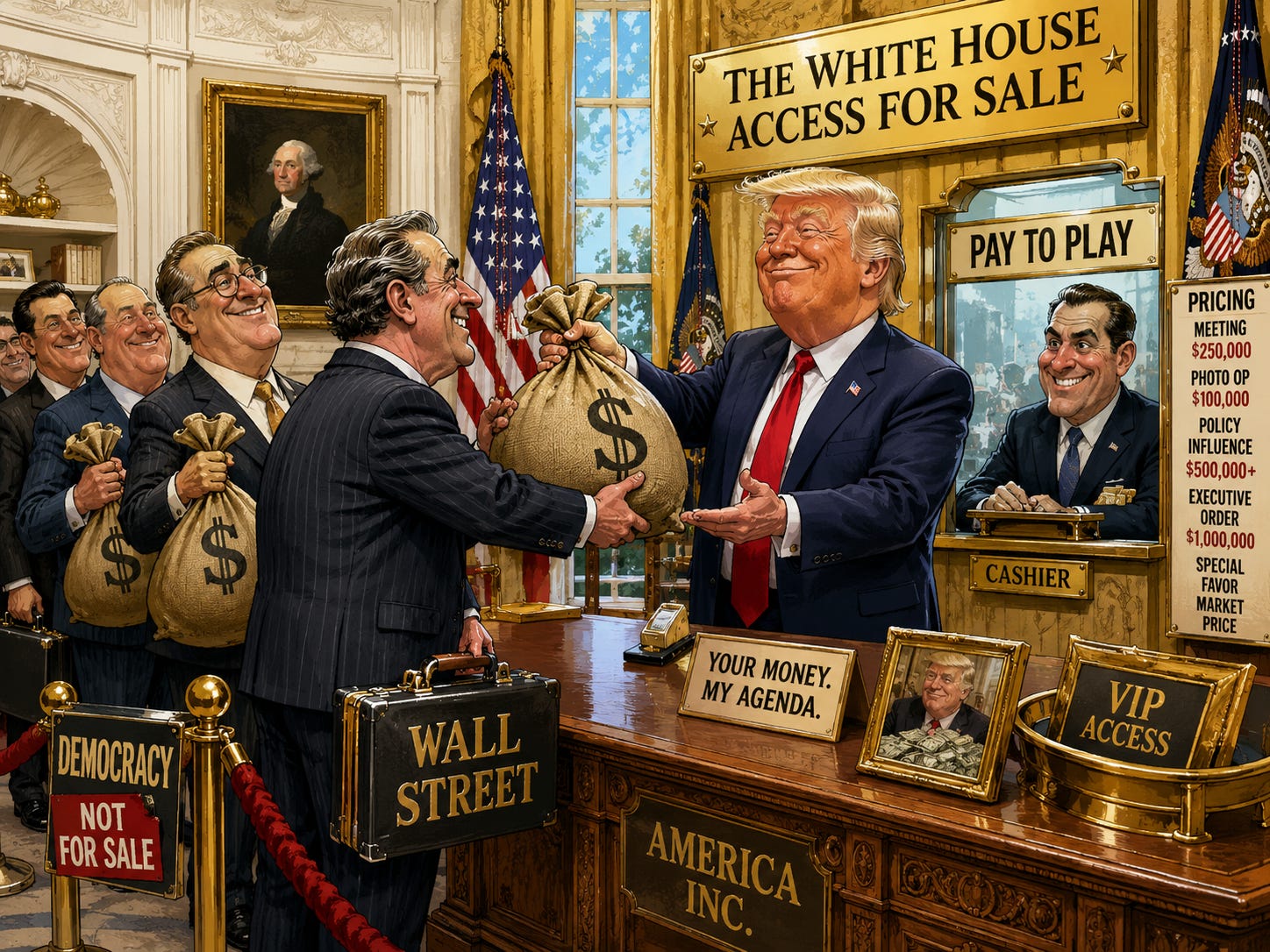
The President of the United States is now selling a trading-speed advantage on his own announcements, and you don’t have to take my word for it, because that’s the sales pitch.
Trump Media launched a product called Truth API on Saturday, which charges Wall Street firms as much as $100,000 a month for what the company describes as “a direct, licensed, real-time feed of the platform’s most market-moving Truths.” Leaving aside the bizarre use of “truths” as social media messages, there is precisely one account on the Trump-owned Truth Social platform that actually and consistently moves markets. It has 13 million followers, announces American policy before the government does, and belongs to the platform’s most famous user, whose family just so happens to be the company’s largest shareholder.
Think about what’s actually being sold here. Last week, for example, Trump called off planned strikes on Iran, announced it on Truth Social, and the Dow jumped 600 points while the price of oil slid. That brief gap between Trump’s post going live and the market fully reacting is where fortunes are made. Truth API turns that informational head start into a commercial product for firms willing to pay $100,000 a month.
The president creates market-moving news as a function of his office, his family’s company sells the fastest pipe to it, and the interim CEO isn’t even pretending otherwise: “Markets already move on Truth Social posts,” Kevin McGurn said in the launch announcement, calling it a strategy to “monetize proprietary assets” into high-margin recurring revenue. The proprietary asset is the presidency.
If you were intentionally trying to design an executive branch corruption story in a lab, you’d struggle to come up with a cleaner concept. It’s simple enough to explain in one sentence, documented in the company’s own press materials, and it monetizes the one thing a president is never supposed to sell: a head start on the exercise of presidential power!
Senators Adam Schiff and Elizabeth Warren called it “an outrageous abuse of the President’s office for his personal benefit” in a letter to the SEC, demanding an investigation. Shockingly? The Trump-appointed leadership at the SEC declined to comment. The stock went up, and every single person reading this knows that nothing whatsoever is going to happen.
The certainty that Trump scandals will produce neither serious investigation nor meaningful consequence is every bit as interesting—and far more revealing about our current state of affairs. The New York Times’ Maggie Haberman explained it better than anyone during a recent sit-down with Ezra Klein, without ever needing to explain a hackneyed theory of Trump’s soul or psyche.
The bestselling co-author of Regime Change told her NY Times colleague about something a Democratic strategist said to her just after the 2016 election: that the country was about to find out “how much of our system is norms and not laws.” Nine years later, that’s the answer that explains the entire ball of wax. Because when you consider a scandal’s entire lifecycle, it’s never just a story, report or exposé. It’s effectively a relay race of individuals, each choosing to do their job.
To wit: after a news outlet breaks a story, an inspector general opens an investigation. A committee chairman signs a subpoena. A prosecutor brings a case. Witnesses testify under oath and generate additional news no reporter could reach alone. At the end of that process sit senators from the president’s own party, deciding whether the scandal transcends partisan loyalties.
Watergate was this system working, largely due to politicians like the now seemingly anachronistic Tennessee senator Howard Baker. The whole process, which led to Nixon’s resignation, featured a large group of people; every one of them acted for a reason that had nothing to do with virtue: the watchdog was protected by law, the chairman got the spotlight, the prosecutor got the case of a lifetime, and the senators feared their own voters back home.
That last and crucial link is the one Trump captured, and everything else sort of fell apart from there. Even if his polls are flagging, he still very much owns the Republican primary voter in a way no president has ever owned his party’s base. Again, not led, but owned and monetized to great effect. Rep. Thomas Massie crossed him and lost his primary to a Trump-backed challenger. Marjorie Taylor Greene saw the same end coming and quit before it arrived. So run the math the way a House chairman runs it: sign a subpoena aimed at this White House and your career ends! But stay loyal, and the president throws you candy bars from what his staff calls the chum closet, as Haberman explained. Nixon’s presidency was over when Barry Goldwater walked into the Oval Office and told him the votes were gone. Nobody makes that walk now, because no one wants to be the messenger whose political career gets killed as a result.
But wait, there’s more! Once congressional oversight is off the board, the rest is cleanup, and Trump and his aides have been remarkably methodical about neutralizing every remaining source of accountability.
In the first weeks of his second term, Trump fired seventeen inspectors general, intentionally omitting the notice the law requires. When a judge ruled the firings unlawful and reinstated nobody, every watchdog left in government learned the statute protecting them was a norm wearing a law’s clothes. Of course it’s worth remembering that the acting attorney general running the Justice Department is his former criminal defense lawyer, Todd Blanche. And as Haberman and Jonathan Swan report in their new book, Trump has told people he’ll pardon anyone who came within a certain radius of the Oval Office, which sounds like generosity until you remember that prosecutors flip witnesses by threatening them with prison. A man who’s been promised a pardon is a man with no reason to talk.
Whether Trump consciously figured out what no president before him had, or simply arrived there through his complete contempt for the ethics of public service, the result is the same: the press was never the most dangerous part of a scandal. “We don’t have subpoena powers,” Haberman told Klein, in a plaintive but righteous reminder that she is still doing her fucking job. “We can only write up to what we know.” The real danger was the relay behind the reporting, with Republican self-preservation as its final backstop. Reverse that incentive, and nobody is left with both the power and the will to defend the rest.
Without institutions willing to act, even the best scandal reporting gets flattened into another round of outrage, distraction and monetizable clicks while a complicit Congress refuses to use the powers it still has.
Reporters are still doing their job, few better than Haberman and Swan. Their job is to expose the scandal. Congress, prosecutors and watchdogs are supposed to investigate it, compel evidence and impose consequences. That is the part of the system that has failed.