


Folarin Balogun will play against Belgium in Seattle on Monday. Donald Trump wants you to know FIFA made that possible. Those two facts, sitting side by side, may have just ruined the 2026 World Cup.
Balogun’s straight red card in the win over Bosnia and Herzegovina carried an automatic one-match ban, with no mechanism for U.S. Soccer to appeal. Then the President of the United States got involved. The New York Times reported that Trump personally called FIFA president Gianni Infantino after the match and urged him to review the suspension that would keep America’s top striker out of Monday’s match against Belgium. The Wall Street Journal added the damning sequel: Infantino promised Trump he would look into it, then later called him back to say the ban would be reversed and Balogun would be free to face Belgium.
Hours later, Trump celebrated the decision on Truth Social: “Thank you to FIFA for doing what was right, and reversing a great injustice.” FIFA may insist its disciplinary committee acted independently, but it made that nearly impossible to believe. The host nation’s government had inserted itself into the chain of command between a referee and a disciplinary committee, and the President had taken the public victory lap. It is worth noticing what FIFA disputed: the influence, never the call.
Clay Travis later reported that the White House effort went even further. Citing sources, he said Trump, Commerce Secretary Howard Lutnick and World Cup Task Force head Andrew Giuliani assembled outside lawyers to argue that VAR’s use of slow-motion replay violated FIFA’s own standards. That account remains the most explosive version of the story. But the scandal no longer depends on it. The confirmed sequence is already enough: the host president called FIFA, FIFA’s president promised to look into it, FIFA reversed course, and the President took a victory lap.
Let’s be clear about the call itself: Balogun should never have been suspended. The referee only produced the red card after VAR recommended an on-field review, turning what looked like a routine fifty-fifty challenge into a sending-off and an automatic one-match suspension. It was a bad decision, the kind that only exists because slow motion instant replay turns ordinary football into forensic evidence that confirms what you are looking to find,
There was precedent for the fix. Before the tournament began, FIFA used the same Article 27 probation mechanism on Cristiano Ronaldo, converting the Portugal captain’s three-match ban into one game served and two suspended under a one-year probation. The precedent only stretches so far, though. Ronaldo sat out a match. Balogun sits out nothing, and the ruling landed roughly 24 hours before kickoff.
So the outcome was just. Hold onto that, because the outcome is the only part of this story that came out clean.
Balogun had every right to be furious with the red card but handled it with grace and wisdom. He stood in front of reporters and cameras on Friday and took the high road. Insisting the contact was unintentional, that a yellow card would have been fair, and that the decision belonged to the referee even though he disagreed with the call. It happened, the team moves forward, and “I have to accept it.” Those are the words of a professional who understands the game is bigger than any single call, and that your standing to complain about officiating rests on your willingness to live with it. The striker showed more respect for FIFA’s process than the President who intervened.
FIFA has spent years insisting that its tournaments are not decided in back rooms by cigar-smoking faceless men. Nobody believes it because FIFA has spent just as long giving them reasons not to. The people with power find a way around the rules. That is what makes Trump’s phone call matter.
Which is exactly why FIFA’s statutes are obsessive about political independence. Member federations are required to run their affairs entirely outside government influence, and FIFA enforces it with a heavy hand. Kuwait was suspended in 2015 over government interference in its football association. Nigeria in 2014, after a court order touched its federation. Indonesia in 2015. India in 2022, when a court-appointed committee took over its federation’s affairs. In each case, FIFA’s position was that the mere structure of political involvement, whatever the intent and whatever the merits, was disqualifying. Yet here, the head of the host government reportedly sought to influence an active disciplinary matter, in the open and on the record, and FIFA’s response was to insist its committee remained independent.
International sport runs on a premise that has no equivalent in American politics: the host nation must appear incapable of tilting outcomes. The tournament belongs to 48 countries and the billions of people watching them, most of whom have no particular reason to extend America the benefit of the doubt. The host gets the stadiums, the revenue, the home crowds. The one thing the host can never have is a thumb on the scale, and the entire enterprise depends on everyone believing it doesn’t.
Run the test on yourself. Imagine Vladimir Putin publicly thanking FIFA after a Russian player’s suspension vanished on the eve of a knockout match in 2018. Imagine the Emir of Qatar ringing Infantino about a red card in 2022. American fans would have screamed corruption before kickoff, and they would have been right to. The standard doesn’t change because the host wears red, white, and blue.
And by the way, here's the deepest irony of all, and it’s almost too neat to believe. Balogun is American by a single thread: he was born in Brooklyn to Nigerian parents and raised in London from early childhood. He came up through Arsenal’s academy, played for England at youth level, and in 2023 chose the country of his birth. The 14th Amendment is the entire legal basis for that choice. Five days before the reported White House call, the Supreme Court struck down Trump’s executive order attacking birthright citizenship, the signature day-one directive that sought to deny automatic citizenship to children born here to parents present unlawfully or temporarily, a category that swept in students, workers, and visitors here legally. His parents’ immigration status in 2000 has never been reported, and the force of the Court’s ruling is that it doesn’t matter: a child born on American soil is American, full stop.
That principle, which Trump spent eighteen months fighting to narrow, is the only thing that makes Balogun eligible to wear the shirt. Trump lost that fight on Tuesday and responded by pushing Congress to finish the job. On Sunday his White House reportedly went to work on FIFA to keep that kind of American on the field, and the President thanked the organization for reversing what he called a great injustice. The President wants Balogun’s goals without the constitutional principle that makes them American goals.
Which brings us to Gianni Infantino, who has a bigger problem than Donald Trump. Trump is going to be Trump. That’s a constant you build around, the way engineers build around gravity. Infantino’s job is to protect the institution, and he has spent this entire tournament doing the opposite: showing up at the White House, accepting the flattery, handing Trump an inaugural FIFA Peace Prize last year, cultivating a personal relationship with the host head of state that FIFA’s own rules would treat as a five-alarm warning in any other country. When the call came in about Balogun, the correct response was simple and it was public: FIFA does not discuss active disciplinary matters with governments. Full stop. Instead, FIFA took the call, issued its ruling, and retreated behind the phrase “independent committee” while the President spiked the football on social media. Legitimacy has two components. One is whether the committee was actually independent. The other is whether anyone on earth believes it. On Sunday afternoon, FIFA surrendered the second one for the rest of the tournament.
The sharpest framework for what FIFA owes everyone came from Unkel, who is also a lawyer and appears as a rules analyst on CBS Sports Golazo. In a thread on X, she argued that discretion is a normal feature of any disciplinary system and that Article 27 plainly gave the committee the power it used. What FIFA skipped was the explanation. No published reasoning, no criteria, no account of what mitigating factors applied, no answer to whether this pathway is now open to every federation in every FIFA competition. Unexplained discretion creates a vacuum, and speculation fills it. Combine that vacuum with a reported White House call and a presidential victory lap, and the speculation writes itself.
Notice, too, where that scrutiny is allowed to live: on X, and on a network with no World Cup rights to protect. The furthest anyone in the Fox orbit has gone is a Stu Holden post from his personal account, a full arm’s length from any Fox camera, that landed on four words which should hang over the rest of this tournament: “Right outcome, wrong process.”
Now play it forward, because there is no clean outcome left for this team. Lose to Belgium on Monday and the home World Cup ends in the round of 16. Win, and the result arrives with a shadow already attached. Here’s what makes that genuinely unfair: Belgium have been ordinary this tournament, and it is entirely plausible the United States would have beaten them without Balogun on the field. Nobody gets to find out. And it only compounds from there. Suppose the win takes a penalty, or a VAR review that breaks the right way, or a soft red card to a Belgian defender, or six minutes of added time that feel like eight. In Brussels, in Buenos Aires, in Berlin, the reaction will be the same knowing shrug: of course it did. Maybe America will deserve every call it gets from here to the final. Probably it will. Plenty of American fans won’t much care how Balogun’s eligibility was won, which is understandable in the moment and beside the point. The players earned this run, and they will now carry an asterisk they did nothing to deserve, hung on them by one man who couldn’t resist the intervention or the victory lap that followed.
Balogun handled a genuine injustice the way you’d want an American to handle it on the world’s stage: with grace, with candor, and with an acceptance that the rules bind even when they’re wrongly applied. His President handled it the way he handles everything, and now nobody will ever be sure which approach produced the result. The World Cup depends on a simple promise: the host nation doesn’t get to call upstairs. The moment the White House picked up the phone and the President said thank you, that promise was broken. Balogun got justice. Team USA lost innocence. And Donald Trump may have ensured that no American victory in this World Cup will ever be accepted at face value.
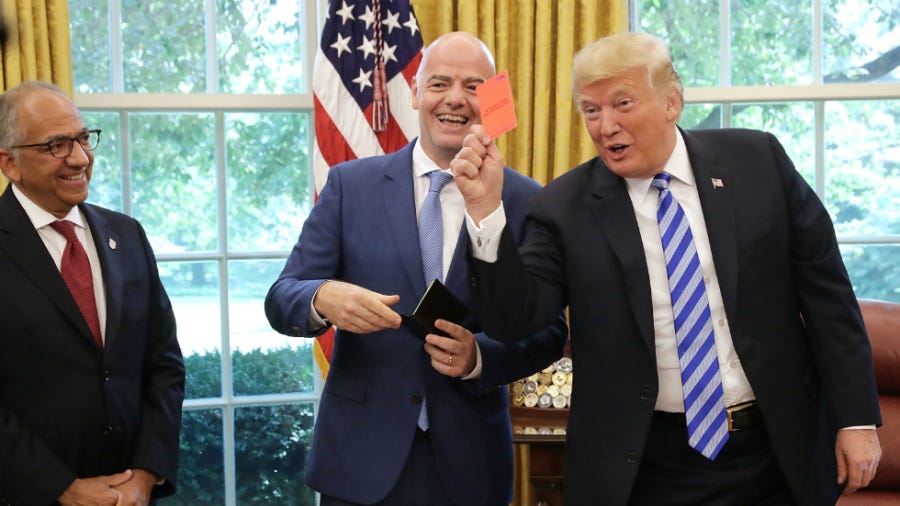
Well, Trump does say he holds all the cards.... In this case dollar bill green.