


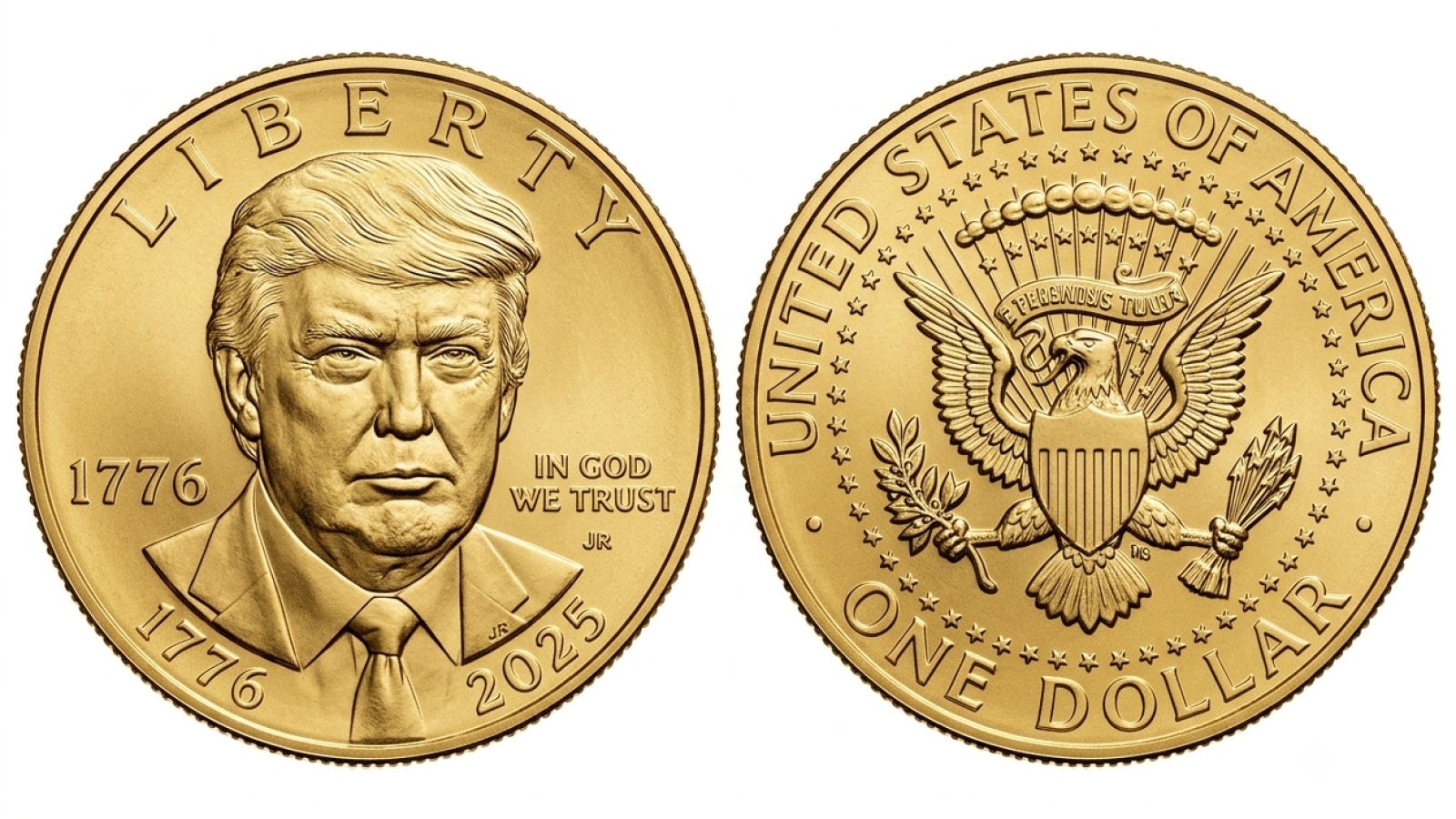
Donald Trump’s face is going on American money.
Yes, a commemorative coin, technically, and the technicality is the whole story. The law says you have to be dead to appear on the real currency, so his own Treasury secretary, Scott Bessent, stood up this week, explained that rule, and then described the arrangement: the face goes on the souvenir, the signature goes on the hundred-dollar bill, and the rule stays unbroken, Treasury insists, in a way nobody in the room believed.
One doesn’t create a workaround for something one is allowed to do. That’s what stayed with me while watching the clip. That, and how little noise followed it.
Everyone keeps waiting for the big authoritarian moment, the one from the movies, where the tanks roll in, or somebody refuses to leave office, and you can point at the screen and say “There it is!” I wrote in October that it wasn’t going to arrive that way, that the capture was already happening through the boring machinery of Project 2025, the purges, the loyalty hires parked where the experts used to sit.
What I didn’t fully appreciate then was the point of it all. Nobody takes over a government just to have it. This week made the purpose plain: the government got taken so it could be used, and it’s being used the way a man uses things with his name on them.
The coin is in many ways the least of it.
Back in January, Trump sued the IRS, an agency he technically now runs, for $10 billion over the leak of his tax returns. He dropped the case in May, and only then did the Justice Department announce what it had agreed to: a $1.776 billion fund to compensate people claiming government persecution, plus a memo signed by Todd Blanche barring the government, forever, from auditing or investigating the president’s past returns. His family’s and his businesses’ too. Yes, Congress balked, and the fund died. But the memo stands, and it seals off everything Trump filed through May. The $2.2 billion he reported earning in his first year back isn’t covered by it, but it will be filed with an IRS that now knows exactly how audits of this president end.
Then Trump stood in front of defense contractors and told them “we need magnets.” ProPublica reported the rest: Donald Trump Jr.’s venture firm took a stake in a rare-earth magnet startup, and about three months later a top White House aide helped that company land a $620 million Pentagon loan.
Put those stories together, and they are no longer separate issues. A coin, a tax deal, and a defense loan, all in one week, all pointing at the same family, and each one covered as if it happened on a different planet. The coin ran as trivia, the audit deal got filed under taxes, and the loan read like any other procurement item. Which is understandable, because accountability in this country is organized exactly the same way the coverage is.
Currency rules live at the Treasury, tax law lives at the IRS, procurement lives at the Pentagon, and every one of those shops was built to catch misconduct that stays in its lane. This kind of power doesn’t stay in its lane. It moved sideways across all three in a single week, and there is no desk anywhere in the government whose job is to notice that.
On Monday, a federal judge showed where the lanes end. Kathleen Williams, acting after 35 former judges petitioned her about the settlement, called the lawsuit a sham brought in bad faith, with no real adversary, designed to put a court’s stamp on a self-granted favor. She found sanctions warranted against Trump’s lawyer and referred him to the Florida bar, sent her order to the bar associations where Blanche already faces discipline, wrote that the audit ban directly contravenes federal law and may violate the emoluments clause, and barred everyone involved from ever citing the deal as a settlement again.
Judge Williams went as far as a court can go, and then she added a footnote: whether a separate private agreement between Trump and his own government would be valid, she wrote, “is not before this court.” The immunity doesn’t depend on the settlement anymore. It lives in a Justice Department memo now, a promise the executive branch made to itself, in a building the president runs.
Thomas Massie, a Republican congressman, looked at the coin and said: “Congratulations, we’ve entered the end stages.” Then: “I feel sorry for the folks who will be sold worthless knockoffs by this. By the usual grifters.”
And once the office becomes personal property at the top, the people around it start treating their own offices the same way. Carol Leonnig reported that the Vance family pressed the Secret Service to book a Marine Two helicopter, which costs an estimated $16,000 to $24,000 an hour to operate, to fly the vice president’s young son to a golf lesson. The weather canceled the flight, but the agents are fed up enough that they minted their own challenge coin, the “Bobcat OTR Survivors Club,” Bobcat being the vice president’s code name. Vance once said, “You have to be careful in this kind of job, or you’re going to end up entitled.” What he meant as a warning has started to sound like a self-fulfilling prophecy.
Presidential vanity is nothing new, and it’s mostly harmless because the honors come after the power is gone. You get the library, the portrait, the airport with your name on it, and you get your face on the money once you’re dead, which is the country’s way of saying the commemoration belongs to history while the machinery belongs to everybody.
What happened this week runs on the live machinery: the working mint, the current government’s settlement terms, the Pentagon’s active loan book, all of it bent toward one man while he still holds the office. Commemoration waits. Requisition doesn’t.
There used to be a raft of people who worked inside the American government whose job was to say: "That belongs to the country, not to you." A counsel’s office, an inspector general, a career deputy with nothing to gain. For two centuries, that sentence quietly killed coins at the proposal stage and struck side letters out of settlements.
Somebody did finally say it this week. It took a federal judge and a petition from 35 of her retired colleagues, and it came more than a month after the government’s own lawyers signed the deal they were supposed to stop. Nobody announces that kind of change. You find out the way we found out this week, when the only person left saying the sentence was standing outside the building.