


Donald Trump’s Iran deal has done something genuinely difficult to pull off in American politics in 2026: it has produced real agreement across the partisan divide. Unfortunately for the White House, the unity is built on deep skepticism of the newly announced Iran deal.
The left’s objections are entirely predictable and arrived on schedule. But the more remarkable development is that some of the sharpest questions are coming from people who spent the last decade telling us exactly what questions to ask about Iran — and who are now discovering those questions don’t go away when a Republican signs the agreement.
Marc Thiessen is not a Democrat. He is not even a Never Trumper. He is a Fox News contributor, a Washington Post columnist, and a foreign-policy voice close enough to Trump that his calls reportedly helped shape the president’s position on Ukraine. He has had dinner at the White House. Responding to a clip of JD Vance defending a 300 billion dollar payout to Iran on CBS on X, Thiessen compared the massive Iran reconstruction fund to “offering the Marshall Plan to rebuild Germany while the Nazis were still in power.” He was not simply defecting from Trump-aligned talking points. He was applying the moral logic conservatives spent a decade constructing — that you don’t rebuild a hostile regime, you constrain it — to a deal signed by the president he helped elect.
Thiessen is not alone in his stunning, principled, and conservative critique of this Trump deal, and the dissent isn’t confined to social media.
On Monday afternoon, Dana Perino on The Five asked with visible frustration, “This is the most transparent administration in history?” The Five is the most-watched cable news show in the country and reliably sympathetic to Trump. That was yesterday.
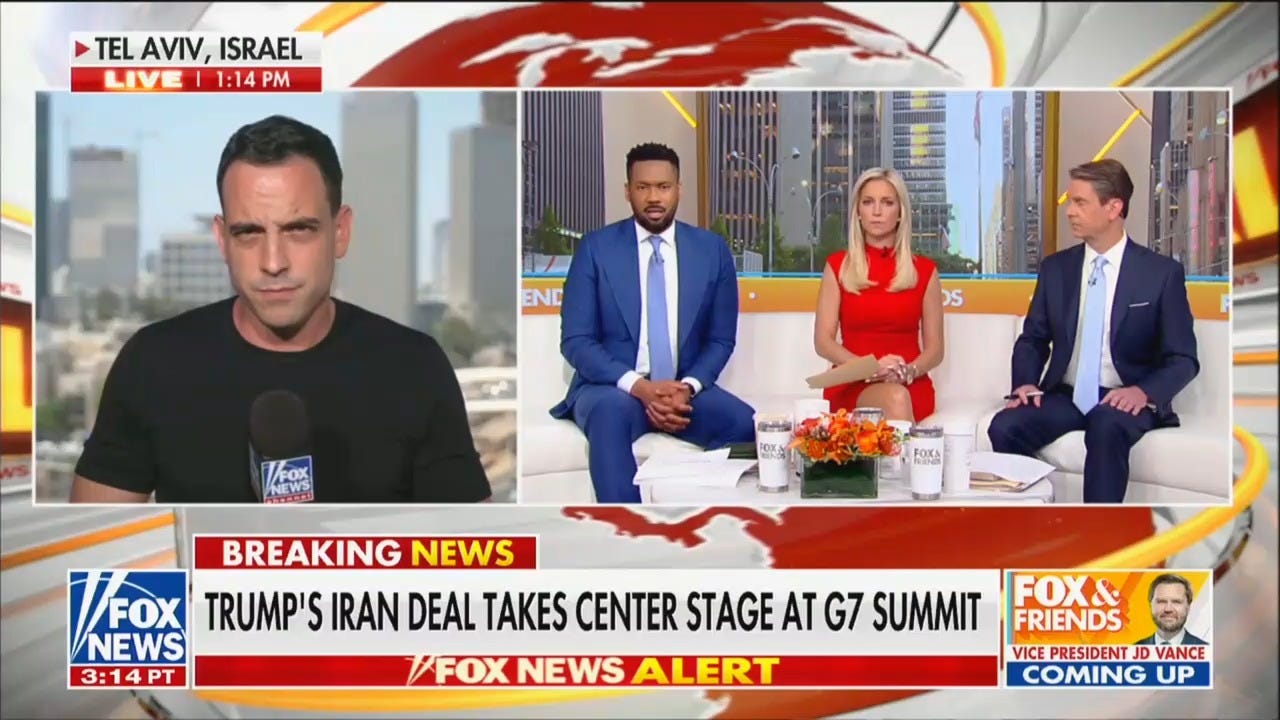
By Tuesday morning, Lawrence Jones was saying something similar on Fox & Friends, which is a different kind of signal. Jones is one of the president’s most loyal defenders, and Fox and Friends is the show Trump has long treated as his preferred daily briefing. He turned to correspondent Trey Yingst and said the quiet part out loud. “I don’t think it serves our audience by sugar coating it. There is some real dissent when it comes to this deal right now.” Yingst agreed, listing the unanswered questions accumulating by the hour: what triggers sanctions relief, how Iran accesses the frozen funds, what happens if Iran won’t surrender its nuclear ambitions when the 60-day clock runs out. “As journalists we have to continue to ask tough questions of the Trump administration about this deal,” he said.
On Fox & Friends. At six in the morning.
This is a remarkable pivot from Monday night, when Jesse Watters flatly told his audience they had won the war and were securing the peace.
Most of the coverage has focused on the money. The more interesting question is how this thing is being structured.
In 2015, Congress passed the Iran Nuclear Agreement Review Act — Corker-Cardin, pushed through at Republican insistence — specifically to prevent a Democratic president from negotiating with Iran and keeping the terms to himself. The law requires any Iran agreement to go to Congress for a 60-day review, with sanctions relief frozen while that review runs. It was built on a premise conservatives treated not as procedural nicety but as democratic principle: the executive branch cannot be trusted to make secret deals with adversarial regimes, and the American people have a right to see what was agreed to in their name.
This week, CNN noted that calling Trump’s agreement a “memorandum” rather than a deal is precisely what allows the White House to route around that trigger. The oversight architecture Republicans constructed to check Obama is now being structured around to protect Trump.
Lindsey Graham says he wants the actual document rather than Iranian propaganda reports. Thom Tillis is asking how he can take a secret deal seriously. Mark Levin is demanding the text. These are not new questions. They are the same questions conservatives spent a decade treating as self-evident. What’s changed is who has to answer them.
And it isn’t just senators and commentators. Axios reported this week that Trump’s own CIA director and Secretary of State Marco Rubio privately doubt the deal. The skepticism isn’t coming from the edges of the coalition. It’s coming from inside the cabinet.
The money is where the tension becomes impossible to ignore. The conservative case against Obama’s deal was built in significant part around a single image: $1.7 billion in cash, loaded onto pallets, flown to Tehran in January 2016 as part of a separate settlement. Trump called it ransom from an airplane in green cash. Levin made it a signature grievance. It became shorthand for everything conservatives said was wrong with the approach — you don’t pay a hostile regime, you pressure it. That number, and that image, did enormous political work for a decade.
The figure now attached to Trump’s agreement is $300 billion. Trump, standing at the G7, called reports of it “ridiculous.” His vice president spent two days confirming Iran “could have access to” exactly that, gulf-funded and tied to good behavior. The people who built their careers on the pallets-of-cash attack line are now being asked to defend a number that makes it look like pocket change.
Trump also called the surviving Iranian leadership “rational” at the G7, which quietly asks conservatives to retire a premise that’s been central to their Iran argument for twenty years — that the regime is too fanatical to be trusted with reconstruction money, sanctions relief, or good-faith negotiation. You can’t simultaneously believe Iran is an irrational death cult and endorse giving it $300 billion for good behavior. At some point the theology has to change, and nobody on the right has quite gotten around to announcing that it has.
The obvious rebuttal is that the deals are different, and that’s probably true. The Gulf states hated Obama’s agreement and endorsed this one. There’s no direct American money involved. Iran was bombed first, so the leverage is genuinely different. Those arguments deserve engagement. But they don’t answer the transparency objection or the oversight objection, because those were never really about the specific terms. They were about the principle that secret agreements with Iran are dangerous regardless of who negotiates them. If that principle was worth enshrining in law under Obama, a Republican signature doesn’t make it less true.
Lindsey Graham, Thom Tillis, Mark Levin, and Marc Thiessen aren’t asking new questions. They’re asking the same questions they spent ten years teaching Republicans to ask. The only thing that’s changed is whose signature is at the bottom.