


Fox News almost never looks confused. For twenty years, it has been the most successful audience-reading operation in American media. It knows which stories its viewers care about, which villains they want, which arguments they find persuasive, and where they want the conversation to go next. Its instincts are so reliable they can feel supernatural.
That’s why the last week has been so revealing.
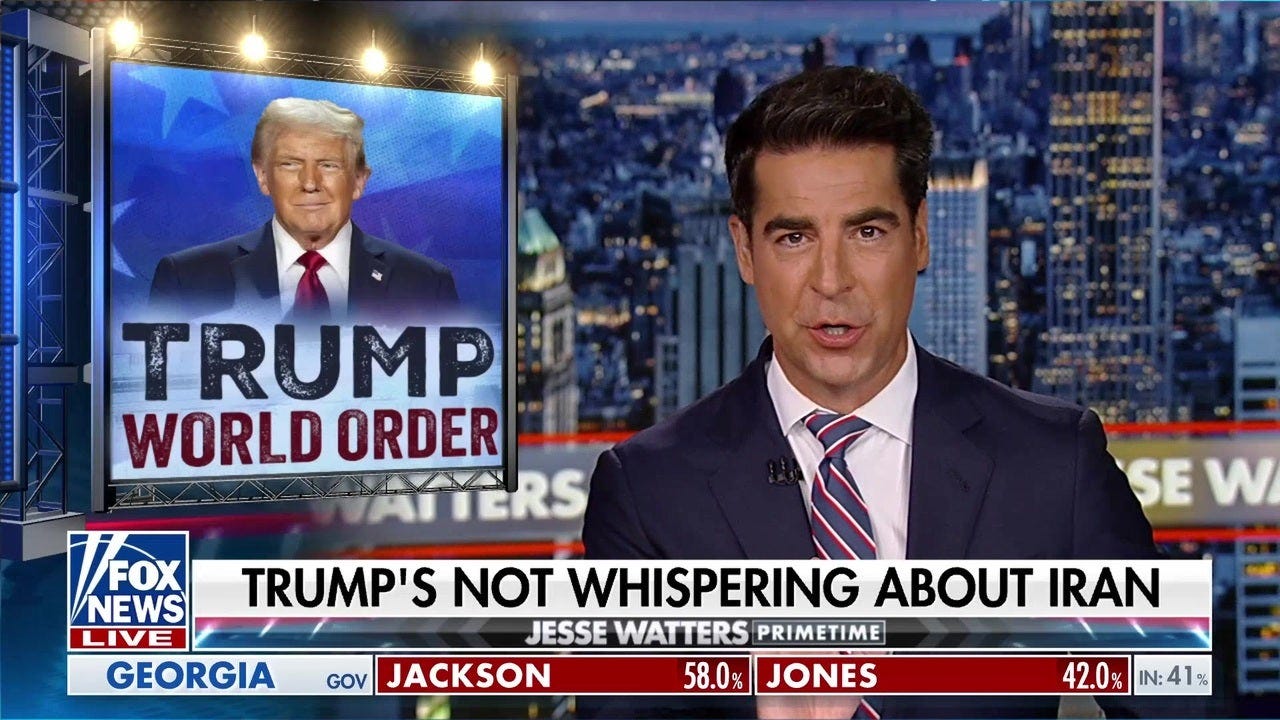
Trump’s Iran deal landed on Fox like a problem with no good solution. Nearly every host reached for a different explanation, yet none of them quite worked. For the first time in years, you could watch the network searching for a narrative instead of confidently telling one.
To see why that’s strange, you have to understand how good Fox News typically is at this. The network isn’t powerful because it’s always right. It’s powerful because it understands its audience better than anyone else. It figured out which stories its viewers cared about and how to frame them in a language viewers immediately recognized. Most networks tell their audience what happened. Fox learned to tell its audience what it meant, in the terms the audience was already using. Over time that sensitivity hardened into a feedback loop: the audience signals what it wants, the network meets it there, the meeting deepens the bond, and the loop tightens. The result has been almost unnervingly reliable. For twenty years, the relationship between Fox News and its audience has been one of the most stable forces in American politics, even as legacy media fractured before our eyes.
And it is easy to underestimate the scale of that machine. We talk about Fox News, CNN, and MS NOW as though they are competitors in the same business. In reality, one is a dominant political institution, and the others are mere mortal cable networks. Fox routinely outdraws its rivals combined by a wide margin. The ten most-watched shows in cable news are usually all on Fox. Millions of Democrats watch it. Its biggest nights rival broadcast television. When Fox decides a story matters, it can shape what a large part of the country thinks about it. When Fox decides a story doesn’t, that silence often matters just as much.
For a decade, that machine was perfectly tuned to Donald Trump. Trump and the Fox audience wanted the same things. Immigration crackdowns. Culture-war fights. Grievance against elites, against the press, against everyone who looked down on the people watching. Fox never had to choose between serving its audience and serving Trump. Trump was the audience.
I wrote about the first cracks back on April 1, when I argued Fox was developing an “unpopular populist” problem. Trump was getting harder to sell. The tariffs were unpopular. The wars were unpopular. The endless drama of the second term was wearing thin. The Iran deal didn’t create that problem. It gathered contradictions that had been building for months into one story the network couldn’t read its way out of.
Because the audience still wants what it has always wanted. It wants Iran beaten, and it wants to pay nothing for the beating. It wants American strength, and it wants cheap gas. It wants Trump to win, and it wants none of the costs his winning keeps producing. None of that is new.
For years those wants never had to be reconciled, because a winning Trump made every contradiction disappear at once. The Iran deal pulled them apart.
No story could satisfy that audience, and at first you could watch Fox try anyway. Jesse Watters’s hour dissolved the problem: the war was already won, so the terms barely mattered. Dan Bongino asked viewers to trust intelligence they weren’t allowed to see. The Gutfeld show chose the man over the memo. Brian Kilmeade called the deal nonsensical, then pivoted and blamed it on JD Vance, Steve Witkoff, and Jared Kushner.
Four shows offered four different explanations and four roads to the same destination: whatever was wrong with the deal, it could not be Trump’s fault. But the more revealing development came later. Fox stopped looking for the right explanation and started looking for a different story.
To see why, go back to the last time Fox told this audience something it did not want to hear. On election night 2020, its own decision desk called Arizona for Biden ahead of every other network. The call was correct. The audience did not want it to be correct, and it punished Fox so fast that viewers were defecting to Newsmax within days. The lesson was simple and expensive: do not tell this audience something it does not want to hear.
So with the Iran deal, Fox mostly didn’t. On Friday, one of the biggest news nights of the cycle, with the deal still the largest geopolitical story in the world, Fox’s most confident hosts looked at it and went somewhere else. Hannity led with Barack Obama. Gutfeld! opened with Rosie O’Donnell. When the deal surfaced at all, the defense was outsourced to analysts who delivered a careful holding pattern, the deal is limited, Iran can’t be trusted, we can always bomb again, while the hosts asked questions instead of making arguments. The network’s real energy went to the stories that still work, the ones it can run without flinching: Mamdani, socialism, flag-shaming polls, World Cup tourists discovering ranch dressing.
The most revealing thing Fox did with Trump’s Iran deal wasn’t defend it. It was decide the deal wasn’t worth defending. The real tell wasn’t what Fox said about the deal. It was what Fox stopped saying.
I’ve written about this dynamic before. One of the easiest ways to shape a narrative isn’t to win an argument. It’s to decide which arguments are worth having in the first place. There is no transcript search for stories that weren’t covered. What exists is a pattern. Fox has always been as influential in deciding what its audience ignores as what it pays attention to. What’s unusual here is the size of the story being pushed aside.
When Hannity chooses Obama and Gutfeld chooses Rosie O’Donnell on the same night the biggest geopolitical story in the world is still unfolding, that’s an editorial judgment.
Fox looked at a terrible deal and decided its best option was to change the subject.
And you can see why. The case against the deal is already written, and Fox wrote the manual. For more than a decade, it taught viewers how to spot appeasement, sanctions relief, reconstruction money, and cash-for-cooperation. Now the audience is running the checklist on Trump. The revolt is loud across conservative media and nearly invisible on Fox itself, because the moment Fox fully airs that critique, the weapon it built turns on the one man it cannot afford to lose.
So the machine isn’t broken. It is working exactly as designed. It looked at the biggest story in the world and concluded its audience did not want to hear it. Fox can protect Trump. Fox can change the subject. Fox can fill the hour with stories its audience still enjoys. What it cannot do is make its audience want an Iran deal it spent twenty years teaching them to distrust.
None of this means Fox is headed for some historic rupture with its viewers. The network has spent two decades proving remarkably adept at reading its audience, adapting to changing incentives, and emerging stronger from moments that looked far more dangerous in real time. The Arizona call didn’t break Fox. The Iran deal won’t either. Which is what makes this week so interesting. Not because the machine failed, but because, for a moment, you could see it working. The most powerful pro-Trump institution in America looked at one of the signature achievements of Trump’s presidency and decided the safest thing was to talk about something else. The audience machine worked perfectly. It just returned an answer the White House can’t have wanted.
There's another Fox-adjacent phenomenon happening, though. The Israel outcry. His very reliable talking heads (Levin, Batya, Shapiro, etc. ) are in open revolt against his statements against Bibi. That is the sleeper story underneath the lack of cohesive message: conservatives and centrists agreeing to disagree with Trump directly. Sort if a Sun Tzu spin, 'The enemy of my enemy isn't exactly my friend but our interests align'. That dynamic is emerging.