


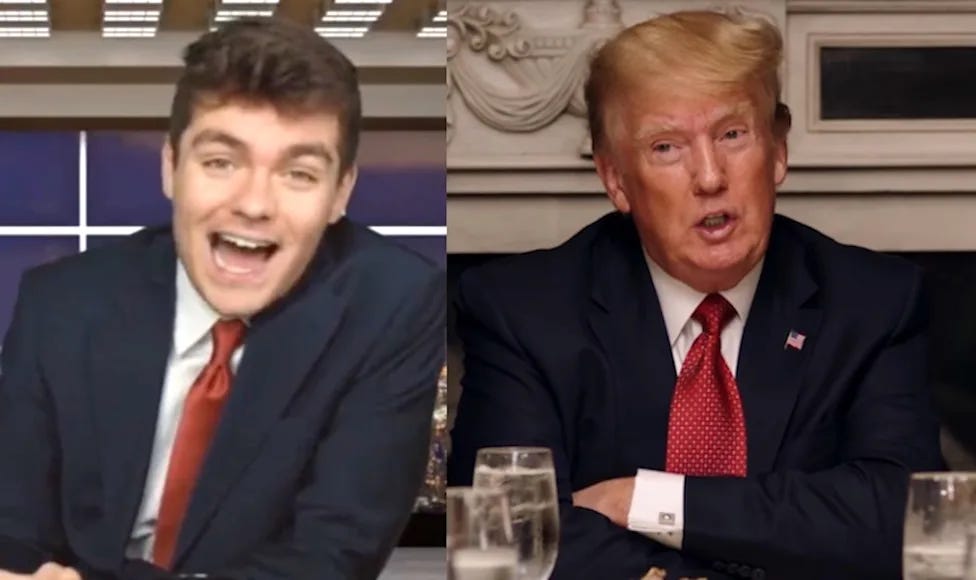
Days after the US military started bombing Iran, Nick Fuentes looked into his camera and told his viewers, “Do not vote in the midterms, and if you do, vote Democrat.”
It’s hard to ever really know if the White Supremacist is being earnest, but he clearly wasn’t trolling. He told his audience of young right-wing men, “The Republicans have to lose,” and “A cleansing fire is the only thing that will save us.” It was an instruction nobody in the MAGA coalition had ever issued before.
An act of this level of heresy in the pro-Trump MAGA media world usually brings rebuke and isolation. What was the consequence for his apostasy? His weekly Rumble views grew from about one million during the 2024 campaign to as high as eight million, per a New York Times analysis published Friday morning.
The loudest anti-Trump stay-home message in right-wing media turned its messenger into the fastest-growing act in the business. What’s more revealing? Pro-Trump outlets are losing viewers. In droves. Which is much more concerning for Donald Trump and, by extension, the GOP, than the raft of terrible CNN and Quinnipiac polling numbers that the political media obsessed over this week. And fair enough, those are brutal.
Writing for the NY Times, Stuart Thompson tracked audience data across YouTube, X, Rumble and podcasts for twelve of the biggest MAGA Media creators on the right. He describes a growing problem for Trump that no poll has clearly captured. After all, polling data measure if people agree with you; this data show if you are reaching them. Yes, Trump’s come back from ugly approval numbers before; but he’s never before faced a collapse of the pro-Trump media ecosystem. And it really looks like its collapsing.
Ben Shapiro, who's long been loyal to Trump and one of the war, has watched his YouTube views fall from roughly 27 million a week in 2024 to about four million now, while his site, The Daily Wire’s traffic dropped by half in a year.
Or consider Dan Bongino. He left Rumble at the peak of his conspiratorial powers to help run the FBI’s day-to-day operations, which lasted about a year, and appeared to damage his reputation among the very conspiracy set he helped create. He came back to the independent streamer racket in February only to find half his audience gone, evidenced by his dwindling YouTube numbers. For those playing at home: the man traded one of the biggest megaphones in conservative streaming for a government title and lost both.
It was just 2024 election night that UFC impresario Dana White stood on stage at Mar-a-Lago and rattled off podcaster names like an executive producer thanking his cast and crew. The Nelk Boys. Adin Ross. Theo Von. Joe Rogan, whose Trump interview cleared 50 million views among an audience of overwhelmingly young men.
That was the machine that worked to elect Trump to a second term, and every Republican consultant in America looked to build their 2026 turnout model assuming it would still be running. “The vote is in November, but the heart of the midterms is happening now,” Ryan Broderick of Garbage Day told the Times. You build mobilization infrastructure in the summer. This summer it’s being stripped for parts.
The rebuttal to this column? Popular and “in-power” media always shrinks. It's much easier to run a campaign and attract viewers with grievance and outrage fueled by opposition to the status quo or party in power. But now Republicans are in charge of every branch of government and many of the problems Trump campaigned on fixing? Not so much.
This has sort of happened before. After Trump left office in 2021, far-right traffic fell 44 percent in four months, and perhaps this is a normal pendulum swing. But what that trend analysis misses is what makes this moment different. That collapse was contraction while this looks much more like defection. Loyalists are bleeding out while the Trump-critical right grows fat on the wound. Fuentes effectively owns Rumble now. Candace Owens turned Charlie Kirk’s assassination into a months-long conspiracy franchise, and her viewers spiked. Viewers are still out there, still watching, still angry. It has just shifted its business to telling people the Trump administration is now the enemy.
It’s an anti-establishment movement working exactly as it was designed; it's just that the establishment has changed. Trump built a media economy where grievance pays better than loyalty, and now that he owns the government, he’s the biggest grievance available.
Loyalty to those in power is. predictable and boring. Brave betrayal is more surprising, even if it's clearly performative. The holy shit moments that get you a viral video now come from shocking defections. Shapiro found out about the first half of that equation, and Fuentes is cashing in on the second. The incentive was always there, and two major events set it in motion. Kirk’s killing last September created the opening, while the Iran war turned it into a revolt.
Joe Rogan is still by far the biggest and arguably the most influential podcaster in America, and has spent months telling his listeners the Iran war “is not something anybody that’s conservative wanted.” The larger concern for a Republican party struggling with its symbiotic relationship of a now unpopular populist in Trump? These guys don’t need to convince a single young man into voting Democrat to make a massive electoral splash. They only need to make voting Republican feel like surrender to the principles they touted just two years ago.
The Times report was just published Friday morning, but don’t expect to hear about it across all cable networks. There’s good reason why this story might get a fraction of the airtime the CNN poll got. Political journalism owns one gauge of public opinion, and green rooms in New York or Washington know how to read it. Nobody really knows whether the legacy machinery that moves those opinions still works as we’d thought. The Times built a new one from scratch, and what it found looks like dark clouds rolling in from a direction the White House was ignoring.
If young Republican men show up in November as though none of this happened, it was all noise and I’ll write that column too. But if the base that a dozen loud voices spent a decade herding to the polls stays on its couches, the autopsy won’t cite Quinnipiac. It will cite a chart of view counts published on a Friday in July, while everyone was busy covering a poll.
Great piece, but what's this? "Ben Shapiro, who's long been loyal to Trump and one of the war"