


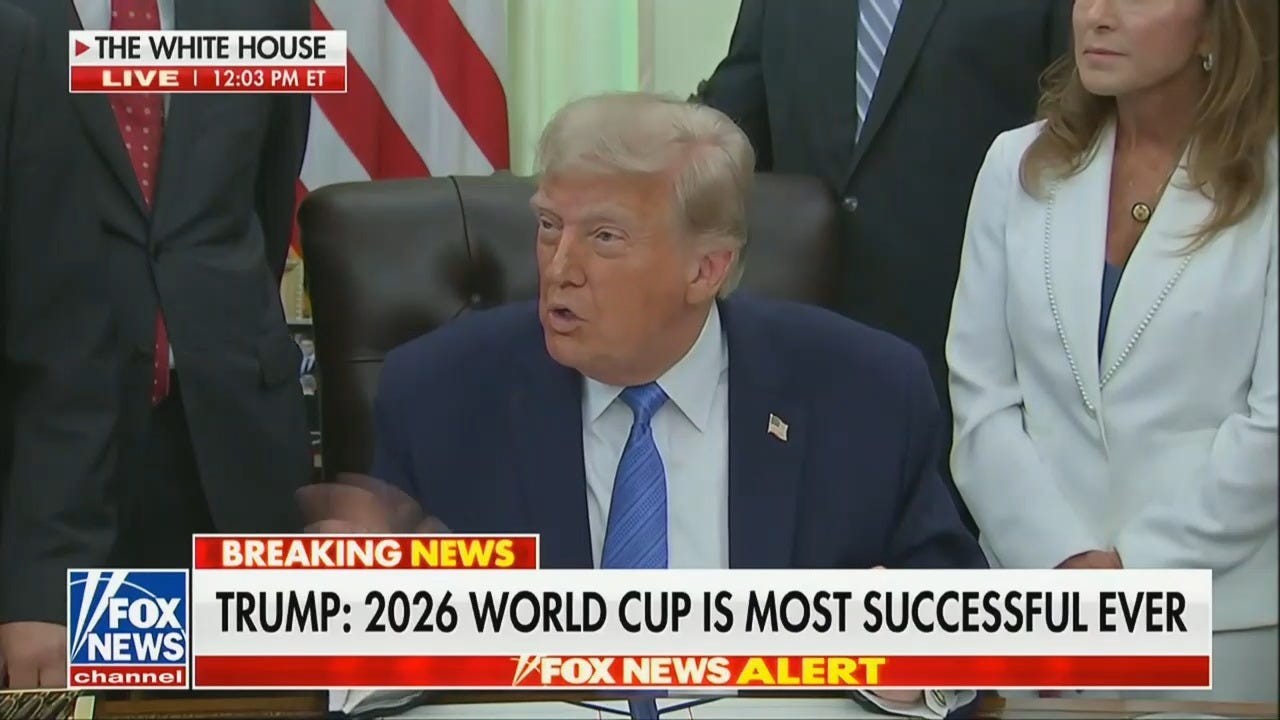
A reporter asked Donald Trump about inflation on Wednesday. He answered with a war briefing.
The number behind the question was real. Inflation had just hit 4.2 percent, a three-year high. “No, I love it,” the president said in the Oval Office. “I love the inflation.” By that night the four words were everywhere, clipped and mocked and offered as proof that he is either lying about the economy or has lost track of it.
Then the clip ended, which is where these things usually end, and the part worth hearing was left on the floor.
Because Trump kept talking. Asked why he would love a number that is making voters miserable, he explained himself, and the explanation was about Iran. Oil moving through the Strait of Hormuz. Barrels the United States has been “taking out.” Ships seized. A price he promised would “come down like a rock” the moment the fighting stops.
He had been asked about the cost of living. He was talking about a stagnant, unpopular war that was directly responsible for inflation.
Almost no one focused on that part. His critics were busy with the joke. His allies were busy selling the war as a win. Both walked past what the president had just told them about where the real pressure on his presidency now lives.
Take him at his word about the cause. If the inflation number is a war number, then the war’s end is the date his economy turns. He has tied the thing voters feel every time they fill the tank to a conflict with no settled end. Prices fall when the fighting stops. But the timing of that outcome is no longer entirely in his control.
Yes, Iran is much weaker now, economically and militarily, than it was in February. Its army, navy, and weapons systems have absorbed months of strikes. And none of it lowers the price of gas.
That is the trap inside his own answer. There are two scoreboards now, and they are not measuring the same game. On the military board, time runs against Iran. Every week of the campaign leaves it with less to fight with. On the political board, time runs against Trump. Every week the war continues is another week of pump prices doing the one thing he spent a decade promising voters he would never allow.
Iran does not need to win on the first board to win on the second. It does not need air superiority or a working weapons program. It needs the war to last. A country that cannot stop the United States militarily can still keep a chokepoint contested, keep a premium on every barrel, and keep an American president explaining gas prices in an election year. The longer Iran absorbs damage, the more leverage it holds over the man inflicting it.
The fragile ceasefire makes it worse, not better. The fighting keeps flaring back. That leaves Trump in the one place he cannot afford to be. He cannot declare the war over, which is the event he has promised will bring prices down. The military line and the political line are running in opposite directions, and on Wednesday the president narrated the gap out loud.
What makes this strange is who is saying it.
Trump built his political identity on the price of things. Eggs, gas, groceries, rent. He ran against Joe Biden as the candidate of the receipt, the man who would make the checkout line feel normal again. Inflation was not one issue among many for him. It was the proof that the people in charge had lost touch with how Americans live.
Now he is the people in charge, and his answer to a three-year high is to ask voters to be patient because there is a war on. The candidate of low prices has become the president of “as soon as this war is over.”
Here is the part that should bother anyone who covers this for a living. The quotable thing crowds out the revealing thing.
The most consequential thing the president said all week was available in full, on camera, and the conversation that followed was almost entirely about four words. The clip economy did him a favor, and it did it automatically. Four ridiculous words are easier to mock than to think about, and mockery feels like winning. His critics clipped “I love the inflation” and took a victory lap. His allies pretended the quote did not exist. Nobody on either side engaged the actual argument the president had made, which is that Americans should accept higher prices as the cost of a war whose ending he does not control.
A confession that arrives wrapped in a viral clip is the safest confession there is, because everyone is too busy sharing the clip to read it. Trump did not hide his Iran problem. He said it on camera, in the Oval Office, to a room full of reporters. It went viral. And it vanished.
The viral clip made him look foolish. The full answer made him look trapped.
He told us where the floor is under this war. It isn’t in Tehran. It isn’t in the negotiating room. It’s at the pump. He said so himself.