


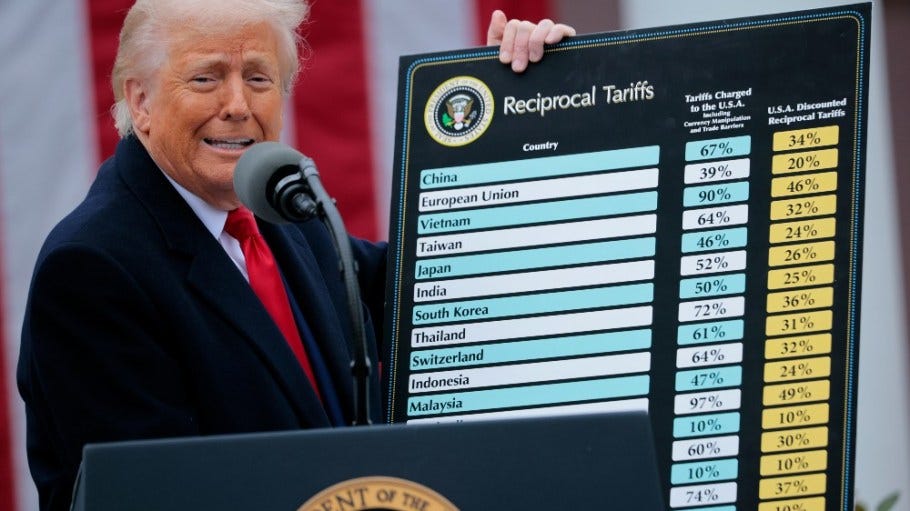
Donald Trump ran for reelection in 2024 on a pretty simple promise that he’d lower the price of groceries, gas, and everything else, and that promise was the closing argument of the 2024 campaign.
His signature economic policy in his first year was the controversial “reciprocal tariffs,” which, according to a new report from economists at the Federal Reserve Bank of New York, were actually the reason for prices going UP, not down, just three months before midterms that already look ugly for the Trump administration and a Republican party that got behind it.
The paper is titled “The Anatomy of Tariff Pass-Through into Consumer Prices,” and is jointly authored by Mary Amiti and Sebastian Heise of the New York Fed and David Weinstein of Columbia. It traces the effects of the tariffs through every manner that reaches everyday American citizens. It considers direct taxes on imports, the higher costs of imported parts used by American factories, and the markups domestic companies added once their foreign competitors got more expensive. It also captures what conventional and earlier pass-through estimates missed. What it comes up with is almost surely to be used in the next Democratic attack ad near you.
Tariff pass-through into U.S. import prices was roughly 90 percent, or as it is framed in the report, “a 10 percent increase in the duty rate pushes up import prices by 9.2 percent.” Simply put, foreign exporters did not cut their prices to absorb the tax. American importers paid it, almost in full, almost immediately.
About 26 percent of the tariff increase passed through to consumer prices at the point of sale. The report finds that, by February 2026, the tariffs had added roughly 2.2 percentage points to 12-month goods inflation in the study’s sample: 2.0 percent with the tariffs, negative 0.2 percent without them. The irony? Without the tariff policy, prices of goods these economists track would have been falling. Yes, in an election year.
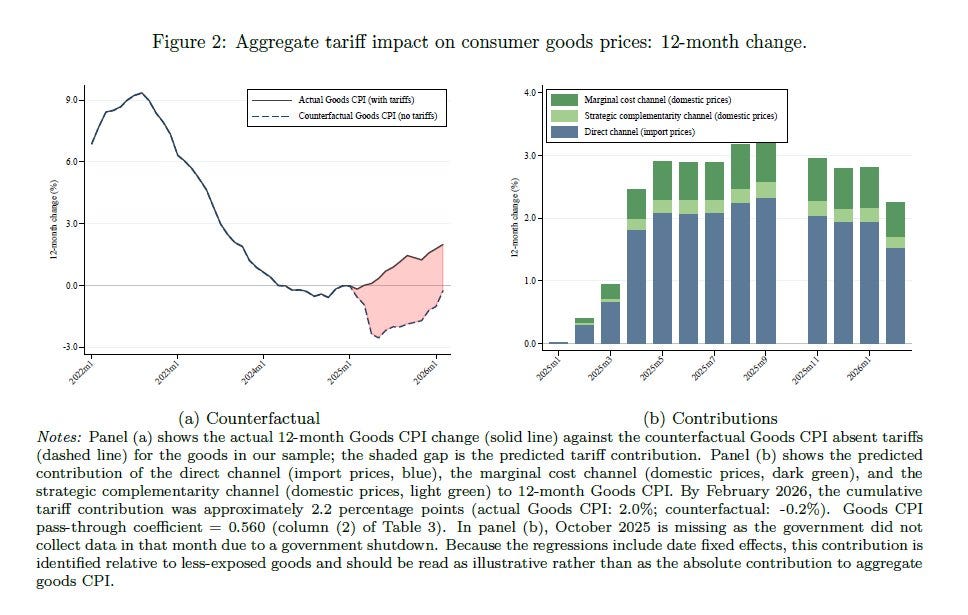
There are more wonky details that have negatively affected the US Economy. To wit: Only 64 percent of the consumer price increase came from the direct tax on imported goods. The remaining 36 percent came through products that were never themselves imported. Tariffs on inputs, like steel, aluminum, and parts, raised production costs for U.S. manufacturers, who passed them along: a 10 percent duty increase raised producer prices about 2.6 percent in the average consumer goods industry.
Domestic firms simply raised their prices because tariffs made their foreign competition and materials more expensive. Economists call this “strategic complementarities,” but a more plainspoken term is pricing cover. Tariffs handed American companies a good reason to charge more for goods made in their home states, so they took it.
This report is not a surprise to anyone who's been paying attention, but the timing of it should terrify Republican strategists and not just because of the looming midterms.
The direct effect of these tariffs hit import prices “nearly completely in the first month,” but the domestic channels took nine to twelve months to work through supply chains, which roughly doubled between month six and month twelve. Every “where’s the inflation?” victory lap taken through mid-2025 was based on data from before its domestic charges had arrived. In April, the Minneapolis Fed published a piece titled “Tariffs Can’t Explain Rising Goods Inflation.” This paper’s answer, in a footnote: the increases were still in the pipeline; they just took about a year to hit the consumers.
Scott Lincicome runs trade policy at the libertarian Cato Institute. He needed just one tweet to summarize the whole paper.
He wrote “I don't know who outside the Oval Office still needs to hear this, but... Yes, Trump's tariffs raised US prices - of both imported and domestic goods. The End.”
When Fed economists and the free-market right’s chief trade wonk land to the same conclusion, its hard to find a partisan angle left to argue.
Trump promised foreigners would pay. Fed economists did the math on who actually did. Voters get to check it in November.
So the tl;dr is just this : macroeconomics gonna macroeconomic.