


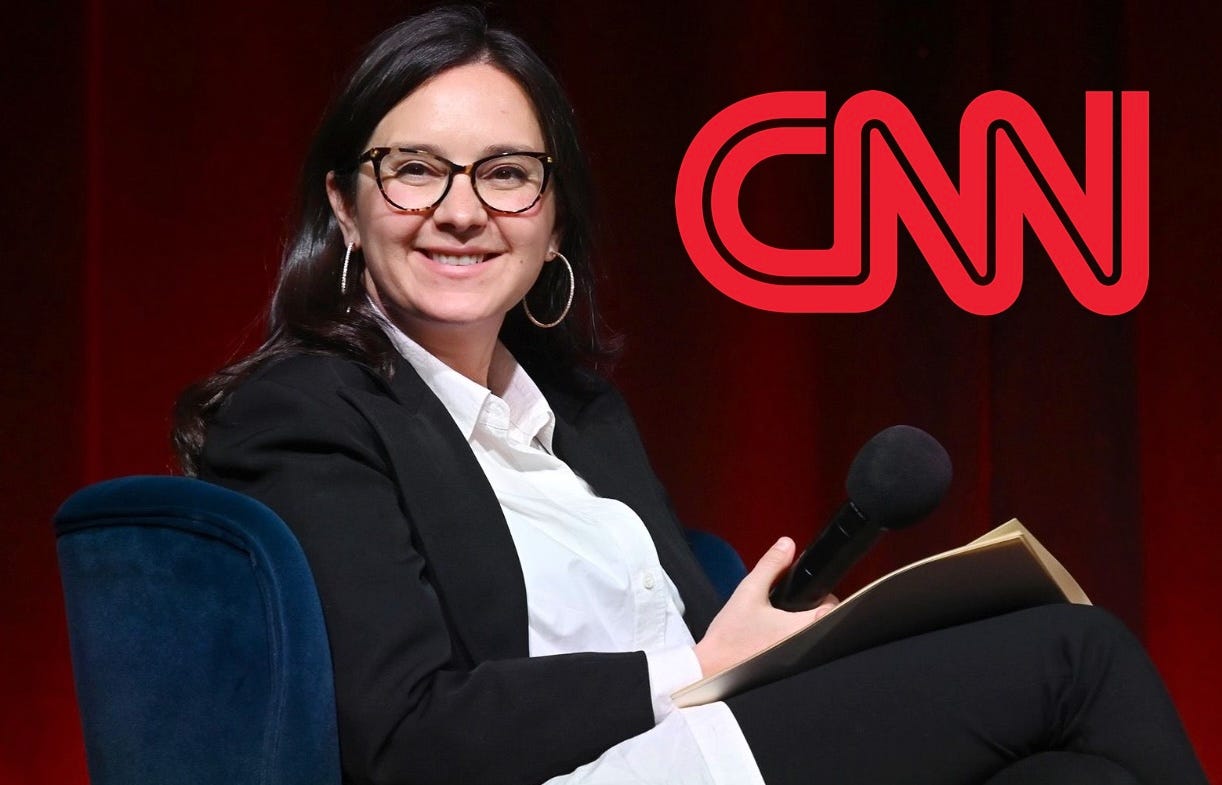
Mark Thompson can’t relax.
The CNN chief told a town hall of 4,000 employees last month that he goes home at night and can still feel the tension in the room because he’s in the room too. New York magazine published his remarks this week, along with the rest of the network’s nervous breakdown: Scott Pelley confronting 60 Minutes‘ newly installed executive producer that same day and accusing Bari Weiss of murdering the broadcast, the chief legal affairs correspondent decamping to MS NOW rather than waiting to learn her fate, and one staffer summarizing the house position on the coming ownership change better than any anchor’s walkout threat: there’s nothing stopping David Ellison from doing “the stupidest thing possible” and giving Weiss the keys.
The dread has a deadline. Paramount Skydance’s $111 billion takeover of Warner Bros. Discovery, CNN’s parent, cleared the Justice Department on June 12 and could close this month. Last week, I wrote about half of this story, the panic ignores, the fate of the executive already fixing what Ellison says is broken. This is the other half, the question consuming every green room in the business: what will Bari Weiss do to CNN?
Before joining the panic, I did the unfashionable thing. I watched the product.
I watched a week of CBS Evening News, braced for Newsmax, and got a broadcast my parents would recognize. The last week of June: wildfires on the Utah-Colorado border that killed three firefighters, flooding in Kentucky, an earthquake in Venezuela, a JetBlue pilot reporting a drone strike on approach to JFK, two hundred million Americans under heat alerts heading into July Fourth. When the Supreme Court handed down its birthright citizenship ruling and Trump complained, the broadcast reported the ruling and the complaint, straight. When democratic socialists won another primary, it was covered as an election result rather than an invasion. The investigative unit is running hospice fraud in California and the Pentagon’s unpreparedness at a U.S. base in Kuwait, which is accountability journalism aimed at this administration’s Defense Department. Nowhere in the week did I find a monologue or a crusade. I found a weather map.
The broadcast does not match the panic. The on-record allegations are another matter, and they deserve full weight. Weiss pulled the CECOT deportation segment hours before air. The Netanyahu interview Lesley Stahl spent months chasing went to Major Garrett instead, reportedly at the subject’s preference. Pelley says he was pushed to make Minnesota protesters look more violent.
Every documented intervention lands on a story this administration was watching: deportations, ICE, Israel. Everything else runs untouched. An executive hired to remake a news division remakes the news division, top of the rundown to the kicker. What CBS shows instead is a division that looks normal almost all of the time, with surgical interventions at precisely the flashpoints one specific audience in Washington monitors.
So why does Bari Weiss still have the job?
In late May she ousted a half-dozen of 60 Minutes‘ senior staff in one afternoon, including its executive producer, its executive editor, and correspondents Sharyn Alfonsi and Cecilia Vega, then installed a Vanity Fair columnist with no broadcast experience to run the most decorated program in television news. Pelley was fired by letter in early June, a day after confronting her new executive producer, and told the Times on his way out that CBS News was on fire and needed adult supervision. Alfonsi left, accusing her, in writing and by name, of substituting politics for editorial judgment. Ratings fell across the division. Any conventional news executive with that six-week stretch would be updating a LinkedIn profile. Ellison stood by her through all of it, publicly and warmly.
None of it surprises anyone who has followed the career. Weiss’s singular professional talent is manufacturing attention through controversy. She is the queen of the hot take disguised as heterodoxy, and the $150 million Ellison paid for The Free Press is the market’s verdict on that skill. It is a real skill, and it is useless for running a broadcast news division.
People close to Weiss at CBS, including some of her most senior advisors, have conceded as much to me in recent weeks: the blunders are real and self-inflicted. They are not delusional about the record, whatever the public posture.
What the record describes is an editor in chief who governs the newsroom the way a columnist would, prosecuting it for a systemic internal bias she is convinced exists and has yet to locate. The blunders follow from the posture. You cannot manage a newsroom you are prosecuting for a crime you haven’t found.
The commentary industry resolves the mystery by picking one of two stories: Weiss is boldly remaking CBS News and the bodies are the cost, or Weiss is failing and Ellison is too stubborn to admit it. Both rest on the same premise, that she was hired to run CBS News. The premise is wrong. She was hired to communicate something to people outside CBS News, and by that measure, the hire has performed flawlessly.
You can’t get fired from a job that was never the job.
In October, Paramount Skydance bought The Free Press for $150 million and appointed Weiss editor-in-chief of CBS News. Ellison was already circling Warner Bros. Discovery, and in December, after Netflix briefly won the studio, he returned with a hostile bid for the entire company. The deal needed approval from a Justice Department answering to a president who had personally sued CBS over a 60 Minutes edit and pocketed a $16 million settlement for his presidential library, weeks before the FCC blessed the Skydance merger.
I can’t read Ellison’s mind. I can do the math. Whatever the intent, the hire carried enormous signaling value at the exact moment signaling value was worth the most, and against $111 billion, $150 million is a rounding error. A signal needs to be conspicuous, and conspicuousness is the one product Weiss has never failed to deliver. Quiet compliance earns nothing from this White House. Visible tribute does, and little is more visible than the enemy’s masthead handed to a friend, legible from Washington without anyone there watching a minute of the broadcast.
The signal was received, loudly and on the record. In March, Secretary of War Pete Hegseth told a Pentagon briefing that the sooner Ellison took over CNN, the better. The FCC chairman framed CNN’s coming change of ownership as proof Trump is beating the press he calls fake. In April, Ellison hosted a dinner honoring the Trump White House at which the president spoke for nearly an hour. Larry Ellison, the money behind the buyer, reportedly told Trump the merger could lead to an overhaul of CNN, a report Paramount answered with a statement denying that any commitments about any news property were made to government officials. Statements like that tend to answer questions somebody was actually asking.
On June 12, the Justice Department approved the merger. No divestitures, no conditions, no concessions.
The tape fits neither ideological capture nor editorial independence. It fits a hire whose signal mattered more than her newsroom: the routine journalism doesn’t touch the signal, so the routine journalism is left alone. And if you want to know what an actual ideological correction looks like, you’re a channel late. CNN shed its loudest Trump antagonists years ago and sanded down the ones who came back. You don’t hire an enforcer for a newsroom that already disarmed. You hire a symbol and make sure the right people see it.
CNN staffers have lately been comparing Weiss to Chris Licht, and the comparison is better than they know, because the hiring timelines tell you what each job actually was. David Zaslav hired Licht for a network whose merger was already blessed and all but closed, a purely operational assignment, and when Licht ran this same playbook, courting conservative guests and softening the network’s Trump language, and flopped, he was gone in thirteen months. His job was operational, so operational failure ended it. Ellison installed Weiss while his own approval was still pending. She has flopped harder and faster than Licht ever did and kept the title. The difference is the job, and what made the jobs different was the calendar.
In May, with the 60 Minutes wreckage still smoking, reports surfaced that Paramount leadership had discussed scaling back Weiss’s role. The company’s answer arrived within the news cycle: a statement affirming Ellison’s unqualified backing of her as the editorial leader of CBS News. That was the posture while approval hung in the balance. Doubts got smothered in public support.
On June 12, the Justice Department approved the merger. The doubts resumed leaking, and this time nobody is smothering them. People close to Ellison have expressed concern about handing her more responsibility, per New York magazine. The Financial Times reports his advisers are warming to the idea of keeping Thompson. Gerry Cardinale, whose firm helped finance the deal, has publicly praised Thompson’s leadership and CNN’s digital chief while counseling patience over disruption.
Nothing about Weiss’s performance changed between May and July. Every fiasco on the list above predates the approval. The conventional read, that her blunders are finally catching up to her, cannot explain why the same blunders drew a formal defense in May and quiet corroboration in July. The calendar can. The signal’s highest-value window closed on June 12, and the value of that name on that masthead has been depreciating daily since. She survived the firings she ordered, the accusations that followed, the ratings slide, and a public evisceration by the most trusted voices in the building, because none of it touched what the position existed to do. What she may not survive is the deal closing.
You can’t be fired for performance in a job that was never about performance. You can be retired when the signal expires.
As for what Weiss herself understood, I won’t guess, for the same reason I won’t read Ellison’s mind. The record speaks on its own: she took the nine-figure check, held the title through every fiasco, and intervened only where Washington was watching. However you read that record, it does not survive contact with the story she has sold for a decade, the fearless heterodox too independent to be anyone’s tool. The one thing a signal can never be is independent.
So what will she actually do to CNN? Follow the model to its end and the answer is less than the panic imagines, and probably less than she wants. The arrangements Ellison’s camp has floated, Weiss paired with a seasoned television operator, Thompson retained, are what a depreciating signal looks like on an org chart: the name stays visible while the controls go to someone hired to use them. Where she does hold power, expect what CBS got, a normal broadcast with surgical exceptions wherever Washington is watching.
The better question, for this hire and every marquee editorial hire made in the shadow of a politically sensitive transaction: don’t ask what the new editor plans to do to the journalism. Ask who the hire was meant to be seen by. At CBS, the audience was never in the building.