


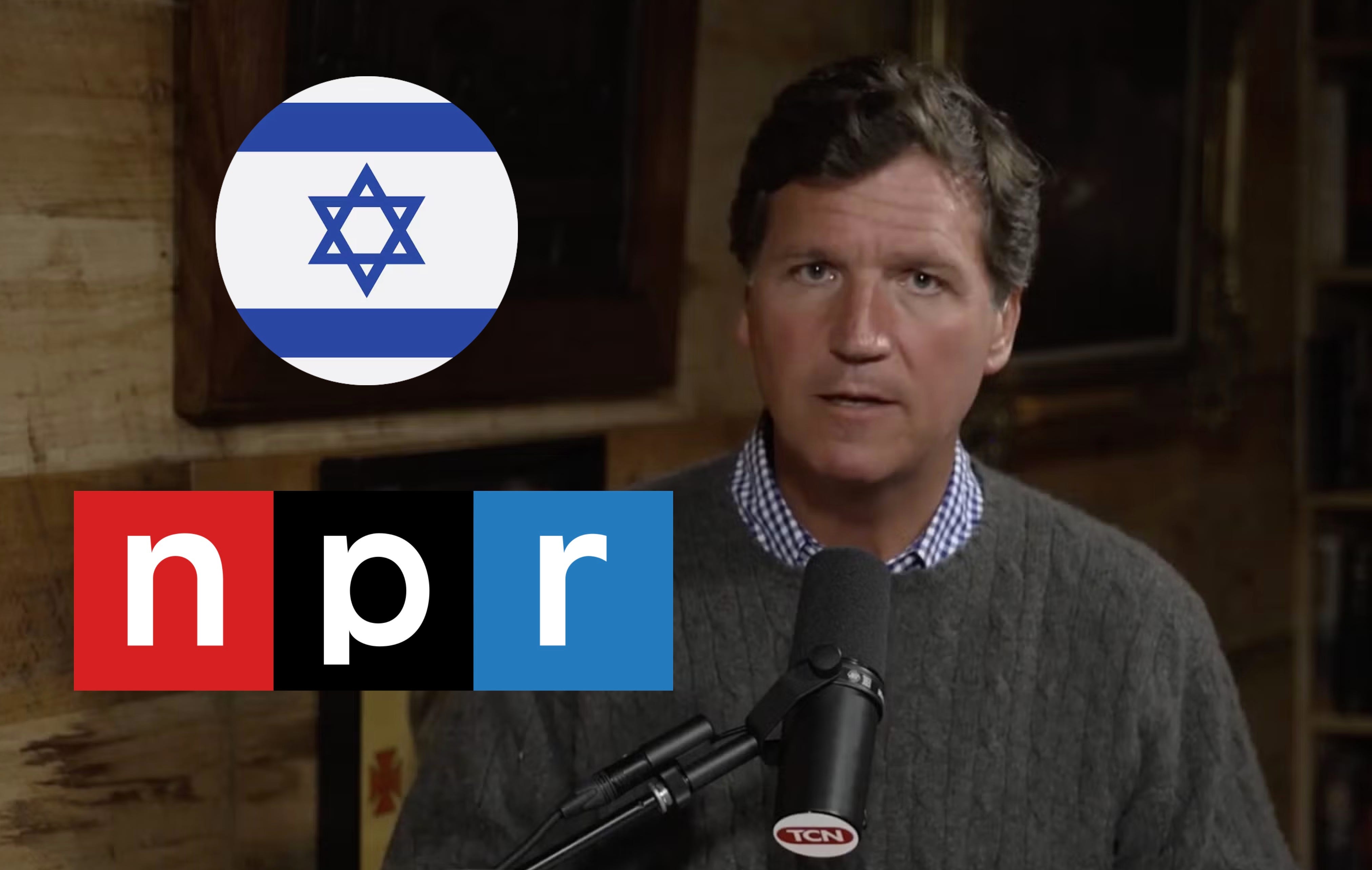
In the same forty-eight hours this week, Tucker Carlson and NPR’s signature media show effectively asked the same forbidden question about Israel. That would normally not be thought possible, yet here we are.
Carlson handed two hours of his show to a theologian arguing that Christian Zionism is not real Christianity. WNYC’s On the Media, the most influential media-criticism program in public radio and a reliably progressive one, spent its main segment mapping the same fracture. Two hosts who agree on nothing, two audiences that share no dial and no worldview, walked through the same subject in the same two days. And until about a year ago, that subject was untouchable.
For forty years, one of the most powerful engines of conservative support for Israel has been a religious idea. Tens of millions of evangelical Christians believe the United States is commanded by God to stand with the Jewish state, and they vote like it. That conviction, called Christian Zionism, is why a Republican could question almost anything about Israel except whether America was obligated to back it at all. That was the line you did not cross.
This week it got crossed twice, from opposite ends of the dial, by two people who agree on nothing.
Tucker Carlson, the most powerful voice on the populist right, handed two hours of his show to a theologian arguing that Christian Zionism is not real Christianity. Within the same forty-eight hours, On the Media, the most influential media-criticism program in public radio and a reliably progressive one, devoted its main segment to mapping the same fracture. Two audiences that share no dial, no platform, and no worldview got walked through the same once-untouchable subject in the same forty-eight hours.
That is not a coincidence about theology. It is a signal about power. When the same question surfaces simultaneously on Tucker Carlson and on NPR, the question has stopped being marginal.
The left criticizing Christian Zionism is the dog that barks every night, and it has never moved anything, because the people who set American policy on Israel were never in that audience. The dog that never barks is the right. This week it barked for two hours, and a progressive radio show across town treated that bark as the news event it was.
Here is what makes it a phenomenon and not a fluke. They are not asking it for the same reason, and they are not even doing the same thing.
Carlson is enacting a rupture. His guest, a polemicist named JD Hall, spent two hours dismantling the theological case for Christian support of Israel, which is exactly the argument the America First wing needs to justify pulling the country back from foreign wars and foreign aid. For Carlson, the critique is a tool. It clears the ground for the pivot he already wanted to make.
Gladstone is diagnosing the rupture. Her guest, the Georgetown scholar Matthew Taylor, laid out the right’s civil war in clinical detail: the Christian Zionists in Trump’s orbit against the America First crowd, the Heritage Foundation fracturing over antisemitism, the line that Carlson himself crossed by platforming the open antisemite Nick Fuentes. For Gladstone, the critique is an object of study, an influence on American policy that public radio has eyed warily for years.
To be clear here, one side is conducting the split, and the other is narrating it. Their conclusions about the theology may rhyme, but the engines underneath are opposite, and anyone reading this as left and right converging on a shared truth has the story backward. They have arrived at the same intersection from roads that do not meet.
And that is precisely why it matters. A taboo does not fall because its enemies attack it. It falls when its enemies and its hosts start poking at it simultaneously, in public, in front of audiences that used to consider the question settled.
What pried the window open was the Iran deal. When Trump signed it, criticism of Israel for threatening the peace stayed almost entirely on the left. Only one prominent Republican carried it, and he carried it from the White House podium. JD Vance, answering Israeli ministers who had attacked the deal, reminded them that American hands and American tax dollars had built most of the weapons defending their country, and that you cannot kill your way out of every national security problem when you are a nation of nine million people.
That was the coalition breaking in real time. The hawks did not fall in line behind him. Ben Shapiro called the deal a disaster and said Vance had failed the president. Lindsey Graham warned it would collapse. Mark Levin went after what he called the Qatar-First crowd. The argument was suddenly happening out loud, with names attached, which is the opposite of a movement that still agrees on its own foundations. Once the vice president says American support has limits, the theology that made that support feel mandatory becomes a thing you are allowed to question. Tucker questioned it. NPR documented him questioning it.
A caveat worth stating plainly, because the realignment does not travel clean. The America First critique slides easily from questioning Christian Zionism into open antisemitism, and often does. Taylor traced that slide through Fuentes and Candace Owens, and you can hear it in the Israeli coverage of the same fight, where a Channel 14 star used an antisemitic slur for American Jewish officials on air. The legitimate argument that American foreign policy should not run on someone else’s end-times theology sits inches from an uglier one that is just hatred hunting for a permission structure. They are not the same, and an honest accounting has to keep them apart rather than letting the first launder the second.
A second caveat, equally important. The crack is at the top. It is showing up in the leadership and the media, in what a vice president says at a podium and what a host puts on the air. The tens of millions of evangelical voters who treat Israel as an article of faith have not moved, and they will not move on the schedule of a news cycle. What shifted this week is not the base. It is the ceiling.
Which is where my reporting keeps landing. Netanyahu spent two decades believing he had cultivated a relationship with America. He had cultivated a relationship with one faction inside America, and the Iran war was the moment he discovered the difference. The Christian Zionist movement is now learning a version of the same lesson about itself. For forty years it sat so close to the center of the American right that nobody bothered to tell the two apart. They functioned as one thing. The Iran deal pulled them apart, and the seam is now visible from both sides of the dial.
A consensus holds best when nobody can see it. It feels like gravity, like a fact about the world rather than a position somebody chose. That is the cover Christian Zionism enjoyed on the American right for a generation. When Tucker Carlson and NPR spend the same forty-eight hours pointing at it from opposite directions, the cover is gone.
Once something becomes debatable, it does not go back to being bedrock.