


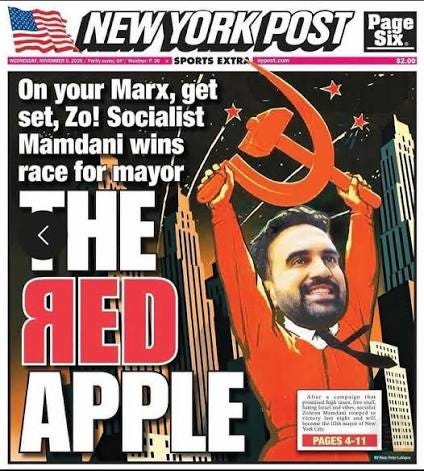
The morning after the election, the New York Post put Zohran Mamdani on its cover in Soviet red, a hammer and sickle in his hands beneath the headline “The Red Apple.” The kicker read “On your Marx, get set, Zo!” The issue sold out by mid-morning, in part because Mamdani’s own supporters were buying copies as souvenirs. By the time the votes were counted, the warning and the joke had already started to blur.
Nobody accused Mamdani of being an ordinary progressive. He was a communist, a danger, an antisemite, a sign of where the Democratic Party was headed. Andrew Cuomo spent a campaign arguing Democrats were moving in a dangerous direction. Donald Trump branded him a communist lunatic and threatened to cut the city’s federal funding. Fox News personalities treated his victory as proof the party had been captured by its furthest edge. Business leaders predicted capital flight. Talk radio reached for “clear and present danger.”
Strip away the different rhetoric, and everyone was making the same argument: this was an emergency. Six months later, New Yorkers are still waiting for the dangers to emerge.
The first crack in the apocalypse narrative showed up almost immediately when Mamdani sat down with President Trump. The meeting was cordial. Trump came out of it calling Mamdani “a very rational person” and saying he would be comfortable living in Mamdani’s New York. The two met again a few months later to talk through a 12,000-unit housing project. For a year, conservatives had cast Mamdani as a Marxist menace. Then the Marxist menace spent the winter taking friendly meetings with the president about housing development.
That was not in the campaign leaflet.
The second surprise was the budget. Mamdani inherited a massive deficit north of $12 billion, the sort of fiscal crisis critics expected would expose him within his first quarter. Instead, he negotiated. The millionaire’s tax that animated his campaign went nowhere, as Governor Kathy Hochul had no interest in it, so he took the deal in front of him rather than hold out for the one he wanted. He cultivated the governor with some old-fashioned and savvy political horse-trading, stayed aligned with her through an ugly budget fight, pulled billions in state aid from it, and closed the gap. The revolution lasted right up until his first budget meeting.
That is not really a criticism so much as a description of the job. Mayors discover soon enough that ideology is not the only thing in the room. The governor is in the room, the bond markets are in the room, the municipal unions are in the room, the city charter is in the room, and the trash-collection schedule is in the room. New York forces everyone into contact with reality eventually. Mamdani just got there way faster than most people expected.
The rest has been almost disappointingly normal: ribbon cuttings, community events, infrastructure projects, housing announcements, the kind of municipal activity that generates very little cable news and even less historical significance. A Marist poll at the hundred-day mark found 74 percent of New Yorkers calling him hardworking and 61 percent calling him a good leader. The man who was supposed to become politically radioactive appears to be piling up a remarkable amount of political capital instead. Maybe it’s a result of ridiculously low expectations combined with hustle and effective publicity campaigns.
His endorsement put Brad Lander, his old cross-endorsement partner, more than thirty points up on sitting Congressman Dan Goldman in polling for the June primary. Whether that lead holds, and whether the coattails are real, is still unsettled. Nobody talks this way about a politician who is supposedly collapsing.
All of which raises an awkward question. What happened to the imminent catastrophe? Businesses were supposed to flee, the budget was supposed to implode, the city was supposed to become ungovernable. Those were not moods. They were forecasts, and forecasts are supposed to get checked.
Politics is hard, and the future is harder, so nobody expects perfect accuracy. Six months is still long enough to start comparing the prediction to the result, and the result has been uncooperative. The businesses are still here, the budget got balanced on paper and passes June 30, and the city is still preoccupied with the same housing fights, transit fights, and school fights it was chewing on before Mamdani arrived
The communist apocalypse has been delayed by municipal governance.
We have seen versions of this movie before. Barack Obama was going to redistribute the wealth and socialize the American economy, and Obamacare was going to trigger economic calamity. Neither happened. The warnings about Mamdani came with the same certainty, often from the same places. Certainty, it turns out, is cheap.
The temptation is to blame dishonesty. More often, the answer is incentive. Nobody gets booked on television to predict a nuanced and reasonably functional future, and nobody builds a media career on the idea that things will probably work out fine. “The city will keep muddling through” is not a segment. Apocalypse is the segment that gets booked, clicked, and shared. Then reality arrives, looks around, shrugs, and keeps moving.
The strangest part is that nobody ever has to go back. The people who predicted New York’s collapse are not asked to explain why it is still standing. Nobody revisits the old segments or pulls up the tape to ask where the crisis went. The prediction gets made, monetized, and quietly abandoned, and everyone moves on to the next one.
That is the most revealing part. Everybody gets things wrong. What the business lacks is any mechanism for distinguishing between being slightly wrong and being spectacularly wrong, so everything gets delivered at the same maximum volume. Every election becomes existential, every opponent unprecedented, every victory civilization-ending. Eventually, the audience loses track of which warnings deserve attention and which are just part of the show.
So here is where six months leave us. A man was introduced to the country as a Marxist threat to the largest city in America, drawn with a hammer and sickle on the cover of its loudest tabloid, and he has answered by cutting deals with Trump, talking the governor out of a few billion dollars, balancing a budget, showing up at community events, and smiling through most of it.
He has become, of all things, a mayor.
For a politician sold as the harbinger of the communist apocalypse, that may be the most devastating outcome imaginable. The fire never came. The people who promised it are already selling the next one.
All part of “The Show”. Fox competes with Netflix, not CNN.