


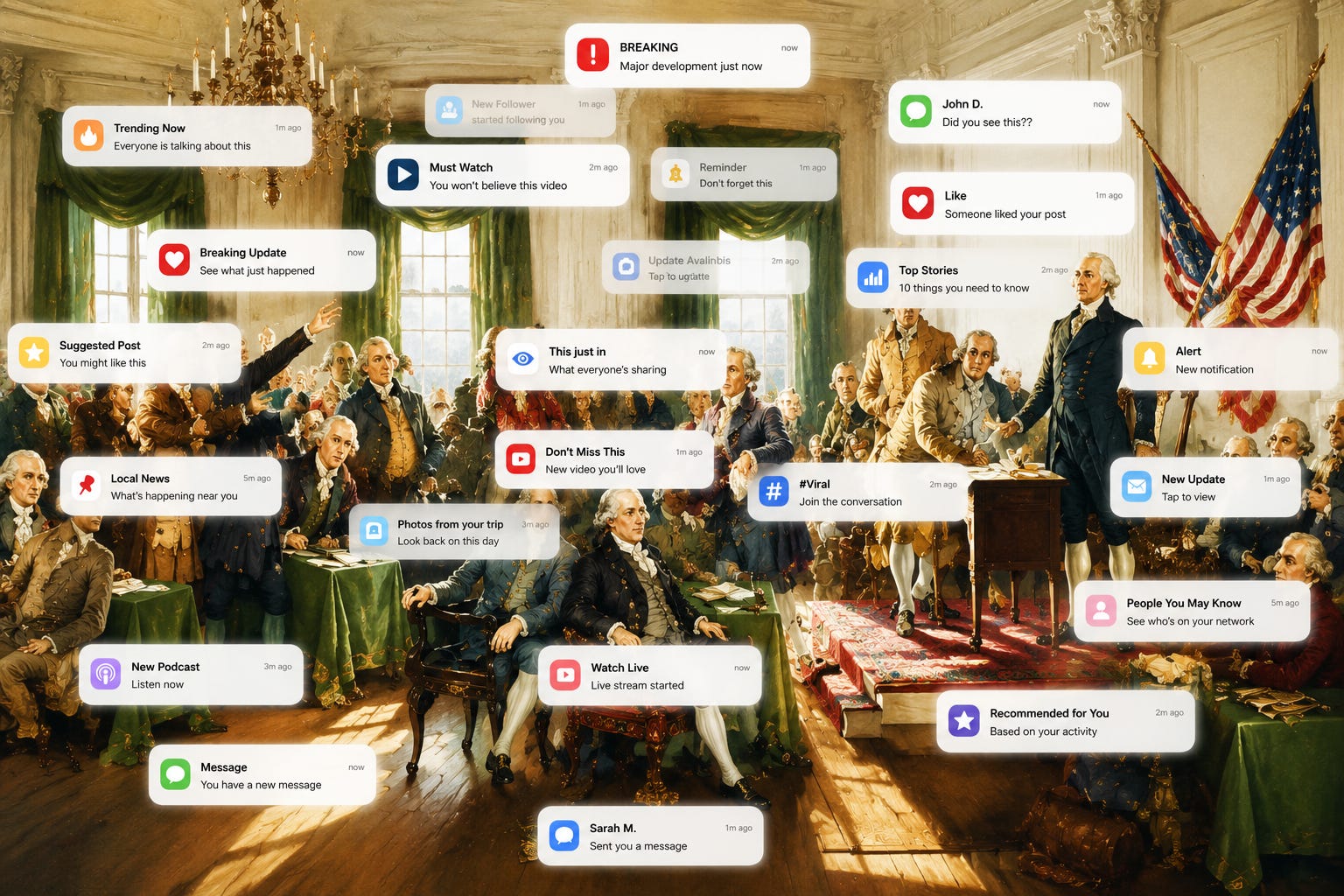
Two hundred and fifty years ago this weekend, a room full of men in wool coats made the riskiest wager in political history. They bet that ordinary people, given honest information, could govern themselves. Not wise people. Not educated people. Informed people. Every other piece of the American experiment, the elections, the courts, the peaceful transfers of power, was built on top of that one assumption, which is why the press got written into the very first amendment.
The whole thing runs on citizens knowing what’s real.
Two hundred and fifty years later, we consume more news than any humans who have ever lived and understand less of what’s happening to us. The bet is in trouble, and I want to tell you why, what I think we do about it, and my own part in the trouble, which is bigger than I’ve ever admitted before.
On Sunday, I wrote about the flag on my wall and how I finally stopped asking permission to love this country. A reader responded with one question that stuck with me.
Whose side are you on?
This is my answer. It starts with naming the actual enemy, which is not the one either party keeps pointing at.
I can’t get worked up about the birthday party itself, the empty fairgrounds, the green reflecting pool, the fireworks pushed to 11 p.m. A country can survive a shitty celebration. What it cannot survive is the thing underneath the bad party: a public that no longer shares enough reality to argue productively about anything, including how to throw a birthday.
Go back to that wager for a second, because the founders planned for almost everything that could threaten it. They imagined mobs. They imagined demagogues. They imagined a corrupt press, a lying government, a gullible public, and they built friction into the system to survive all of it. What they never imagined, what they could not have dreamed in their wildest Enlightenment fevers, was a machine with no author and no politics that would sort every piece of information by how much feeling it generates, deliver each citizen a private reality tuned to his appetites, and get rich doing it. Madison planned for tyrants. Nobody planned for the algorithm.
It took me fifteen years inside the machine to see the design flaw plainly, and here it is. Every safeguard the founders built assumes information is scarce and that power will try to suppress it. The First Amendment armors the supply side. What nobody protected, what it never occurred to anyone to protect, was the demand side. When information became infinite, our collective attention became the scarce resource, and the entire economy of news quietly reorganized around harvesting it. The founders feared a government that would starve citizens of information. We built an industry that drowns them in it instead, and drowning, it turns out, works just as well.
That’s why I have little patience for the argument over which team broke the country. The media machine doesn’t have a team. It stirs the left and the right with the same spoon, and it has quietly redefined what all of us mean by “informed.”
The fracture everyone feels this weekend, the two Americas that can’t share a birthday, is not simply an ideological problem. It’s also a plumbing problem. Bad information moves faster than good, division pays better than understanding, and every incentive in the system points toward more of both. It’s not a 2010 story, either.
This very week, a wire-service reconstruction of a strike that killed more than a hundred Iranian children got next to no cable news pickup while a mayor’s advice about air conditioning led a network’s morning show, and four different outlets handled the president’s $2 billion disclosure four different ways, each one serving its own audience’s appetite. The fix isn’t mysterious, and I’ve argued for it before. Slow the machine down before things go viral. Make the platforms show their algorithmic sorting. Give the country back a shared front page when it matters. What’s been missing is anyone with the power to choose those things over the money.
Which brings me to the confession, because you deserve to know why I understand this machine as well as I claim to.
In 2009, I co-founded Mediaite, and part of what we built there changed television in ways I didn’t understand at the time. We took cable news segments and cut them down to their sharpest moments, wrote headlines engineered to travel, and watched the numbers every morning. The day I still think about came in March of 2010, when a hot mic caught then-VP Joe Biden telling President Barack Obama that signing the Affordable Care Act was a “big fucking deal.” We clipped it and published it first, and I watched Chartbeat, the software that tracks readers on your site in real time, blow past its own capacity.
The most consequential domestic legislation in a generation had just become law, and the story was the swear word, and the winner was whoever got the swear word up fastest. We were funded by banner ads, so the numbers were the business. That day taught us, with brutal consistency, something the dashboards would confirm for years: the forty seconds to get something up fast and without context beat the five to ten minutes that even the least bit of context needed. Every time. The confrontation beat the explanation. The gaffe beat the argument. Nobody in that room thought we were changing television. We were convinced we were covering it.
But the networks could read the same numbers we could. They learned what got clipped, and slowly, then not slowly, they started producing for the clip. The panel is built to combust. The monologue is written as shareable. The politician is performing for the aggregators instead of the room. We didn’t invent the attention economy, and I want to be precise about that, because overclaiming my sins would be its own kind of vanity. Facebook, the feed, the smartphone, those did the heavy lifting. What we did was prove, early and publicly, that the moment was worth more than the conversation. Everyone copied the proof.
And here is the harder confession underneath the first one: it worked, and it felt like winning. Nobody in that room was cynical. The numbers read like proof that we were giving Americans exactly what they wanted, because we were. We didn’t decide the country cared more about the swear word than the health care law. The country decided, click by click, and we served the verdict, and every incentive in the business said that was good journalism. That’s the part that should unsettle you, because it’s the recognizable part. Nobody wakes up planning to break anything. You wake up to great numbers.
For years afterward, I told myself Facebook broke the news business. It took me an embarrassingly long time to admit that Facebook was mostly running our playbook at planetary scale, serving the same appetite our dashboards had been measuring all along. Somewhere in there, I stopped believing something I’d built a career on, which is that the market, left alone, rewards better journalism. It rewards attention. Those were never the same thing. We just got to be the generation that proved it.
So, to my friend’s question, asked in the country’s 250th year and answered a year into building this publication, now that I finally understand what I’ve been building: I’m on the reader’s side. Against the machinery. All of it, whoever owns it.
I’ll show you how the machine works.
When evidence kills my thesis, you’ll read that too. It happened this week: I chased a tip that a network was benching a contributor, counted every appearance on tape, and the count killed my own tip. What the count found instead runs next week.
When I change my mind, you’ll watch it happen in print. When I’m wrong, you’ll hear it from me first. Will this make a difference in the grand scheme of things? I mean probably not but if you aren’t part of the solution…
That’s the work. And I genuinely believe the work matters more this year than any year of my life, because the founders’ wager is still live. It has survived worse than this. It survived a civil war, two red scares, and yellow journalism that made our clickbait look like scripture. Every one of those eras felt terminal to the people living through them, and every one ended because enough people decided the information commons was worth repairing and got to work. The structural repairs will take lawmakers and platforms and publishers, and we should demand all of it, loudly. But while we’re demanding, there’s leverage nobody can take from us.
The machine serves our appetites. Which means the appetites are the leverage. And the appetites are ours.
Choose curiosity over affirmation once a day. Pay for work that shows its work. Notice when you’re being managed. That’s citizenship now, as surely as voting.
The flag’s still up.
I spent fifteen years helping optimize media for attention. I’m going to spend whatever comes next helping optimize it for understanding.