


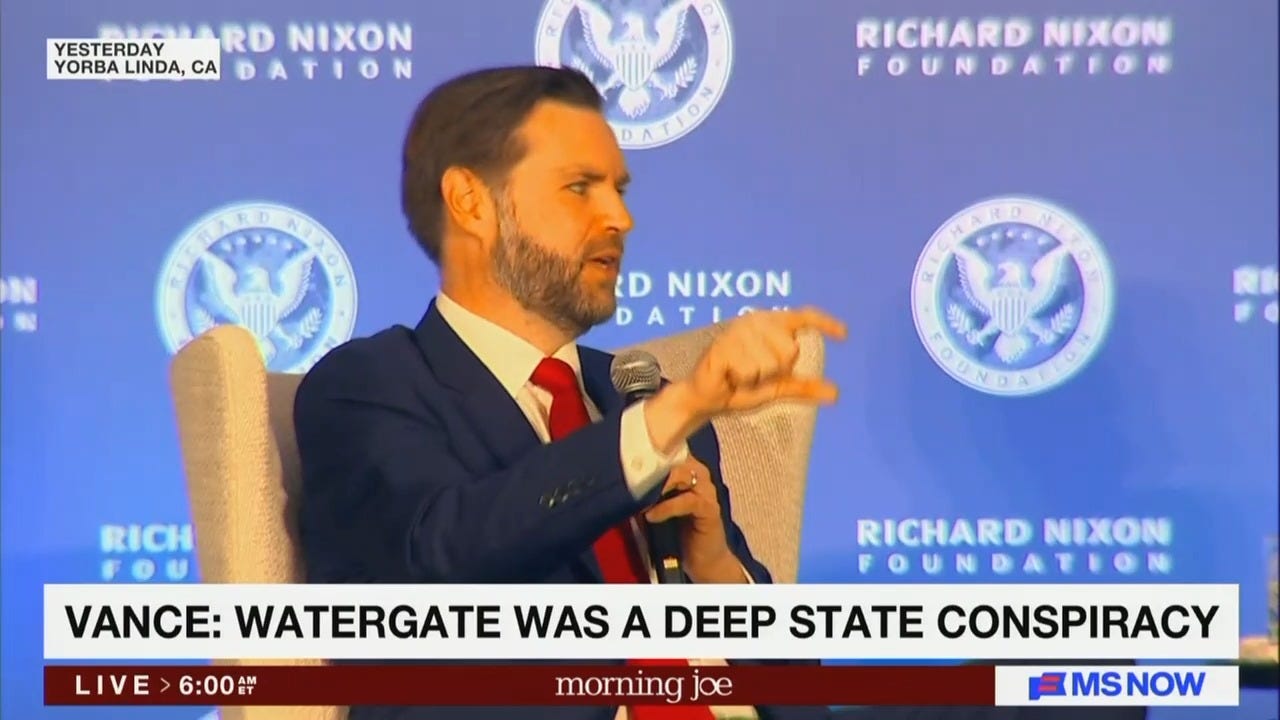
Friday morning, Morning Joe opened cold on JD Vance and spent its first ten minutes taking him apart.
What set them off? On Thursday, onstage at the Nixon Library for a stop on the book tour for his memoir Communion, Vance told the room that Watergate today would be a “12-hour news story,” and that the idea it once brought down a presidency is “crazy.” The deep state that took Richard Nixon down, he said, was “not all that different” from the institutions that came for Donald Trump. Then he ran the parallel nobody had asked him to draw. Young senator, vice president, bestselling author, hated by the press. “It kind of sounds like JD Vance,” he said. “I’ve always liked Richard Nixon.”
As history, the Nixon claim is nonsense. Nixon resigned because the tapes existed and his own party walked to the White House and told him it was over. He chose the weakest case in modern political history, the one a show like Morning Joe could not possibly ignore.
Joe Scarborough noted, correctly, that Nixon used the deep state rather than the other way around. Richard Haass drew the distinction, accurately, between a conservative who believed in institutions (Nixon) and a populist who does not (Vance). Eugene Robinson described Watergate as the system working as designed, which is also correct. Every word was true, and every word was what Vance came for. Morning Joe thought the fight was about Richard Nixon. Vance knew it was about JD Vance. They spent the morning playing different games on different scoreboards, and only one of them knew the other was even on the field.
You could hear the trap close in real time. “I’m not ready to let this go,” Scarborough said, and from there the segment stopped being about Watergate at all. The panel traced Vance’s whole arc on air, from Hillbilly Elegy and calling Trump cultural heroin and worse, to lying for him every day now. They went at his diploma. Where did you go to school, man, did you really get a degree from Yale. By the end they were telling kids watching at home to skip the Ivy League and go to a southern state school, because at least there you learn something. None of it was about Nixon anymore. All of it was about whether JD Vance is a fraud, which is a far more useful morning for JD Vance than a clean history lesson would have been.
We saw the same instinct last week as a disastrous Iran Deal unfolded and Vance took the heat for a rare consensus that this was a terrible blunder. Most of the press read it backward. I argued at the time that Vance had taken Trump’s biggest political liability, an Iran deal the country didn’t want, and turned it into the best week his 2028 hopes have had. At the time, it read like a fluke. A second week built the same way reads like a method he can call up on command. He spent those days looking like he was losing an argument with the public, when the public was never his intended audience.
That is the method, and Morning Joe is just this week’s clearest example of it. The argument was built so a panel like that one could not let it pass, because defending the historical record against exactly this kind of revision is the reason the show exists. Hand that panel a bad-faith reading of Watergate and it will, quite understandably, call bullshit. It engaged, and once it engaged, every road led back to Vance, because the teardown was itself the message. Worth opening the show with.
Vance’s 2028 campaign could not have scripted it any better.
The speech was never about Nixon. Nixon is evidence, introduced for another argument. The job is to make one sentence sound reasonable, that powerful institutions have brought down presidents before. Get a room nodding along to that about 1974 and the reflex is pre-loaded for the present, where the rest of the sentence is waiting. When they come for this one, you will already believe it.
Whether or not Vance planned it this way, the rundown told the story by itself. The cold open, the most valuable real estate on the show, the slot that tells viewers what the day is about, went to a scandal that ended fifty years ago. The present-tense version of his thesis, an administration hollowing out an institution right now, did not get its own segment until 6:24, when Mark Hertling walked through Pete Hegseth’s removal of more than two dozen senior officers and the forced retirement of General Chris Donahue, the four-star who ran U.S. Army Europe and Africa. The institutions actually under stress this week are not Nixon’s. They got the back half of the hour.
The exit was right there, and it is the move cable almost never makes. An anchor could have looked at the tape, said on air that it was bait, declined it, and pointed at the firing of the generals instead. That sentence ends the trap, because it denies Vance the only thing he came for. It is also the hardest thing for the format to do, because naming the bait is far less satisfying than swinging at it, and satisfaction is the fuel the morning runs on.
None of this belongs to MS NOW alone. The right takes the identical bait from the left every week, and CNN has handed whole days to a single tweet engineered to bait it. The mechanism is the business model, not the channel. Vance simply ran the cleanest version anyone has managed in a while, which is its own kind of credential for a man who wants the job after this one.
Television believes it decides what deserves the country’s attention. Vance has figured out that he can make that choice for it, by picking a fight built so a show like Morning Joe has no way to skip it. Once that happens, being right stops mattering. The argument only has to be impossible to ignore. He was never going to be right about Nixon. He didn’t need to be. He needed nine minutes of Morning Joe proving it, and he got them. The politician who picks the argument usually wins the morning, even when he loses the argument.