


Gianni Infantino told Donald Trump there was nothing he could do. Four days later, FIFA did it.
The sequence is now in the open: Trump called Infantino on Wednesday night, hours after Folarin Balogun’s red card, according to three people who described the call to the New York Times. On Sunday, FIFA’s disciplinary committee used Article 27 to suspend the implementation of Balogun’s ban for a year. The red card still stands. The punishment does not. Balogun plays against Belgium. It is the first time since 1962 that a World Cup sending-off has produced no suspension. Trump thanked FIFA on Truth Social for reversing a great injustice. The White House’s official account reposted it.
The “nothing I can do” line comes from the friendliest account available, a source who described the call to Axios in terms meant to absolve the President: he just wanted to understand the process, never asked for anything, was told nothing could be done. Believe every word. Even the alibi has the head of FIFA pleading powerlessness on Wednesday and FIFA delivering by Sunday. The Times’ sources describe the call more pointedly, with Trump asking Infantino to review the suspension. Pick either version and the ledger balances.
The Receipts
March 2025: The trophy in the Oval Office. Infantino puts the Club World Cup trophy on display in the Oval Office, converting FIFA property into presidential decor.
May 2025: The delayed congress. Infantino holds up FIFA’s own annual congress in Paraguay to keep traveling with Trump through the Middle East. UEFA calls the move deeply regrettable and says accommodating private political interests does the game no service.
July 2025: The Trump Tower office. FIFA opens an office inside the host president’s family business, announces it beside Eric Trump, and never discloses the terms.
July 2025: The tickets. Infantino gives Trump ten Club World Cup final tickets, valued at $15,000 on the President’s own financial disclosure.
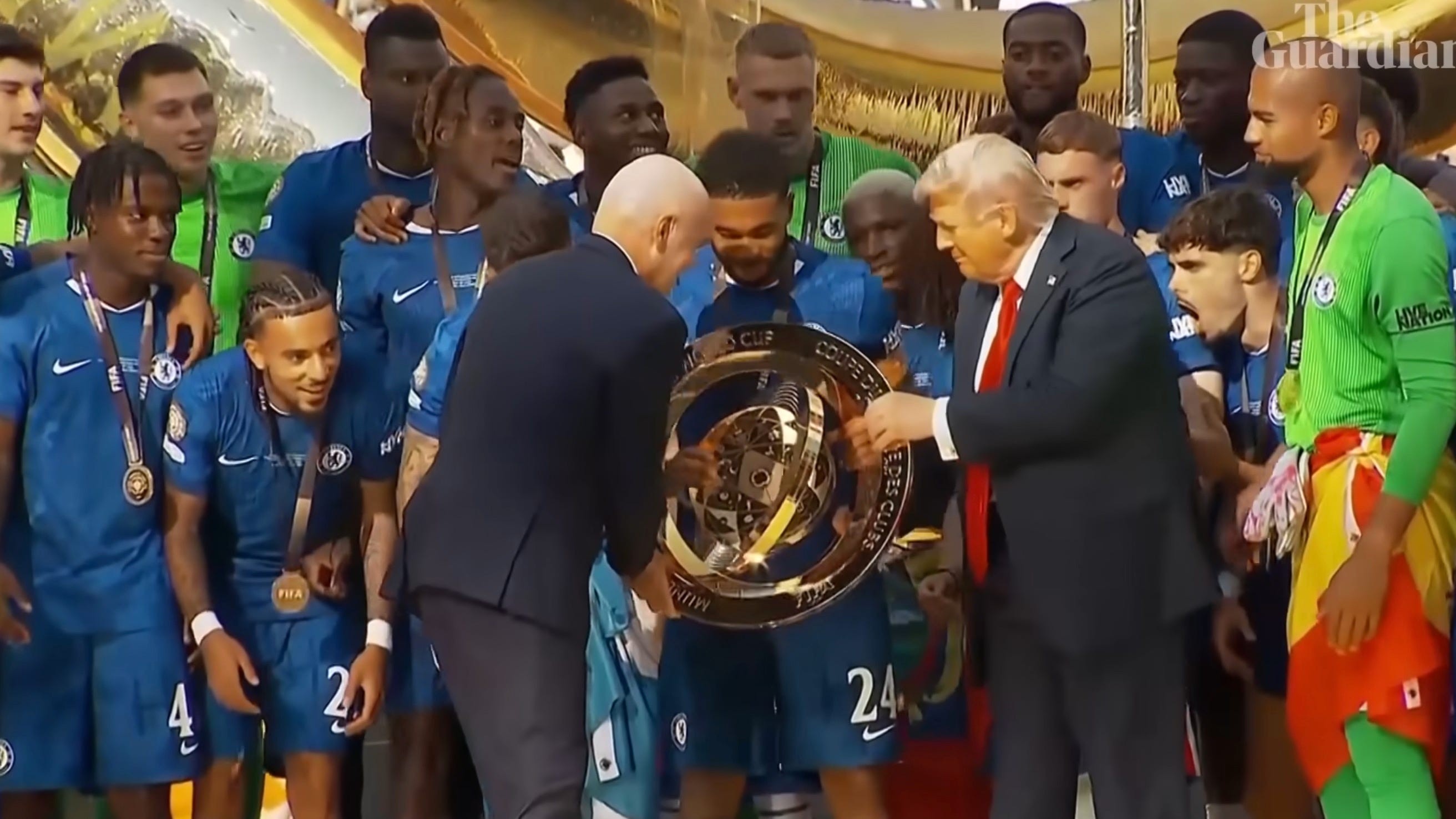
July 2025: The trophy lift. Trump presents Chelsea the trophy and stays on the podium as the players celebrate around him, visibly confused. FIFA later gives Trump the original. Chelsea keeps a replica.
December 2025: The Peace Prize. FIFA invents a prize Trump plainly wanted, presents it at the World Cup draw with a video praising his foreign policy, and Infantino promises from the stage that Trump can always count on his support.
July 2026: The call. Trump phones about Balogun. Infantino says there is nothing he can do. Four days later, FIFA does it.
Friendship doesn’t need a spreadsheet. What Infantino built keeps accounts, and on Sunday, the account was drawn down.
Trump’s side of the ledger paid in kind: a White House World Cup task force he chairs personally, Andrew Giuliani running point, $625 million in security money in his signature spending bill, the visas and protection and federal machinery a 48-team tournament across eleven American cities requires, and the attention, which for FIFA may be worth more than the money. That attention now includes the plan for Trump to hand over the World Cup itself at MetLife on July 19.
FIFA’s official story is process: independent committee, discretionary rule, no political influence. The ledger tells the other story. By the time Trump called about Balogun, the ask barely mattered. In a relationship built on anticipation, the inquiry is the instruction.
The Peace Prize is easy to laugh at. That’s why it’s useful. It showed the arrangement in its purest form. Trump wanted a Nobel and spent the fall campaigning for one. FIFA couldn’t deliver a Nobel, so it invented the nearest available substitute, staged the presentation at the Kennedy Center, wrapped it in a highlight reel of the President’s foreign policy, and had its own president pledge allegiance from the stage. FIFA has never published the criteria for the prize or the process that selected its first winner. The criterion was obvious: the audience. Institutions used to be captured with cash. This one was captured with flattery, and flattery is cheaper.
It was also legible to everyone watching. Norway’s federation president joined an ethics complaint accusing Infantino of violating FIFA’s political neutrality statutes over the prize. Fifty members of the European Parliament wrote FIFA last Monday demanding its ethics committee act with speed and sincerity. Days later, Infantino took the President’s call about a red card.
The prize revealed the relationship. Balogun revealed what it was for.
About that red card: Balogun deserved to play. I wrote that before the reversal and it holds, which makes the scandal cleaner rather than weaker. FIFA had a defensible outcome available and still made it look like the bill had already been paid. The committee published no reasoning, no criteria, no explanation of why this sending-off, alone among every sending-off since 1962, earned probation instead of a ban. The most charitable published account of the President’s involvement has Infantino declining to help. Then help arrived. Nobody needs to prove that Infantino gave an order, and that is precisely the point. He had spent a year learning what Trump wanted, and by the time the call came, no order was necessary.
On CNN, John Berman found the joke that turns the scandal into a precedent: does King Charles now ring FIFA about England’s red cards? The laugh works because it isn’t really a joke. Macron for France. Lula for Brazil. Every head of state now knows the hotline exists. Every federation now knows the question to ask: what does our president have to offer FIFA before our next red card? The New York Times reports that senior soccer officials are privately asking whether any federation can now demand a suspended player back, and the last time the maneuver worked, in 1962, a government did the asking then too, when Brazilian officials petitioned FIFA to put Garrincha in the final.
Which is why this stopped being a sports story the moment the ban was lifted. The networks settled early, however weak the case. Law firms pledged hours before the executive order landed. Universities negotiated before the punishment arrived. Tech executives figured it out early enough to buy front-row seats at the inauguration. Across American life, institution heads have absorbed the same lesson: the cheapest way to survive this presidency is to pay tribute before the ask arrives. FIFA did it with the whole world watching and called it independence. This is how Trump handles institutions, and by now it is how institutions handle Trump.
Infantino reportedly first told the President there was nothing he could do. Then FIFA did it. The two statements only look contradictory if you’re still listening for an explicit order. In Trump’s Washington, the smartest institutions don’t wait for pressure. They flatter early, gift often, preserve deniability, and deliver when called. FIFA found the tribute economy already running in America and proved it works on the world’s biggest field.