

Among the many great things about the 2026 World Cup, the best was the sound of it: strangers not just talking to but often celebrating and dancing with each other, everywhere, all summer, in a country that had nearly forgotten how. That sound stopped Sunday night, and I miss it way more than the football.
Which surprises me, because the football gave us a perfect ending. Spain won the World Cup on Sunday, and the football gods got one right. A shithousing, cheating Argentina side ran into La Roja, which played the game the way it was meant to be played, and got taken apart for 120 minutes. I have already said my piece about Argentina, so I will just call the final what it was: a palate cleanser served at the perfect moment.
I was also, frankly, ready for it to end. Arsenal won the league for the first time since 2004. The Knicks won it all and united New York in a way this city rarely permits. I commemorated both with my first tattoos at an age when men are supposed to be done making decisions like that, and then a home World Cup moved in for six weeks. By Sunday’s final whistle I was full, and I figured the week ahead would feel like the morning after a great party, when some quiet part of you is glad to have the house back.
The feeling lasted exactly one dog walk.
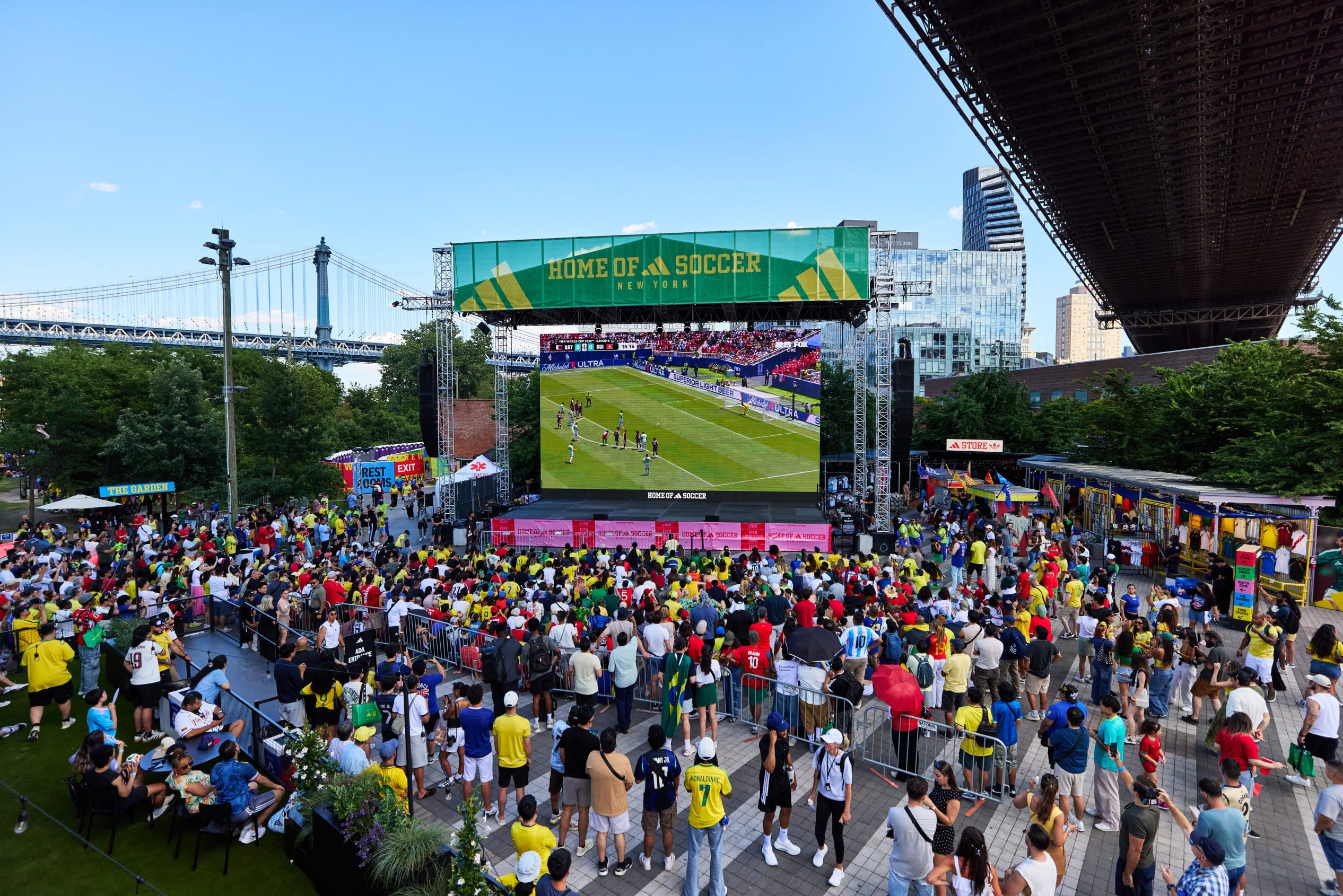
Every weekday after I publish my world-class Morning Frame newsletter, I take Frank, my French Bulldog, on our constitutional from Cobble Hill along the water to the Manhattan Bridge and back. For six weeks that walk ran straight through an Adidas World Cup activation/viewing site that pulled fans from every continent into my corner of Brooklyn. This morning the whole apparatus was being methodically taken apart. The benches and stunning views were blissfully free of selfie sticks, and the quiet I had been looking forward to arrived — but curiously felt nothing like relief.
It took me most of the walk to figure out what was missing, because it wasn’t the football.
For six weeks, that stretch of waterfront, ordinarily teeming with the tourists I have spent years perfecting the art of dismissively ignoring, was the most social place I have been in years. Every morning brought a fresh crop of national kits, of which I was characterologically incapable of passing in silence. (My sons spent their entire childhoods being embarrassed by exactly this behavior.) Suddenly the tournament handed me a planet’s worth of new victims of my unbridled charm. I called out players’ names to people wearing their shirts. I got into real tactical arguments with people I had known for ninety seconds, about Thomas Tuchel parking the bus too early against Argentina, about Moroccan teenager Ayyoub Bouaddi running an aging Brazilian midfield off the pitch, about Japan playing some of the most fluid football of the group stage. Maybe I was the loud American (I was). But I’ll be honest, the visitors genuinely seemed delighted to engage, and I fell a little in love with every one of them.
There was celebrity garnish too, because this is New York during a World Cup. I hugged Lee Dixon over Arsenal’s title. I watched Roy Keane and Ian Wright stroll into the hotel where Fox built its rooftop set against the bridge. Great moments. The one I keep returning to is the guy in the Croatia kit whose name I never got but I impressed with my genuine love for perhaps the most underrated footballer of the last two decades, Luka Modric
Somewhere past the bridge this morning, I finally named what I missed: the random questions. Where are you from? Who are you rooting for? Where are you watching? Have you been to New York before? I heard them loads of times on that walk, from random strangers to fellow random strangers, and it took the end of the random interactions to register just how remarkable it was to hear at all. Somewhere along the way, without any of us deciding on it, those random things to say to a person you don’t know became unique, particularly in our suddenly isolated world.
We created our lives to be this way, one digital habit and convenience at a time. I walk Frank with AirPods in (my ears, not Frank’s), the same as almost everyone else. Almost no one asks for directions anymore because everyone is carrying the digital GPS locator on their phones. The neighborhood restaurant now relies on an app that leaves their bag of prepared food at your door. None of it was built maliciously, and all of it was an economic transaction designed for benign convenience. But the thing we have given away is a very necessary and human reason to interact, face to face. Adults in this country now go entire weeks without a socially sanctioned reason to speak to someone they haven’t already met.
Which is what made this summer so great, and not just on my daily walk through Brooklyn Bridge Park. Lawrence, Kansas adopted Algeria and won hearts across North Africa that no diplomat has reached in years. Boston and Scotland’s Tartan Army fell into a six-week romance and drank the town dry. Erling Haaland spent the tournament embracing the strangest corners of American culture with such open joy that fans who resented him for years as Manchester City’s finisher simply gave up and loved him back, and after six weeks of Norway’s rowing chant I was pricing flights to Oslo.
It feels like millions of international visitors arrived informed by two years of anti-Trump, anti-American coverage about a hostile, closed nation, and instead returned home with stories about Americans who were warm, welcoming, adopted their teams, loved ranch dressing, and treated them warmly and with respect. Reuters is calling the tournament the Great American Sleepover. I wrote in June that the local hosts in Lawrence are not the State Department. They turned out to be much better at the job.
The tournament had its ugly moments, and it deserves an honest accounting.
The Iranian team that played at SoFi and was escorted directly to a departure gate after the final whistle. A Sudanese referee was refused entry. Fans were turned away at the border for reasons nobody bothered to explain. Donald Trump inserted himself into the Flo Balogun red card reversal and broke the one promise a host nation has to keep: don't ask for special treatment. The precedent has already begun to spread: over the weekend, Bryson DeChambeau reacted to an accurate penalty from British Open officials by threatening to call Daddy Trump for relief. The halftime show of the final was pure cheese, though the world blaming America seemed unfair as the whole production was felt more Eurovision than Nashville.
But you know what never made the list of negatives? The local bartenders. The college band learning the Algerian national anthem. A stranger with a cute French Bulldog named Frank on a sidewalk. (Hey girl.)
FIFA and, to some extent, the U.S. government spent six weeks being exactly what the world expected. But both the American people and visiting fans spent six weeks being what the world was not expecting. These massive institutions took the Ls. The people took the Ws.
Simply put, the World Cup gave us a much-needed excuse to have fun. And boy did we need it. A football kit turned into a conversation starter. A watch party became a shared experience. Total strangers stood on my sidewalk arguing about a back line, hugging over goals scored by countries neither of them was from. Nobody needed to be taught how to talk about a sporting event. Nobody had to ease into being kind to one another. The whole nation picked it up mid-stride, like the proverbial bike we never forgot to ride.
Everything doomsayers insist we’ve lost — the openness, the curiosity, the ridiculous instinctive generosity toward people we have never met — has been with us the entire time. I wrote on the Fourth of July that the American gathering instinct never died, that the hot dogs and the ballgames were always just excuses to be together. This summer, a few million visitors proved it on a global scale. The instinct is still there and healthy and only waiting on an invitation.
Then the whole world came to my local park for six weeks and behaved exactly like me. I have never felt more normal in my life.